



- Home
- /
- Supreme court
- /
- 'Property Acquisition With Token...
'Property Acquisition With Token Compensation Arbitrary' : Supreme Court Quashes Bihar Act To Take Over Historic Library At 1 Rs
Yash Mittal
11 March 2026 1:58 PM IST
Observing that the deprivation of property must be based on law which is “just, fair and reasonable”, the Supreme Court on Tuesday (March 10) struck down the Bihar law that allowed the State to take over a historic library for a token compensation of just one rupee, holding that such a provision is “confiscatory” and fails constitutional scrutiny. “While Article 300A of...
This is a premium content
Available exclusively to
Our subscribers
Subscribe Premium 
INR 1099+GST
Your support helps us to bring you more content at
an affordable subscription scheme !!!
All payment options available
Observing that the deprivation of property must be based on law which is “just, fair and reasonable”, the Supreme Court on Tuesday (March 10) struck down the Bihar law that allowed the State to take over a historic library for a token compensation of just one rupee, holding that such a provision is “confiscatory” and fails constitutional scrutiny.
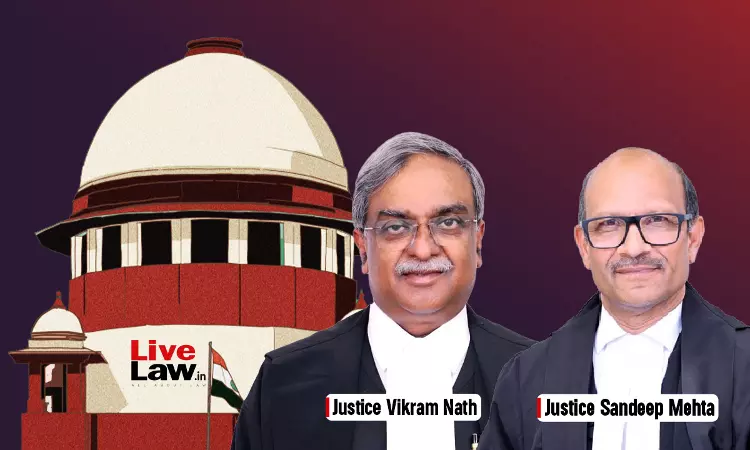
“While Article 300A of the Constitution permits deprivation of property by authority of law, such law must nevertheless be just, fair and reasonable, and not arbitrary or confiscatory in effect. A statutory provision that enables acquisition of property while reducing compensation to a token amount lacks the basic attributes of fairness. The confiscatory nature of the vesting contemplated under the impugned Act therefore reinforces the conclusion that the enactment is manifestly arbitrary and fails constitutional scrutiny.”, observed a bench of Justices Vikram Nath and Sandeep Mehta.
The Court set aside the Patna High Court's ruling, which had upheld the law for taking over the library, established in 1924 by Sachchidanand Sinha, who served as the first temporary President of the Constituent Assembly of India.
The library was established in memory of Sinha's wife, Smt. Radhika Sinha. The institution was created through a trust supported by Sinha's personal funds and his extensive collection of books.
In 2015, the Bihar legislature enacted the Srimati Radhika Sinha Institute and Sachchidanand Sinha Library (Requisition & Management) Act, 2015, dissolving the trust and vesting its management and property in the State government. Section 7 of the Act authorised the State Government to pay compensation, if any, up to a maximum of one rupee for the takeover of the institute and its assets.
The Act was challenged before the Patna High Court, which had upheld the Act, prompting the petitioners to move to the Supreme Court.
Allowing the appeal, the judgment authored by Justice Nath found the Act to be arbitrary on two counts: first, the law takes over the entire management and control over the library, presuming it to be a public trust, without disclosing a finding of abandonment, failure of purpose, or established mismanagement of the Institute & Library, and second, the provision (Section 7) lacked any guiding principles for determining compensation and effectively reduced payment to a nominal token amount by awarding just one rupees.
“the record before this Court discloses no finding of abandonment, failure of purpose, or established mismanagement of the Institute & Library. No inquiry appears to have preceded the enactment. No contemporaneous material has been placed to demonstrate that the objectives of the Trust were being defeated or that lesser measures were inadequate. In the absence of demonstrated necessity, compulsory acquisition coupled with dissolution of trust arrangements is plainly disproportionate.”, the court said.
“The arbitrariness of the statutory scheme is further aggravated by the compensation provision contained in Section 7. The provision authorises the State Government to pay compensation, if any, up to a maximum of one rupee, after examining claims, without prescribing any principles, criteria, or procedural safeguards. Such a scheme vests unguided discretion in the legislature and reduces compensation to a nominal and illusory figure.”, the court added.
The Bench noted that although Article 300A allows deprivation of property by law, the law itself must satisfy constitutional standards of fairness and non-arbitrariness. A provision reducing compensation to a token amount, the Court said, lacks the basic attributes of fairness and reveals the confiscatory nature of the legislation.
“The absence of any principled or meaningful framework for compensation underscores the arbitrary character of the legislative measure. While Article 300A permits deprivation of property by authority of law, such law must be fair, reasonable and non-confiscatory. The impugned Act fails to meet this standard.”, the court said.
Accordingly, the appeal was allowed, the law was struck down, and managements and administration of the Trust governing the Institute & Library, together with its rights of management and administration, was restored to its pre-existing legal position prior to the enactment of the impugned Act.
Headnote
Constitution of India – Article 14 – Manifest Arbitrariness – Srimati Radhika Sinha Institute and Sachchidanand Sinha Library (Requisition & Management) Act, 2015 – Unconstitutionality – Held: The impugned Act, which provides for the complete takeover of the management and assets of a private trust-run institution (Sinha Library) without a principled framework for compensation or a demonstration of mismanagement, is "manifestly arbitrary" - The State cannot use its legislative power to single out a specific institution for takeover without an intelligible basis or fair process - The Act fails the test of reasonableness and non-confiscatory nature required under Article 300A.
Doctrine of Manifest Arbitrariness – Evolution and Application – Held: Manifest arbitrariness is a well-settled ground for striking down plenary legislation under Article 14. A law is manifestly arbitrary when it is "capricious, irrational, or not guided by any principle" or is "excessive and disproportionate" - A legislative enactment that targets a specific entity for total deprivation of management and property rights without following due process, providing adequate compensation, or establishing a clear public necessity (beyond mere "better management") is hit by Article 14 of the Constitution – Appeal allowed. [Relied on Shayara Bano v. Union of India (2017) 9 SCC 1; E.P. Royappa v. State of Tamil Nadu (1974) 4 SCC 3; Maneka Gandhi v. Union of India (1978) 1 SCC 248; Paras 35-50]
Cause Title: ANURAG KRISHNA SINHA VERSUS STATE OF BIHAR & ANR.
Citation : 2025 LiveLaw (SC) 226
Click here to download judgment
Appearance:
For Appellant(s) : Mr. Sunil Kumar, Sr. Adv. Ms. Rohini Prasad, AOR Ms. Ashika Ranjan, Adv.
For Respondent(s) :Mr. Ranjit Kumar, Sr. Adv. Mr. Manish Kumar, AOR Mr. Divyansh Mishra, Adv. Mr. Kumar Saurav, Adv. Mr. Akash Dikshit, Adv. Mr. Mrigank Prabhakar, AOR Mr. Siddharth Sahu, Adv. Ms. Astha Singh, Adv. Mr. N.R. Shwetabh, Adv.
Tags

Yash Mittal
Yash Mittal is a Correspondent with LiveLaw, covering the Supreme Court of India

