



- Home
- /
- Supreme court
- /
- Public Recruitment | Supreme Court...
Public Recruitment | Supreme Court Cautions Courts Against Entertaining Challenges To Rejection Due To Errors In Online Applications
LIVELAW NEWS NETWORK
10 April 2026 8:01 PM IST
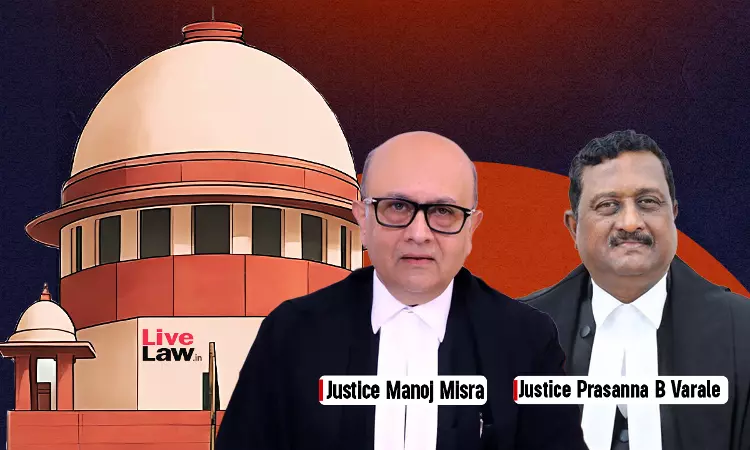
The Court said that entertaining such challenges will stall the process where lakhs of candidates are participating.
The Supreme Court on April 10 observed that in large-scale public recruitment processes conducted through online systems, even minor errors in applications or supporting documents can legitimately lead to rejection of candidature, and courts should ordinarily refrain from interfering with such decisions as it may delay recruitment and adversely affect numerous other candidates.Highlighting...
This is a premium content
Available exclusively to
Our subscribers
Subscribe Premium 
INR 1099+GST
Your support helps us to bring you more content at
an affordable subscription scheme !!!
All payment options available
The Supreme Court on April 10 observed that in large-scale public recruitment processes conducted through online systems, even minor errors in applications or supporting documents can legitimately lead to rejection of candidature, and courts should ordinarily refrain from interfering with such decisions as it may delay recruitment and adversely affect numerous other candidates.
Highlighting the systemic implications of judicial intervention in recruitment disputes, the Bench of Justices Manoj Misra and Prasanna B. Varale stated that challenges to rejection of candidature arising from application errors should not normally be entertained because doing so could stall the timely completion of recruitment processes.
“In matters of public recruitment, where large number of candidates participate, application forms are submitted online along with the scanned eligibility documents, certificates, etc. Such applications are processed through computer applications/ software and therefore, any error in the application is bound to result in rejection of the candidature.”
“Challenge to such a rejection must not ordinarily be entertained as it could stall expeditious completion of the recruitment process thereby frustrating thousands and lacs of aspirants.”
Background
The case arose from recruitment to 9,212 posts of Female Health Workers by the Uttar Pradesh Subordinate Service Selection Commission, with 10 percent of posts reserved for the Economically Weaker Sections (EWS) category.
Candidates who applied under the EWS category were excluded from the select list after authorities found defects in their EWS certificates, particularly that the certificates did not correspond to the required financial year prior to the year of application.
The candidates contended that the errors were attributable to issuing authorities and that they had otherwise established eligibility. However, the authorities maintained that compliance with the prescribed format and financial year requirement was mandatory.
Certificate Of Wrong Financial Year Goes To Root Of Eligibility
The Supreme Court upheld the rejection of candidature, holding that submission of an income certificate relating to the correct financial year was a fundamental eligibility requirement for claiming EWS reservation.
The Court noted that several certificates relied upon by the candidates were issued before the closure of the relevant financial year or pertained to a different financial year altogether, rendering them invalid for the purpose of reservation.
It also observed that candidates had sufficient opportunity to obtain fresh certificates after publication of the recruitment advertisement but failed to do so.
Finding no merit in the candidates' claims, the Court dismissed the appeals and affirmed the High Court's decision upholding rejection of their candidature for failure to submit valid EWS certificates within the prescribed timeline.
Headnote
Constitution of India, Article 16 – Reservation for Economically Weaker Sections (EWS) – Validity of Income and Asset Certificates – Requirement of Specified Financial Year – Held: For claiming the benefit of EWS reservation, the Income and Asset Certificate must relate to the financial year prior to the year of application as prescribed in the advertisement and relevant Government Orders - A certificate pertaining to a different financial year, or one issued prior to the closure of the relevant financial year, is invalid and goes to the root of a candidate's eligibility - Candidates must be in possession of the necessary certificate in the prescribed form on or before the cut-off date - Rejection of candidature due to non-conformity with these requirements is justified to ensure the expeditious completion of public recruitment processes.
Recruitment Process – Judicial Interference – Rejection of Online Applications – Held: In large-scale public recruitment where applications are processed via software, errors in application or supporting documents inevitably lead to rejection - Courts should not ordinarily entertain challenges to such rejections as they risk stalling the recruitment process for thousands of aspirants. [Relied on UPSC v. Gaurav Singh & Ors. (2024) 2 SCC 605; Divya v. Union of India and Others (2024) 1 SCC 448; Paras 20-28]
Case : Poonam Dwivedi v State of UP and others
Citation : 2026 LiveLaw (SC) 359
Click Here To Read/Download Order
Appearances:
For the Petitioner(s) : Ms. Vanya Gupta, AOR, Mr. Tarun Kumar Sobti, Advocate, Ms. Madhu Yadav, Advocate, Ms. Parul Shukla, AOR (arguing counsel), Ms. Shubhangi Pandey, Advocate, and Mr. Saday Mondol, Advocate.
For the Respondent(s), Mr. Talha Abdul Rahman, AOR, Mr. M. Shaz Khan, Advocate, Mr. Sudhanshu Tewari, Advocate (arguing counsel), Mr. Rafid Akhter, Advocate, Mr. Faizan Ahmed, Advocate,
Ms. Garima Prasad, Senior Advocate and Additional Advocate General (arguing counsel), Mr. Sarvesh Singh Baghel, AOR, Mr. Satvik Misra, Advocate, Dr. Vinod Kumar Tewari, AOR, Mr. Bhoopesh Pandey, Advocate, Mr. Pramod Tiwari, Advocate, Mr. Vivek Tiwari, Advocate, Ms. Priyanka Dubey, Advocate, Ms. Saumya Mishra, Advocate, and Mr. Amit Kumar Pandey, Advocate, appeared.


