



- Home
- /
- Supreme court
- /
- Reach Stacker Is Not A 'Motor...
Reach Stacker Is Not A 'Motor Vehicle' Under MV Act, Accident Victim Can't Approach MACT: Supreme Court
LIVELAW NEWS NETWORK
30 July 2026 6:13 PM IST
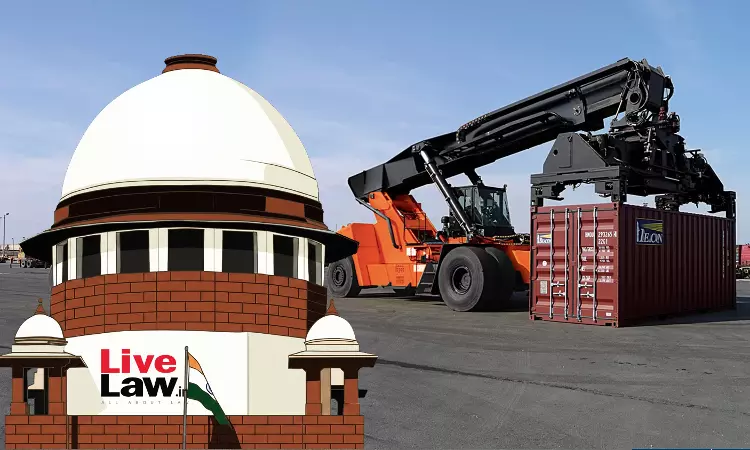
The Supreme Court has held that a Reach Stacker, a heavy container-handling machine used within Inland Container Depots (ICDs), is not a "motor vehicle" under the Motor Vehicles Act, 1988, and therefore a compensation claim arising from an accident involving such a machine is not maintainable before a Motor Accident Claims Tribunal (MACT).A Bench of Justice Sanjay Karol and Justice...
This is a premium content
Available exclusively to
Our subscribers
Subscribe Premium 
INR 1099+GST
Your support helps us to bring you more content at
an affordable subscription scheme !!!
All payment options available
The Supreme Court has held that a Reach Stacker, a heavy container-handling machine used within Inland Container Depots (ICDs), is not a "motor vehicle" under the Motor Vehicles Act, 1988, and therefore a compensation claim arising from an accident involving such a machine is not maintainable before a Motor Accident Claims Tribunal (MACT).
A Bench of Justice Sanjay Karol and Justice Nongmeikapam Kotiswar Singh allowed an appeal filed by the Container Corporation of India Limited (CONCOR) and restored the MACT's order dismissing a compensation claim filed by an accident victim.
The case arose from an accident at the Inland Container Depot, Tughlakabad, New Delhi, where the claimant was run over by a Reach Stacker in September 2013, resulting in severe injuries and amputation of his right leg. He sought compensation of ₹75 lakh under Section 166 of the Motor Vehicles Act. While the MACT held that the claim was not maintainable, the Delhi High Court reversed that decision, holding that a Reach Stacker was a motor vehicle. The Supreme Court has now set aside the High Court's ruling.
The Court examined whether a Reach Stacker falls within the definition of "motor vehicle" under Section 2(28) of the Motor Vehicles Act. It noted that although the machine is mechanically propelled and runs on wheels, the Act expressly excludes "a vehicle of a special type adapted for use only in a factory or in any other enclosed premises."
The Bench held that the ICD is an enclosed, customs-bonded area accessible only to authorised persons and therefore does not qualify as a "public place" under Section 2(34) of the Act.
"Since the ICD is a custom bonded area... only those persons who are duly authorized by the competent authority will have access to the same... the roads within ICD... do not constitute 'public place' as defined under Section 2(34) of the MVA," the Court observed.
The Court also found that the Reach Stacker is designed exclusively for handling containers within such enclosed facilities and is not adapted for normal road use. It noted that the machine weighs over 70 tonnes even when unloaded, exceeds the maximum permissible vehicle weight prescribed for public roads, is transported in dismantled form, and lacks the safety features required for ordinary road vehicles.
Rejecting the contention that rubber tyres alone make the machine suitable for road use, the Court observed:
"To say that only because a vehicle has rubber tyres and is on chassis that it is suitable for public roads, would be a rather simplistic view of the whole situation."
The Bench further held that specially reinforced internal roads within ICDs are constructed to bear the weight of Reach Stackers, reinforcing the conclusion that such machines are meant only for enclosed premises.
The Court relied on its recent decision in Ultratech Cement Ltd. v. State of Gujarat 2026 LiveLaw (SC) 27, which held that special-purpose construction equipment used only within enclosed premises falls within the exclusionary part of Section 2(28), even if it otherwise possesses characteristics of a motor vehicle.
The judgment also referred to a notification issued by the Regional Transport Authority, Hyderabad, stating that Reach Stackers are not motor vehicles and therefore do not require registration under Section 39 of the Motor Vehicles Act.
Clarifying the scope of its ruling, the Court said that its finding that an ICD is not a "public place" should not deprive victims of compensation in accidents involving ordinary road-going vehicles operating within an ICD.
"This should, however, not restrict a claimant's right to seek compensation under the MVA should such an untoward incident ever take place within the four walls of the ICD with a 'regular' vehicle that ordinarily plies on roads," the Bench observed.
Accordingly, the Court restored the MACT's order dismissing the compensation claim. However, it directed that any amount already paid to the claimant should not be recovered.
Headnote
Motor Vehicles Act, 1988 — Sections 2(28), 2(34) & 39 — Motor Vehicle — Public Place — Reach Stacker — Exemption from Definition of Motor Vehicle – Held - 1. Inland Container Depot (ICD) is not a “Public Place”: An Inland Container Depot (ICD) being a custom-bonded area under Section 7 of the Customs Act, 1962, where access is restricted only to authorized personnel, does not constitute a "public place" under Section 2(34) of the Motor Vehicles Act, 1988 - Members of the general public cannot claim entry to such premises as a matter of right - 2. “Reach Stacker” is excluded from the definition of “Motor Vehicle”: A Reach Stacker—a heavy machine operating on wheels designed exclusively to lift and stack shipping containers within restricted/enclosed industrial areas—does not qualify as a "motor vehicle" under Section 2(28) of the Act - Since it exceeds maximum permissible road weight limits, lacks general road safety features, requires reinforced surfaces, and is used solely in confined spaces, it falls under the exclusionary second part of Section 2(28) (a vehicle of a special type adapted for use only in a factory or enclosed premises) - 3. Registration Requirement: Where transport authorities certify that a machine is a special type adapted for enclosed premises and does not fall within Section 2(28), non-registration under Section 39 is not a mere omission or violation, but a consequence of it not being a "motor vehicle". [Relied on Ultratech Cement Ltd. v. State of Gujarat, 2026 SCC OnLine SC 48; Bolani Ores Ltd. v. State of Orissa, (1974) 2 SCC 777; Goodyear India Ltd. v. Union of India, (1997) 5 SCC 752; Tarachand Logistic Solutions Ltd. v. State of A.P., 2025 SCC OnLine SC 1851; distinguished from Natwar Parikh & Co. Ltd. v. State of Karnataka, (2005) 7 SCC 364; Western Coalfields Ltd. v. State of Maharashtra, (2016) 11 SCC 613; Paras 11-15]
Case : Container Corporation of India Ltd v Rishi Ranjan Mishra
Citation : 2026 LiveLaw (SC) 740
Click here to read the judgment
Tags


