S. 106 Evidence Act | Inmates Of Matrimonial Home Must Explain Unnatural Death Of Woman : Supreme Court
Yash Mittal
3 Nov 2026 10:13 AM IST
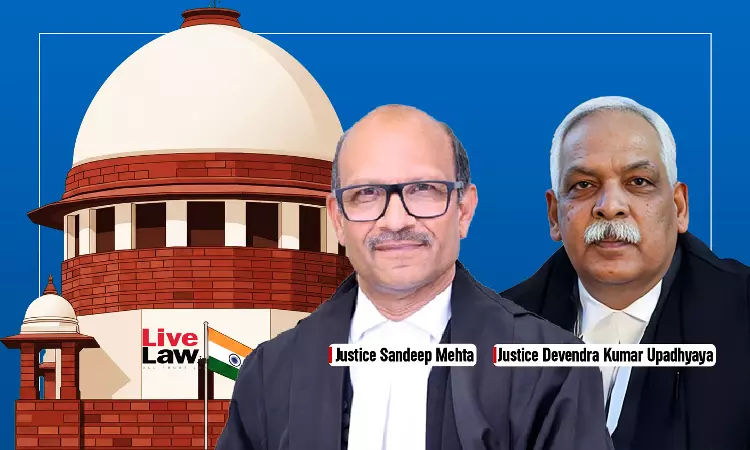
The Supreme Court on Monday (November 2) upheld the conviction of a man for committing the murder of his wife, who was subjected to continuous harassment over dowry demands.
The accused's defence that her wife met with a tragic, accidental death, having suffered a sudden epileptic seizure while her was engaged in sexual intercourse with her, was rejected by a bench of Justice Sandeep Mehta and Justice Devendra Kumar Upadhyaya, noting that failure of the Appellant-husband to provide a cogent explanation under Section 106 of Evidence Act / Section 109 of Bharatiya Sakshya Adhiniyam, coupled with a concocted story of his wife suffered death due to epileptic seizures formed an additional link to incriminating materials against him, when the deceased was in exclusive company of the Appellant, and incident occurred inside her matrimonial house.
“…the fact that the deceased-Vimalbai was in the exclusive company of the appellant-Ramkishan at the matrimonial home when she met her unnatural death assumes significance. By virtue of Section 106 of the Evidence Act, the statutory burden rested heavily upon the appellant-Ramkishan, who was in the exclusive company and holding custody of his wife Vimalbai in the privacy of the matrimonial home when she met with unnatural death, to offer a cogent, credible, and satisfactory explanation regarding the circumstances culminating into her death. Instead of discharging this statutory burden, the appellant-Ramkishan set up a demonstrably false and concocted defence, alleging that the deceased-Vimalbai suffered an epileptic seizure and giddiness while they were engaged in sexual intercourse, a plea categorically with connected matter excluded and refuted by the medical evidence and post-mortem findings.”, the Court observed.


The Court relied on its earlier judgment of Trimukh Maroti Kirkan v. State of Maharashtra (2006), where it was observed:
“In view of Section 106 of the Evidence Act there will be a corresponding burden on the inmates of the house to give a cogent explanation as to how the crime was committed. The inmates of the house cannot get away by simply keeping quiet and offering no explanation on the supposed premise that the burden to establish its case lies entirely upon the prosecution and there is no duty at all on an accused to offer any explanation.”
“The failure of the appellant-Ramkishan to furnish a plausible explanation and in discharging the burden cast upon him by virtue of Section 106 of the Evidence Act coupled with the introduction of a with connected matter false defence, provides an additional incriminating link that completes the chain of circumstantial evidence, and thereby establishing his guilt for the offence of murder punishable under Section 302 of the IPC.”, the Court added.
Appellant failed to rebut the presumption under Section 113B of Evidence Act
“Evidence regarding the persistent harassment and cruelty to which the deceased-Vimalbai was subjected in connection with unlawful demands for dowry was given in unequivocal terms by the complainant-Narayan (PW-2) who testified that, during her visits to the parental home, the deceasedVimalbai complained of being beaten by the accused persons, tortured mentally, starved, and a horrifying incident where she was tied with a rope and lowered into a well accompanied by a threat to kill her if the demands raised by the accused were not satisfied. This unflinching narrative of PW-2 receives strong corroboration from Sambhaji Turatwad (PW-3), the mediator who facilitated the marriage; Ramrao (PW4), the father of the deceased-Vimalbai, who affirmed the persistent demands and physical abuse; as well as Vaijnath Sambhaji Marpatwar (PW-5) and Mahajan Munjaji Yembalwad (PW-6), two independent neighbours of the parental home of the deceased-Vimalbai, who also supported the prosecution version regarding the ongoing harassment of Smt. Vimalbai owing to unmet unlawful dowry demands. Hence, we are of the firm opinion that the accused-appellants failed to rebut the statutory presumption under Section 113-B of the Evidence Act and were rightly convicted by the Courts below.”, the Court held.
In terms of the aforesaid, the appeal was dismissed, thereby sustaining the conviction and sentence of life imprisonment.
Appearance:
For Appellant(s) : Mr. Shivaji M. Jadhav- 1117, AOR Mr. Vishwajit Singh, Sr. Adv. Mr. Shivaji M. Jadhav, Adv. Mr. Aditya S. Jadhav, Adv. Mr. Brij Kishor Sah, Adv. Mr. Vignesh Singh, Adv. Ms. Apurva, Adv. Ms. Shivali Chaudhary, Adv. Mr. Dere Kishor Shankar, Adv.
For Respondent(s) :Mr. Varad Kilor, Adv. Mr. Siddharth Dharmadhikari, Adv. Mr. Aaditya Aniruddha Pande- 3259, AOR Mr. Shrirang B. Varma, Adv.