



- Home
- /
- Supreme court
- /
- S. 125 CrPC | Wife Can Be Denied...
S. 125 CrPC | Wife Can Be Denied Interim Maintenance If Husband Ex Facie Shows Her Adulterous Relationship : Supreme Court
Yash Mittal
31 July 2026 6:12 PM IST
The Supreme Court on Friday (July 31) held that an interim maintenance under Section 125 of Cr.P.C. can be denied to the wife once the husband ex facie establishes the wife's adulterous relation at the stage of an interim maintenance. “…we are of the view that if a husband files an application under Section 125(4) and is, at the first instance, able to establish the charge through...
This is a premium content
Available exclusively to
Our subscribers
Subscribe Premium 
INR 1099+GST
Your support helps us to bring you more content at
an affordable subscription scheme !!!
All payment options available
The Supreme Court on Friday (July 31) held that an interim maintenance under Section 125 of Cr.P.C. can be denied to the wife once the husband ex facie establishes the wife's adulterous relation at the stage of an interim maintenance.
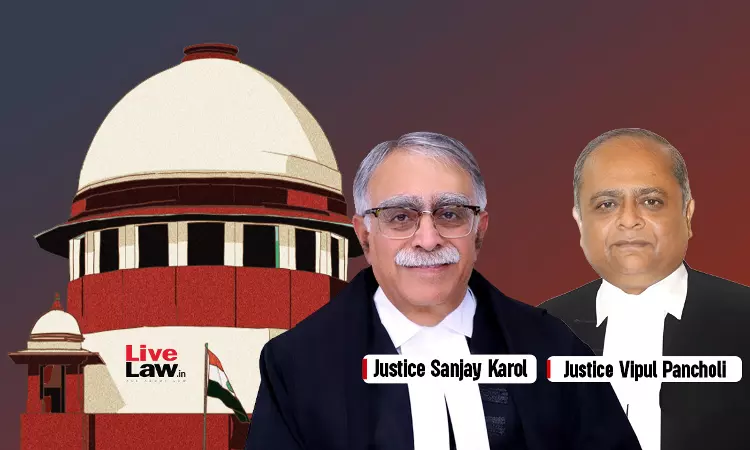
“…we are of the view that if a husband files an application under Section 125(4) and is, at the first instance, able to establish the charge through evidence ex facie, then only, there can be said to be a bar to interim maintenance.”, observed a bench of Justice Sanjay Karol and Justice Vipul M. Pancholi, while allowing the appeal filed by a husband whose application under Section 125(4) alleging adultery was dismissed by the Trial Court on the ground that the issue could only be decided at the stage of final adjudication.
The appellant, husband, married to the Respondent No. 2, wife, in 2014. Due to strained relations, the wife left the matrimonial home in 2020, along with the child and valuables. Thereafter, she filed an application under Section 125 Cr.P.C. seeking maintenance.
The husband filed an application under Section 125(4) Cr.P.C., contending that on account of adulterous relationships, the wife was not entitled to any maintenance. He placed photographs and other evidence allegedly showing the wife's infidelity.
The Trial Court dismissed the husband's application, holding that the authenticity and originality of the documents could only be determined after evidence was exhibited in the main petition.
The High Court affirmed this view, holding that there was no provision mandating adjudication of such an issue before deciding an application for interim maintenance.
Against the High Court's decision, the husband moved to the Supreme Court.
Setting aside the impugned judgment, the judgment authored by Justice Karol noted the Courts below erred in dismissing the Appellant's application under Section 125(4) Cr.P.C. at the threshold. Once the evidence brought on record by the husband ex facie established the adulterous relations of the wife, instead of deciding his application at the interim stage, it was unreasonable for the Courts below to dismiss the same at the threshold.
“The courts below clearly fell into error to hold that it was only at the stage of final adjudication that such a question could be decided. This view would render otiose what has been provided in the statute.”, the Court said.
“…the matter stands remanded to the Trial Court to make a decision on the merits since they had in this instance dismissed the application on the threshold.”, the Court held.
The appeal was allowed.
Headnote
Code of Criminal Procedure, 1973 (CrPC) — Section 125(1) & Section 125(4) — Interim Maintenance — Adultery as a Defense — Adjudication of Application under Section 125(4) as an Interlocutory Stage - Section 125(4) CrPC — Pendency of Section 125(4) application per se does not bar interim maintenance — Ground of adultery raised under Section 125(4) must be decided after interim maintenance order and before final adjudication — Deferring adjudication of adultery to final disposal is unsustainable - Section 125 is oriented towards social justice, secular in character, and summary in nature to prevent vagrancy and destitution - An application for maintenance is stage one of the proceedings, wherein interim maintenance may be awarded under the second proviso to Section 125(1) - An application filed under Section 125(4) constitutes stage two, and its decision determines whether the case reaches final maintenance under Section 125(1) - If a husband files an application under Section 125(4) alleging adultery, the Court cannot defer its determination to the stage of final adjudication - Adultery, if proved, disentitles the wife to maintenance; hence, the Section 125(4) application must be decided in the interregnum after the order granting interim maintenance and before the final adjudication of the main maintenance petition - If the evidence presented along with the Section 125(4) application ex-facie/on first blush establishes adultery or if the fact is admitted, interim maintenance becomes a non-starter or will be stopped, and the main application will be dismissed - Where the evidence requires proof in accordance with law, interim maintenance will continue during the intervening period while the Court undertakes a review of the evidence to conclusively decide the Section 125(4) application. [Paras 15 - 20]
Evidence Act, 1872 — Section 65B (Bharatiya Sakshya Adhiniyam, 2023) — Electronic Records — Admissibility & Regulation of Private Investigators - Electronic Evidence & Private Investigators — Admissibility subject to Section 65B mandatory certification — Lack of legislative regulatory framework for Private Detective Agencies highlighted - Photographs, audio, or video evidence (including those procured via private investigators) are electronic records - Under Section 65B(4) of the Evidence Act, 1872, mandatory certification is a condition precedent to admissibility - Oral evidence cannot substitute this statutory requirement Admissibility requires relevance to the matter in issue, identification of voice/source, and proof of accuracy by ruling out tampering or morphing - The Code of Criminal Procedure does not recognize private investigating agencies. Concerns regarding individual privacy, data protection, authenticity/morphing of evidence, and lack of regulation/grievance redressal mechanisms for private detectives were raised - The Supreme Court directed copies of the judgment to be forwarded to the Secretary, Ministry of Law and Justice, and the Chairman, Law Commission of India, to consider framing appropriate rules/regulations. [Relied on Navinchandra N. Majithia v. State of Meghalaya, (2000) 8 SCC 323; R.M. Malkani v. State of Maharashtra, (1973) 1 SCC 471; Arjun Panditrao Khotkar v. Kailash Kushanrao Gorantyal, (2020) 7 SCC 1; Paras 21 24]
Cause Title: HIMANSHU CHORDIA VERSUS STATE OF RAJASTHAN & ANR.
Citation : 2026 LiveLaw (SC) 748
Click here to download judgment
Appearance:
For Petitioner(s) : Mr. S. S. Jauhar, AOR Mr. Prabhjit Jauhar, Adv. Ms. Tulika Bhatnagar, Adv. Ms. Chahat Raghav, Adv. Ms. Shreya Narayan, Adv. Mr. Tanay Kalia, Adv.
For Respondent(s) : Mr. Shiv Mangal Sharma, A.A.G. Ms. Shalini Singh, Adv. Mr. Aishwarya Jaiswal, Adv. Ms. Nidhi Jaswal, AOR Ms. Preeti Singh, AOR Mr. Sunklan Porwal, Adv. Ms. Kriti Dahiya, Adv. Ms. Sakshi Trivedi, Adv. Mr. Akshay Chhabra, Adv.
Tags

Yash Mittal
Yash Mittal is a Correspondent with LiveLaw, covering the Supreme Court of India

