



- Home
- /
- Supreme court
- /
- S. 149 IPC | Failure To Prove...
S. 149 IPC | Failure To Prove Specific Overt Acts Of Each Member Of Unlawful Assembly Not Fatal To Prosecution : Supreme Court
Yash Mittal
13 March 2026 1:17 PM IST
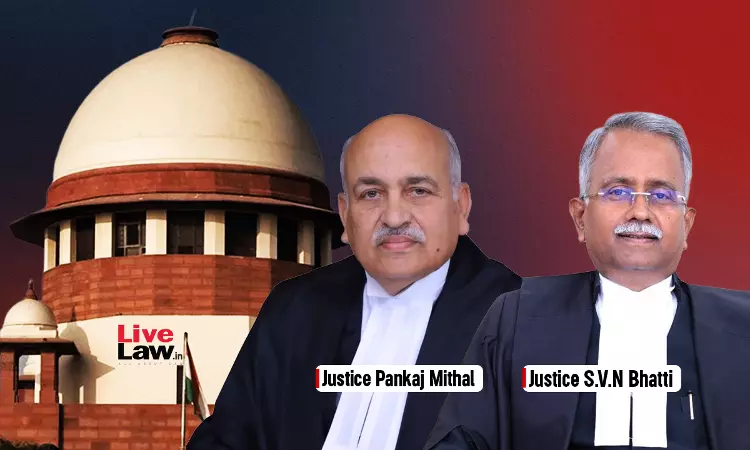
The Supreme Court upheld the murder conviction and life sentences of four individuals, observing that the absence of a specific eyewitness account of the accused firing at the deceased is not fatal to the prosecution's case when the accused acted as members of an unlawful assembly with a common object under Section 149 of the Indian Penal Code, 1860. A bench of Justice Pankaj Mithal and...
This is a premium content
Available exclusively to
Our subscribers
Subscribe Premium 
INR 1099+GST
Your support helps us to bring you more content at
an affordable subscription scheme !!!
All payment options available
The Supreme Court upheld the murder conviction and life sentences of four individuals, observing that the absence of a specific eyewitness account of the accused firing at the deceased is not fatal to the prosecution's case when the accused acted as members of an unlawful assembly with a common object under Section 149 of the Indian Penal Code, 1860.
A bench of Justice Pankaj Mithal and Justice S. V. N. Bhatti heard the appeals filed by the convicted persons, who, among other grounds, challenged their conviction by arguing that the independent witness to the incident had not seen them firing or causing harm to the deceased, and therefore their involvement in an unlawful assembly attracting liability under Indian Penal Code, 1860 could not be justified.
Dismissing the appeals, the bench observed that once the accused are shown to be members of an unlawful assembly sharing a common object, the failure of an independent witness to attribute specific overt acts to each individual becomes immaterial.
The prosecution's case was that the six accused persons, armed with deadly weapons, formed an unlawful assembly, right after stepping out of a bus, and a gunshot was fired at the deceased by one of the accused, which hit his left hand. Thereafter, the deceased ran and hid in a house to save his life. However, the accused persons found him and dragged him out of the house, killing him. The house owner was an independent witness who heard the firing of the gunshots.
However, the defence relied on the testimony of an independent witness (PW-6), who stated that he had not seen most of the accused firing upon the deceased or fleeing from the scene, except one accused, Vikram. The defence argued that this omission created a serious gap in the prosecution's story and weakened the case against the remaining accused.
Affirming the convictions, the judgment authored by Justice Pankaj Mithal rejected the appellants' contention, holding that the prosecution's case cannot be undermined merely because an independent witness did not see each accused firing at the victim. The Court noted that the evidence clearly established that the accused acted together in furtherance of a common object, with one accused firing at the deceased while the others chased him up to the house of the independent witness.
“The mere fact that the independent witness PW-6 did not see any of the accused persons firing upon the deceased or fleeing away from his house except Vikram, does not make any difference, nor does it belie the prosecution story that all the accused had chased the deceased from the bus stand to his house and that multiple shots were fired resulting in the death of the deceased. This in itself is sufficient to rope in all the accused by applying Section 149 IPC.”, the court observed.
“It is settled in law that in view of Section 149 IPC, every member of the unlawful assembly is vicariously liable for acts done by anyone of them to achieve a common object. Therefore, two things are essential to attract Section 149 IPC. The first is “unlawful assembly” and the second is “common object”. The presence of the accused persons as part of the unlawful assembly is sufficient for conviction even if no overt act is imputed to each one of them individually. In the case at hand, all the accused persons had alighted from the bus together armed with firearms, thus, they were part of the unlawful assembly and had arrived at the bus stand with a common object. The movement of the accused persons in the above manner is sufficient enough to draw an inference that they had a common object. Therefore, the presence of the accused persons in the unlawful assembly to achieve a common object makes all of them vicariously liable for the acts of the unlawful assembly.”, the court held.
Accordingly, the appeals were dismissed, and the accused were directed to surrender to serve the remaining sentence, since they were out of jail on bail.
Headnote
Indian Penal Code, 1860 – Section 149 – Unlawful Assembly and Vicarious Liability – Murder – The Supreme Court upheld the conviction of four appellants sentenced to life imprisonment for the murder of a Watershed Committee Chairman - Noted that to attract Section 149 IPC, two essential elements must be established: an "unlawful assembly" and a "common object" - Even in the absence of a specific overt act attributed to each member, the mere presence of the accused as part of an armed unlawful assembly is sufficient for conviction - noted that all accused alighting together from a bus while armed with firearms clearly established their common motive and participation in the unlawful assembly. [Paras 12, 13]
Evidence Act, 1872 – Ocular Evidence vs. Unnatural Conduct – held that the testimony of related witnesses (brother, son, and nephews of the deceased) could not be discarded merely because they failed to intervene or take the victim to the hospital after the shooting - Such "unnatural behavior" does not invalidate their evidence when consistent with other facts, such as the established political rivalry and the forensic evidence of multiple gunshot wounds. [Paras 11 - 15]
Criminal Procedure Code, 1973 – Section 157 – Procedural Lapses – Alleged non compliance with the requirement of sending the FIR to the Magistrate under Section 157 CrPC is not, by itself, fatal to the prosecution case - Such procedural lapses are insufficient to overturn a conviction when the overall evidence establishes the guilt of the accused - The movement of multiple accused persons, arriving together armed with firearms and chasing the deceased into a private residence to execute the killing, is sufficient to draw an inference of a common object - The recovery of 40 pellets from the body and multiple entry/exit wounds corroborated the involvement of multiple shooters. [Paras 13, 17 - 20]
Cause Title: DABLU ETC. VERSUS STATE OF MADHYA PRADESH (with connected case)
Citation : 2026 LiveLaw (SC) 238
Click here to download judgment
Appearance:
For Appellant(s) (Item 104) Mr. S. Mahendran, AOR(argued by)
(Item 104.1) Mr. Prafulla Kumar Behera, Adv.(argued by) Mr. S. S. Nehra, AOR Mr. Sanjay Singh, Adv. Mr. Deepak Jyoti Ghildiyal, Adv. Mr. Ramesh Chandra, Adv. Mr. Chetan Sharma, Adv. Mr. Neeraj Dutt Gaur, Adv.
For Respondent(s) Mr. Shreeyash U. Lalit, Adv.(argued by) Ms. Maitreyee Jagat Joshi, Adv. Mr. Astik Gupta, Adv. Ms. Akanksha Tomar, Adv. Mr. Pashupathi Nath Razdan, AOR

Yash Mittal
Yash Mittal is a Correspondent with LiveLaw, covering the Supreme Court of India

