



- Home
- /
- Supreme court
- /
- S. 32(1) Evidence Act | Imminent...
S. 32(1) Evidence Act | Imminent Death Not A Precondition For Treating Statement As Dying Declaration : Supreme Court
Yash Mittal
5 Dec 2025 3:04 PM IST
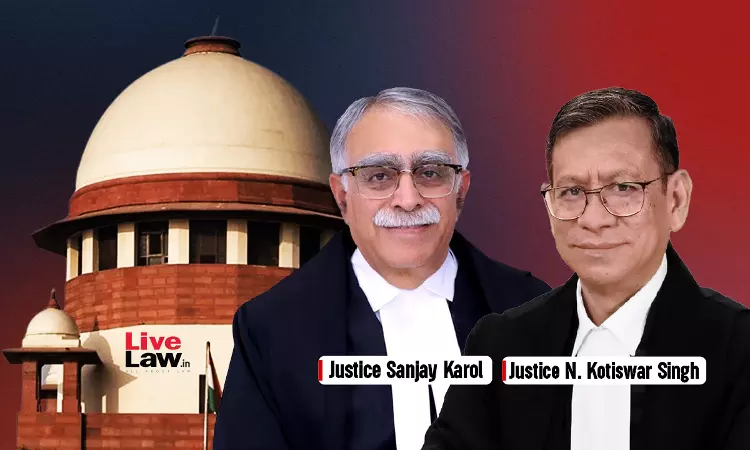
The Supreme Court on Thursday (December 4), while restoring the summons to the deceased's in-laws in the shooting case, held that the mere fact that death was not imminent at the time of recording the statement does not render a dying declaration irrelevant. The bench comprising Justices Sanjay Karol and N Kotiswar Singh heard the case where the appellant lodged an FIR after his deceased...
This is a premium content
Available exclusively to
Our subscribers
Subscribe Premium 
INR 1099+GST
Your support helps us to bring you more content at
an affordable subscription scheme !!!
All payment options available
The Supreme Court on Thursday (December 4), while restoring the summons to the deceased's in-laws in the shooting case, held that the mere fact that death was not imminent at the time of recording the statement does not render a dying declaration irrelevant.
The bench comprising Justices Sanjay Karol and N Kotiswar Singh heard the case where the appellant lodged an FIR after his deceased sister was shot by her husband. Although the victim initially named only her husband in her Section 161 Cr.P.C. statements, she later gave another Section 161 Cr.P.C statement implicating her mother-in-law, father-in-law, and brother-in-law, alleging they had instigated her husband to shoot her.
Despite these allegations, the police framed charges only against her husband. During the trial, the prosecution sought to summon the in-laws as additional accused under Section 319 Cr.P.C, relying on the evidence emerging from the witnesses.
Both the Trial Court and the High Court refused, holding that there was no “strong and cogent evidence” to justify summoning them. Amongst other aspects, the High Court had refused to consider the victim's statements as dying declarations, citing a nearly two-month gap between her recording of the statement and her death and a lack of certification by a Magistrate or doctor.
Disagreeing with the High Court's refusal to treat the victim's Section 161 Cr.P.C statements as 'dying declaration' under Section 31(1) of the Evidence Act, 1972, the judgment authored by Justice Karol observed:
“the High Court erred in holding that these statements cannot be treated as dying declaration(s) merely because the death of the deceased occurred after a substantial lapse of time from their recordings. Such an approach is clearly untenable since the law does not require that a declarant, at the time of making the statement, to be under the shadow of death or the expectation that death is imminent. Here the time gap between the incident and the death is less than 2 months. In any event, Section 32 of the Evidence Act, contains no such limitation. What is pertinent is that the statement relates either to the cause of death or the circumstances leading to it.”
Also from the judgment- While Deciding S.319 CrPC Application, Court Not Required To Test Credibility Of Evidence : Supreme Court
Cause Title: NEERAJ KUMAR @ NEERAJ YADAV Versus STATE OF U.P. & ORS.
Citation : 2025 LiveLaw (SC) 1171
Click here to download judgment
Tags

Yash Mittal
Yash Mittal is a Correspondent with LiveLaw, covering the Supreme Court of India

