



- Home
- /
- Supreme court
- /
- Why Rules Under Shariat Application...
Why Rules Under Shariat Application Act Not Framed? Supreme Court Seeks Responses Of Union, UP Govt
Yash Mittal
16 Feb 2026 4:09 PM IST
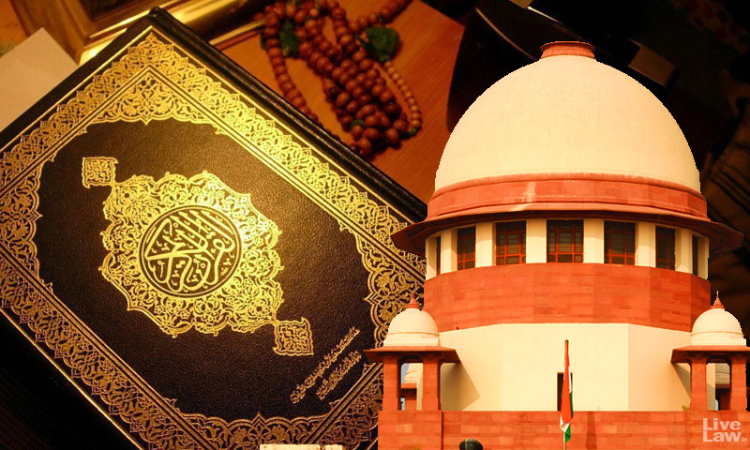
The Supreme Court has sought responses from the Union Government and the State of Uttar Pradesh on why rules under Section 4 of the Muslim Personal Law (Shariat) Application Act, 1937 have not been framed.A Bench comprising Justice Sanjay Karol and Justice Augustine George Masih issued notice to the Union of India and the State of Uttar Pradesh, calling for clarification on whether Section 4...
This is a premium content
Available exclusively to
Our subscribers
Subscribe Premium 
INR 1099+GST
Your support helps us to bring you more content at
an affordable subscription scheme !!!
All payment options available
The Supreme Court has sought responses from the Union Government and the State of Uttar Pradesh on why rules under Section 4 of the Muslim Personal Law (Shariat) Application Act, 1937 have not been framed.
A Bench comprising Justice Sanjay Karol and Justice Augustine George Masih issued notice to the Union of India and the State of Uttar Pradesh, calling for clarification on whether Section 4 of the Muslim Personal Law (Shariat) Application Act, 1937 has been effectively implemented in Uttar Pradesh.
The Court noted that in the absence of such rules, a Muslim would be unable to file the declaration contemplated under Section 3 effectively. As per Section 3, a Mulsim can file a declaration before the prescribed authority that he/she wished to be governed by the Shariat law in matters related to marriage, maintenance, inheritance, guardianship etc. Once such a declaration is filed, and the prescribed authority accepts it, the person and his/her descendants would be governed by the Shariat law.
As per Section 4, the State Government has to frame the rules prescribing the authority before whom the Section 3 declaration has to be made.
The Court observed that unless the rules under Section 4 prescribe the requisite form, designate the competent authority, and lay down the procedural mechanism, a Will cannot be formally declared to be governed by Shariat law.
The appeal filed before the Supreme Court challenges a 2011 Delhi High Court judgment that invalidated a 1992 Will propounded by the appellant, Gohar Sultan, the daughter of the deceased testatrix, Mst. Nawab Begum.
The High Court had ruled against the appellant because her sole attesting witness turned hostile, failing the strict proof requirements of the Indian Succession Act, 1925. The High Court held that since the testatrix had not made a formal declaration under Section 3 of the Shariat Act to be governed by Muslim Personal Law, her Will had to be proved under the rigorous secular law, i.e., the Indian Succession Act, 192,5 which requires two attesting witnesses.
However, during the hearing, the Supreme Court noted a potential statutory vacuum. The appellant's counsel argued that the testatrix could not have made the required Section 3 declaration because the State Government (Uttar Pradesh) never framed the procedural rules under Section 4 to accept such declarations.
"It is brought to our notice that thus far, there is no compliance of Section 4 thereof," the Bench observed.
As a result thereof, the Court was inclined to implead “Union of India through Secretary, Department of Legislation as party respondent as also State of Uttar Pradesh through its Chief Secretary.”
To clarify, the Court has impleaded the State of UP, because the testatrix was from UP, and she was not able to make a formal declaration under Section 3 of the Act to be governed by the Shariat Act.
The matter is directed to be re-listed on February 18, 2026, and in the meanwhile, “newly added respondent may file their affidavit indicating the latest status.”, the court said.
Cause Title: SMT. GOHAR SULTAN VERSUS SHEIKH ANIS AHMAD & ANR.
Appearance:
For Appellant(s) Mr. Rakesh Khanna, Sr. Adv. Mr. M. Khairati, Adv. Mr. Irshad Ahmad, AOR Mr. Ashok Kumar, Adv. Mr. H.M.ghouse, Adv. Mr. Junaid Ali Khan, Adv. Mr. Shoaib Khan, Adv.
For Respondent(s) M/S. Equity Lex Associates, AOR Mr. Salman Khurshid, Sr. Adv. Mrs. Naghma Imtiaz, Adv. Mr. Zargham Ahmed, Adv. Mr. Saif Naseem, Adv. Mrs. Lubna Naaz, Adv. Ms. Mariya Mansuri, Adv. Ms. Sidra Khan, Adv. Ms. Azra Rehman, Adv.

Yash Mittal
Yash Mittal is a Correspondent with LiveLaw, covering the Supreme Court of India

