



- Home
- /
- Supreme court
- /
- Statement Of Accused Absolving...
Statement Of Accused Absolving Himself & Incriminating Co-Accused Not Reliable : Supreme Court
Yash Mittal
23 May 2026 10:34 AM IST
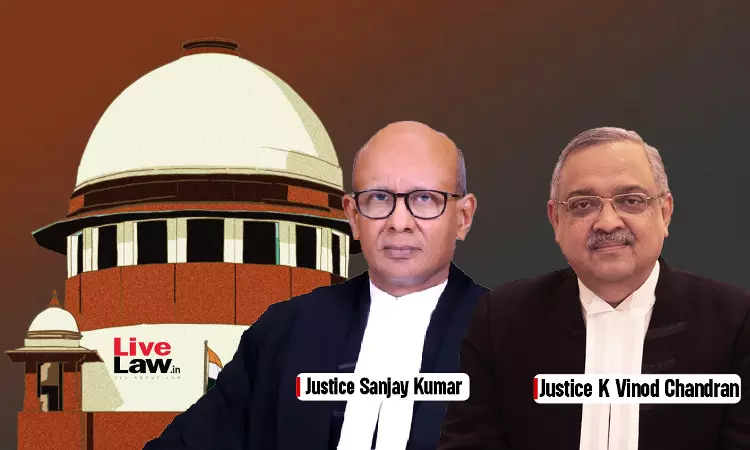
The Supreme Court on Friday (May 22) set aside a murder conviction, upon noting that the statements of an accused by way of an extra-judicial confession, arraying other co-accused, without affording them an opportunity to cross-examine the maker, would be fatal to the prosecution's case, and not reliable for a conviction. A bench of Justice Sanjay Kumar and Justice K. Vinod Chandran...
This is a premium content
Available exclusively to
Our subscribers
Subscribe Premium 
INR 1099+GST
Your support helps us to bring you more content at
an affordable subscription scheme !!!
All payment options available
The Supreme Court on Friday (May 22) set aside a murder conviction, upon noting that the statements of an accused by way of an extra-judicial confession, arraying other co-accused, without affording them an opportunity to cross-examine the maker, would be fatal to the prosecution's case, and not reliable for a conviction.
A bench of Justice Sanjay Kumar and Justice K. Vinod Chandran overturned the Calcutta High Court's decision, which had affirmed the trial court's decision of convicting the Appellants for an offence of murder. Amongst other flaws in the prosecution's case, the Court found that the Appellant's conviction was based on the extra-judicial statement of an accused, who had made an exculpatory statement, absolving him, but accused the other co-accused persons of the commission of the crime.
Disregarding such exculpatory statements, the court observed:
“The exculpatory statement made absolving himself and accusing the co-accused, by its very nature is unreliable. It cannot be put against the other accused, for no cross examination being provided to them, of the one who made that statement. It cannot also incriminate the person who made the statement since there is no element of confession in the recital as spoken of by three witnesses, as against one.”
Further, the Court found that the prosecution's case was weakened since the statement was made by the accused person under the influence of the mob, who had detained them pursuant to the alleged incident; therefore, the statement made under a coercive environment or under the mob influence would not be considered either reliable or credible.
“The extra-judicial confession by its very nature being a weak piece of evidence has not at all been proved in the present case. In any event, the statement is made when the two accused were detained by a mob, on the accusation of murder. Obviously, there is considerable pressure put on the detained persons, who could have spoken, on undue duress or under threat of violence. In fact, the records indicate that after arrest, when A1&2 were taken for medical examination, they had injuries on their body, which again cuts at the root of credibility of the statement made; which anyway has doubtful standing as a confession.”, the Court observed.
On the “last seen together” theory, the Court held that the time gap between the deceased being last seen with the accused and the estimated time of death was too wide to draw a conclusive adverse inference.
“What assumes significance in placing reliance on the last seen together theory is the gap between the time they were seen together and the death having occurred,” the Court observed, adding that where the time gap is large, intervening circumstances cannot be ruled out.
The bench also expressed serious doubt about the testimony of a prosecution witness who claimed to have seen the deceased and the accused drinking together in a public field, noting inconsistencies in her account.
The Court was equally unconvinced by the alleged recoveries under Section 27 of the Indian Evidence Act. It held that the prosecution failed to establish the essential ingredient of concealment and knowledge necessary for admissibility of such recoveries.
The bench also noted procedural deficiencies, including failure to clearly establish ownership of the recovered motorcycle and failure to produce alleged weapons before the doctor for medical opinion.
The Court further observed that while motive is not always essential in a circumstantial evidence case, its absence assumed significance here given the prosecution's failure to establish a coherent chain of incriminating circumstances.
“In the totality of the circumstances… none of those projected having qualified as incriminating, linking the accused to the murder, we cannot but reverse the order of conviction,” the Court held.
The Court ultimately allowed the appeals and directed the immediate release of the appellants unless required in any other case.
Significantly, noting that the third accused had also been imprisoned along with the appellants but had not filed an appeal, the Court directed the National Legal Services Authority and the West Bengal State Legal Services Authority to ensure that legal assistance is provided to him so that an appeal can be filed before the Supreme Court within two months.
Headnote
Criminal Evidence — Circumstantial Evidence — Last Seen Together Theory — Extra-judicial Confession — Recovery under Section 27 of the Indian Evidence Act — Absence of Motive — Conviction set aside - Last Seen Together Theory — Time Gap & Proximity - What assumes significance in placing reliance on the 'last seen together' theory is the gap between the time the accused and the deceased were seen together and the occurrence of death - The proximity of the death having occurred within a short time after they were last seen together is most relevant for that fact to be taken as an incriminating circumstance - When the time gap is large, intervening circumstances can snap the link and prevent an adverse inference against the accused, even if the accused fails to explain when they parted company. [Relied on State of Goa v. Sanjay Thakran and Another, (2007) 3 SCC 755; Para 7-10]
Elastic Time of Death - Extra-Judicial Confession - Exculpatory Statements - Where the postmortem report indicates an elastic timeframe for the time of death (e.g., '24 hours not passed during examination') and the time gap between when the deceased was last seen with the accused and the recovery of the body is large, death cannot be termed as proximate. Consequently, no conviction can be sustained solely based on the last seen together theory - An exculpatory statement made by an accused absolving himself and accusing the co-accused is, by its very nature, unreliable. It cannot be used against co-accused persons as they have no opportunity to cross-examine the maker, nor does it incriminate the maker since it lacks an element of confession. Furthermore, a statement made while being detained by a mob under pressure, undue duress, or threat of violence lacks credibility and is a weak piece of evidence. [Paras 9-11]
Recoveries under Section 27, Evidence Act — Essential Ingredients - Concealment and its knowledge, revealed from the statement of the accused, are the crucial ingredients of Section 27 of the Indian Evidence Act - In the absence of a recorded statement showing that the concealment was effected by the accused, a mere recital in the seizure list that objects were recovered "on being shown and certified" by the accused does not qualify as a valid recovery under Section 27 - Assault: Where weapon recoveries lack clarity, are made from open spaces with free access, are not produced or confronted before the witnesses in Court, and are not shown to the medical officer to elicit an opinion on whether they could cause the injuries found on the deceased, such recoveries do not form a clinching incriminating circumstance – Motive - While the absence of motive is not imperative when the chain of circumstances is so complete as to establish only a hypothesis of guilt, its absence raises a reasonable doubt when the individual links in the chain of circumstances are weak, unproven, or not incriminating. [Paras 12 - 19]
Cause Title: Papan Sarkar @ Pranab Versus State of West Bengal (with connected case)
Citation : 2026 LiveLaw (SC) 532
Click here to download judgment
Appearance:
For Petitioner(s) Ms. Ashima Mandla, AOR Ms. Mandakini Singh, Adv. Mr. Ayush Shrivastava, Adv.
For Respondent(s) Ms. Shraddha Chirania, Adv. Mr. Kunal Mimani, AOR

Yash Mittal
Yash Mittal is a Correspondent with LiveLaw, covering the Supreme Court of India

