Students' Fees Cannot Be Hiked Midway Through Professional Courses Except In Exceptional Circumstances: Supreme Court
Yash Mittal
15 Oct 2026 12:36 PM IST
Fee regulatory commissions must strive to notify the fee payable for the entire course at the threshold itself, the Court stated.
The Supreme Court has held that fees payable by students pursuing professional courses in self-financing higher educational institutions cannot ordinarily be increased midway through the course, except in exceptional circumstances such as an unforeseen increase in expenditure.
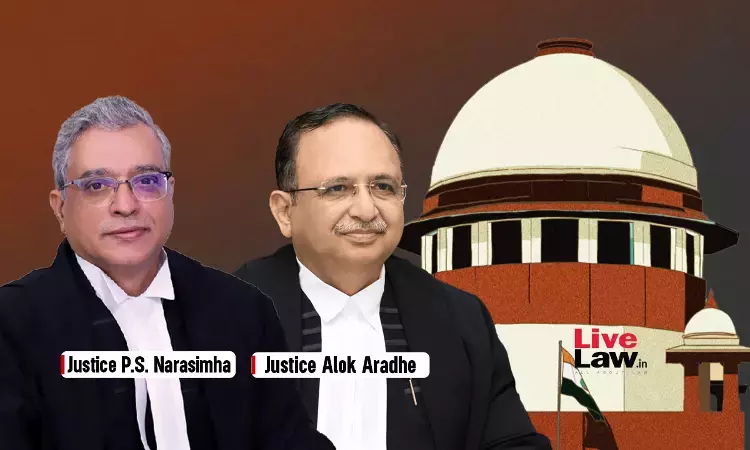
A Bench of Justice Pamidighantam Sri Narasimha and Justice Alok Aradhe observed that certainty about fee liability is essential for students and their families, who often commit a substantial part of their income and savings, or take educational loans, to finance professional education.
Hence, the fee fixation authorities must notify the fees payable for the entire course before a student takes admission, ensuring certainty about the financial liability undertaken by students and their families.
“The regulatory regime for fixation of fees, as contemplated in the decisions of this Court, AICTE Regulations, National Education Policy, 2020, coupled with principles of certainty, necessitates the relevant authorities to notify fee payable for the entire course before a student takes admission. There must be certainty about the fee liability; variation in the fee payable during the subsistence of the course is permissible only in exceptional instances such as unforeseen increase in the expenditure.”, the Court held.


According to the Court, “a student entering a four-or five-year professional programme should ordinarily know, at the very threshold, the financial liability that they or their family is undertaking. Such advance determination promotes transparency, enables informed choice, and facilitates financial planning.”
Revision in Fees justifiable only in exceptional circumstances
“This does not mean that the fee structure must remain incapable of adjustment in every conceivable circumstance. Costs may increase unexpectedly because of extraordinary economic conditions, statutory changes or other circumstances which could not reasonably have been anticipated. A narrowly defined mechanism may therefore be provided to accommodate such exceptional circumstances. But such adjustment must remain an exception and cannot become a substitute for timely assessment and proper institutional planning.”, the Court said.
The Case
The dispute arose after the West Bengal Government issued an October 16, 2023 notification revising the fee ceiling for private self-financing engineering, pharmacy and architecture colleges, with a maximum annual tuition fee of ₹1.10 lakh, applicable from the 2023-24 academic year. The revision followed a seven-year gap, with the Fee Structure Committee forwarding its recommendations to the State in June 2023. However, the notification came after admissions for the 2023-27 B.Tech batch had concluded.
On December 15, 2023, Dr. B.C. Roy Engineering College increased the batch's semester tuition fees and introduced a development fee, resulting in an overall hike of approximately 37.5% from the second semester. The college relied on a prospectus clause stating that fees could change in accordance with government decisions.
The students challenged the increase before the Calcutta High Court. A single judge dismissed their petitions, but a Division Bench held that the revised fees could apply only to students admitted on or after October 16, 2023. It directed colleges to refund the excess collected from earlier-admitted students or adjust it against future semester fees.
The colleges then challenged the Division Bench's decision before the Supreme Court.
Certainty in fee liability essential
The Supreme Court emphasised that fee fixation for professional education involves balancing three legitimate interests: the need for students and parents to have certainty about the fees payable, the requirement of self-financing institutions to secure adequate resources for quality education and development, and the societal interest in reasonable fee regulation through government authorities and fee fixation committees.
The Court observed that professional education constitutes a substantial financial commitment for most families, with many relying on educational loans. Unanticipated increases in fees can create financial insecurity for students and their parents.
It said that a student entering a four- or five-year professional programme should ordinarily know, at the outset, the financial liability they or their family would be undertaking.
The Court also recognised the role of private institutions in meeting the demand for professional education and observed that such institutions require adequate resources for infrastructure, equipment, technology, student services and faculty remuneration.
It clarified that the principle of fee certainty does not mean that the fee structure must remain incapable of adjustment in every conceivable circumstance. Unexpected increases in costs arising from extraordinary economic conditions, statutory changes or other circumstances that could not reasonably have been anticipated may justify exceptional adjustments. However, such adjustments must remain an exception and cannot substitute for timely assessment and institutional planning.
Fee fixation committees must act efficiently
The Court stressed that fee fixation committees must function as effective regulatory institutions and complete their assessments well before the commencement of the admission process.
Referring to the All India Council for Technical Education (Norms and Guidelines for Fees and Guidelines for Admission in Professional Colleges) Regulations, 1994, the bench observed that fee revision must be based on the committee's recommendations and estimates of expenditure required for the efficient functioning of professional colleges.
It noted that the regulations contemplate fee revision at intervals of at least three years and require the assessment to take into account audited expenditure figures and projected requirements.
The Court observed that the fee fixation committee and the West Bengal government had failed to complete the revision exercise in time for the 2023-27 batch. The fees had last been revised in the 2016-17 academic year, and the fresh revision was undertaken only in October 2023, after the admission process for the relevant batch had concluded.
“The problem arising out of mid-stream implementation of revised fee schedule could have been avoided, if the State Government had issued the notification dated 16.10.2023 before the commencement of academic session 2023-2024,” the Court observed.
It added that the functioning of fee fixation committees and action taken by the State on their recommendations had often not been up to the mark.
The Court held that High Courts must exercise judicial review to ensure that fee fixation committees discharge their functions with institutional efficiency, expertise and integrity.
Decision
Partly allowing the appeal, the Supreme Court, though agreeing with the High Court's decision to term the revision in fees in the middle of the course as impermissible, disagreed with the impugned judgment to the extent that it allowed the benefit of fees refund retrospectively, i.e., students admitted before October 16, 2023.
“While we uphold the conclusions drawn by the Division Bench of the High Court for the independent reasons that we have given, we are not in agreement with the reasoning of the Division Bench that the implementation of the revised fee structure for the 2023-27 course will have the effect of giving retrospective obligation to the Notification dated 16.10.2023. We are also of the opinion that the approach adopted by the High Court in applying principles of equity and estoppel against the Appellant-College on the basis of its admission brochure is not sustainable in law. To that extent, the judgment of the High Court is set aside.”, the Court said.
As a result, the appeal was partly allowed.
Appearance:
For Petitioner(s) :Mr. Jaideep Gupta, Sr. Adv. Mr. Kunal Chatterji, AOR Ms. Maitrayee Banerjee, Adv. Mr. Rohit Bansal, Adv. Mr. Varij Nayan Mishra, Adv. Mr. Harin Raval, Sr. Adv. Mr. Rauf Rahim, Sr. Adv. Mr. Firdous Samim, Adv. Mr. Ali Asghar Rahim, Adv. Ms. Gopa Biswas, Adv. Mr. Mohsin Rahim, Adv. Mrs. Tania Tamanna, Adv. Ms. Shrestha, Adv. Mr. Shekhar Kumar, AOR
For Respondent(s) :Mr. Sanjay R. Hegde, Sr. Adv. Mr. Dibyadyuti Banerjee, Adv. Ms. Sumedha Halder, Adv. Ms. Astha, Adv. Mr. Abhijit Sengupta, AOR Mr. Pranshu Dahiya, Adv. Mr. Navneet Singh, Adv. Mr. Vishal Kumar Singh, Adv. Mr. Balmiki Prasad, Adv. Mr. Rakesh Kumar Sharma, Adv. Mr. Birendra Kumar, Adv. Ms. Rajlakshmi, Adv. Mr. Uddyam Mukherjee, AOR Mr. Swapnil Pattanayak, Adv. Ms. Kratika Kushwaha, Adv. Mr. Harish Pandey, AOR Ms. Pearl Sharma, Adv. Mr. Jaideep Gupta, Sr. Adv. Mr. Kunal Chatterji, AOR Ms. Maitrayee Banerjee, Adv. Mr. Rohit Bansal, Adv. Mr. Varij Nayan Mishra, Adv.