



Supreme Court Acquits Man In POCSO Case Over Victim's Failure To Identify Him In Court, Unexplained Delay In FIR
Saima Anjum
11 Oct 2026 4:41 PM IST
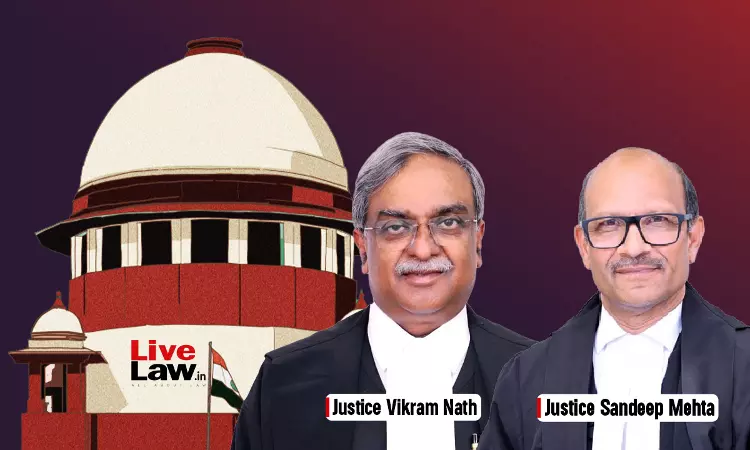
A bench of Justice Vikram Nath and Justice Sandeep Mehta set aside the concurrent findings of the trial court and the Meghalaya High Court. It found that the evidence of the victim's mother (informant), the victim and the victim's cousin was wavering and unreliable.
It is alleged that the appellant sexually assaulted the 40% intellectually disabled victim in 2015 when she was 11 years old, at her home when her mother (informant/PW 1) had gone out and she was alone. PW 1 allegedly saw the accused plucking mulberry leaves in the garden next to the house as she left. Thereafter, the victim then went to her cousin's house (PW 2) and stayed for the night. The cousin told the victim's mother about the incident the next day, but the mother did not take it seriously because the child did not confirm the accusation. Later, the victim disclosed the incident to her school teacher who informed the parents and an FIR was lodged nearly 10 days after the alleged incident.


The accused was then convicted by Special Judge (POCSO) and was sentenced to 10 years' rigorous imprisonment and a fine of Rs 1 Lakh. The accused appealed before the High Court which dismissed his appeal in 2022.
Aggrieved by the High Court's dismissal, the appellant approached the Supreme Court.
Before the Supreme Court, Senior Advocate Gaurav Agrawal argued for the appellant (accused) that the prosecution had failed to explain the delay of nearly ten days in lodging the FIR. It was submitted that PW 2 (victim's cousin) had told PW 1 (victim's mother/informant) about the incident on the very next day, yet this fact was not mentioned in the FIR, and the mother took no recourse to police action or medical assistance, which would have been the natural reaction had the allegations been true. It was further submitted that the incident was reported only after the victim allegedly disclosed the incident to her teacher, whom the prosecution failed to examine without offering any explanation.
With regards to identity, Agrawal submitted that although the accused was known to the victim and her family, neither the victim nor her cousin (PW 2) identified him during their sworn testimony despite being specifically called upon to do so. Both of them admitted that his name had been disclosed to them by the victim's mother, who was not an eyewitness. It was also pointed out that the victim admitted in cross-examination that her examination-in-chief was given as instructed by the Public Prosecutor. It was also argued that no Test Identification Parade was conducted and that the prosecution evidence was inconsistent on the accused's relationship with the victim's family, since the victim called him her paternal uncle while PW 1 described him as the husband of her brother's sister-in-law.
It was also contended that there was no independent or corroborative evidence connecting the accused with the offence. Owing to the delayed FIR, no forensic or scientific evidence could be collected, and the medical evidence, based on an examination about ten days after the incident, did not connect the accused with the crime. Agrawal added that the defence of the plea of alibi was proved by documentary and oral evidence but was ignored by the trial court and the High Court.
On the contrary, Advocate General Amit Kumar appearing for the respondent submitted that the conviction was recorded after proper appreciation of evidence. It was argued that the courts had rightly relied on the statements of the victim and PW 2 recorded under Section 164 Code of Criminal Procedure, 1973 (CrPC, now Section 183 of the Bharatiya Nagarik Suraksha Sanhita, 2023/BNSS) by a Judicial Magistrate at the earliest available opportunity, when the incident was fresh in their minds. According to him, these statements substantially corroborated the prosecution case and could not be discarded because of trivial inconsistencies in their trial court depositions.
It was argued that the victim, a specially-abled child with 40% intellectual disability, deposed in 2017, nearly two years after the incident, and that her mental condition and the passage of time adequately explained her inability to identify the accused. It was also submitted that the informant had seen the accused plucking mulberry leaves in the garden adjoining the house just before the incident, while the victim was alone inside, which gave rise to a presumption that the accused had knowledge of the child being alone at her house, placing the burden on him under Section 106 of the Indian Evidence Act, 1872 (now Section 109 of the Bharatiya Sakshya Adhiniyam, 2023), which he failed to discharge.
Perusing the submissions made, the Supreme Court found that the conduct of the victim's mother was very unnatural. It observed that the child's disability should have made her more cautious on hearing the allegation.
“This disability factor of the child would definitely have made the mother more wary and a serious complaint of sexual assault on the child would not have been brushed aside so casually only because the child did not confirm that she had been subjected to any such assault. If at all there had been any iota of truth in the theory that PW-2 had informed PW-1 about the incident, then, she being the mother of the child, would be expected to at least check her physical condition and to be specific, the genital area,” the bench observed.
It also observed that the victim's cousin first claimed in her examination-in-chief to have seen the victim and the accused eating betel nut. However, in cross-examination, she stated that she did not know the accused, could not recollect his face, and that the victim's mother had told her his name. Later, in re-examination, she deposed that her earlier statement of naming the accused was incorrect and could not identify him in the courtroom. The Court also noted that the Public Prosecutor made no effort to confront her with her Section 164 CrPC statement, which “strike at the very foundation of her testimony and completely diminish its evidentiary value.”
The Court also found that when the doctor (PW 3) was examined, the accused's counsel was not available, and the trial court neither provided legal aid to the accused nor deferred the cross-examination. In the case of the other doctor (PW 8) also, the trial court did not even offer the opportunity of cross-examination to the accused's counsel. Due to this, the Court concluded that “the testimony of both medical jurists cannot be read in evidence as the defence was not given an effective opportunity of cross-examining both the witnesses (PW-3 & PW-8).”
With regards to the victim's statement in cross-examination that she had met the Special Prosecutor beforehand, that he instructed her to depose, that her mother had told her the accused's name, and that she could not identify the person who raped her, the Court observed that this “creates a doubt in our mind that the witness may have been tutored to give the statement against the accused-appellant.”
It noted that the prosecution never asked the victim to identify the accused in her examination-in-chief, and that neither the Public Prosecutor nor the Presiding Officer re-examined her after the negative answer in cross-examination. It also observed that no effort was made to confront her with her Section 164 CrPC statement made before the Magistrate. The Court also noted the inconsistency over the accused's relationship with the family, since the victim called him her father's eldest brother while the informant described him differently.
“We are conscious of the fact that the victim was a mentally challenged girl and as such, a certain degree of latitude would have to be given while appreciating her evidence. However, even after giving due deference to her weak mental disposition we find that there was a complete failure of the victim to identify the accused-appellant before the Court. Admittedly, the prosecution could not present any scientific corroboration for the incident as the FIR itself was lodged after 10 days of the incident. In such a situation, it would be unsafe to rely upon the testimony of the victim so as to sustain the conviction of the accused,” the Court held.
Further, the Court called the Section 106 argument made by the respondent unconvincing, noting that the last seen theory was a material improvement over the FIR, which contained no such allegation. According to the Court, the informant merely stated that she saw the accused plucking mulberry leaves before she left, and “nowhere stated that the victim was present with the accused or that both of them were seen together at any point of time.” It, therefore, held that “there is no question of shifting the burden of proof on the accused by virtue of Section 106 of the Evidence Act.”
The bench also reiterated that an FIR should not be expected to be an encyclopaedia, except in cases where a circumstance forms “the very foundation of the prosecution case, its omission from the earliest version assumes considerable significance.” Relying on Amar Nath Jha v Nand Kishore Singh and Ram Kumar Pandey v State of MP, it observed that two material facts were missing from the FIR despite the delay of 10 days. These were that the informant had seen the accused in the garden, and that the victim's cousin had informed her about the incident the next day. The Court held that the subsequent improvements made by the informant during her evidence rendered her testimony highly doubtful and unsafe to rely upon.
With regards to non-examination of victim's teacher, the bench observed as follows:
“Though the prosecution is not obliged to examine each and every witness cited during investigation, it is unquestionably under a duty to examine witnesses whose evidence goes to the root of the matter and is essential to elicit the truth. Where a material witness, capable of throwing light on the genesis of the occurrence is withheld without any plausible explanation, the Court would be justified in drawing adverse inference against the prosecution, particularly when such witness occupies a pivotal position in the chain of events.”
For this, the bench drew an adverse inference against the prosecution, relying on Takhaji Hiraji v Thakore Kubersing Chamansing.
Finding that the defence had led credible evidence to prove the plea of alibi, the bench stated that the trial court and the High Court “very lightly brushed aside this palpable defence evidence,” which was not at all justified. The Court noted that, according to the defence evidence, the accused had gone to another village in connection with a property transaction.
The bench perused the unnatural conduct of the victim's mother and the delay in lodging the FIR, the failure of the victim and her cousin to identify the accused before the court, the contradictory versions on his relationship with the family, the non-examination of the teacher, and the defence evidence on alibi, collectively, and held that the evidence led by the prosecution was not enough for sustaining the conviction. It, thus, granted the accused the benefit of doubt and acquitted him.
Accordingly, the trial court's judgment and the High Court's judgment were set aside.
“In view of the discussion made hereinabove, we are unable to concur with the view taken by the trial Court and affirmed by the High Court. The prosecution has failed to establish the guilt of the accused-appellant beyond reasonable doubt. The Courts below clearly fell in error in relying upon the wavering testimony of the informant (PW-1), her niece (PW-2) and the victim (PW-4) to convict the accused-appellant and in affirming his conviction in appeal. In our considered opinion, the evidence brought on record falls woefully short of the standard required for sustaining the conviction of the accused appellant. The findings recorded by the Courts below, in the impugned judgments are unsustainable in law and the same deserve to be set aside. The appellant is entitled to be acquitted by giving him the benefit of doubt,” it held.
Appearance:
For Appellant: Mr. Gaurav Agrawal, Sr. Adv.; Mr. Ashutosh Ghade, AOR; Mr. Ashutosh Ghade, Adv.; Mr. Jopmiki Shylla, Adv.; Ms. Saloni Jitendra Meshram, Adv.; Mr. Jagatjeet Singh, Adv.; Ms. Sneha Devrao Balapure, Adv.; Ms. Gouri Monga, Adv.
For Respondent: Mr. Amit Kumar, Advocate General; Mr. Avijit Mani Tripathi, AOR; Mr. Zh Issac Haiding, Adv.; Mr. Daniel Stone Lyngdoh, Adv.; Ms. Marbiang Khongwir, Adv.; Mr. Aditya Kumar, Adv.


