Supreme Court Applies Doctrine Of Indoor Management, Says Company's Boardroom Dispute Cannot Invalidate Sale To Bona Fide Third-Party
Yash Mittal
17 Nov 2026 5:01 PM IST
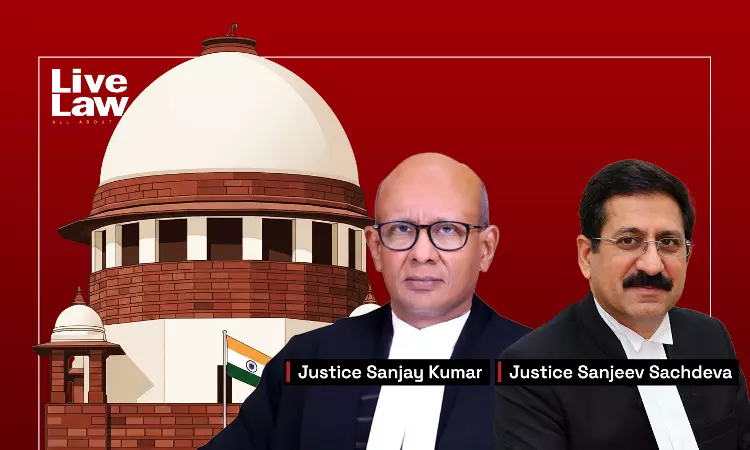
The Supreme Court has observed that a third-party purchaser of a company's asset relying on a Company's Board Resolution meeting to undertake the purchase is protected under the Transfer of Property Act, and the sale cannot be invalidated merely because there's an internal dispute regarding the authority to execute the sale deed. According to the Court, the unrelated third party cannot be expected to verify the internal affairs of the company, particularly whether the Board meeting authorising the transaction was validly convened.
A bench of Justice Sanjay Kumar and Justice Sanjeev Sachdeva set aside the concurrent findings of NCLAT and NCLT, which had ruled against the unrelated third party, i.e., the Appellant-M/s Elaine Info Solutions Pvt. Ltd., on the pretext that the Appellant was not able to establish that another Director of the Respondent company participated in the board meeting, in which the resolution to sell the company's asset was passed.


Noting that the Appellant is an unrelated third party to the Respondent's internal affairs and cannot be expected to know about the company's meeting and passing of the resolution, hence, a sale deed executed pursuant to the Respondent's board resolution cannot be cancelled merely because the Appellant failed to prove the participation of another director in the meeting.
“The Doctrine of Indoor Management would clearly come to apply in the present case. Both NCLT and NCLAT have primarily acted by holding that the resolution of the Board of Directors had not been passed and the sale deed executed based thereon was invalid. Appellant, being an unrelated third-party would have no knowledge of the indoor affairs of the Company… It may be noted that the Appellant is a third-party to the affairs of the Company. The Board Resolution dated 01.08.2015 is alleged to have been passed in a meeting held on the same date 01.08.2015. Though the sale deed dated 04.09.2015 refers to a resolution of the Board Meeting dated 01.08.2015, Appellant cannot be attributed to have any knowledge of the same as the holding of the meeting and passing of the said resolution would be within the personal knowledge of the Directors/shareholders of the Company.”, the Court observed.
The case arose from a dispute within Respondent company-M/s J & A Avenues India Private Limited, whose shares were equally held by a mother and her son, both of whom were also directors. The mother had approached the NCLT under Section 241 of the Companies Act, 2013, alleging that her son had transferred 9 acres and 28 guntas of the company's land to the Appellant, Elaine Info Solutions Pvt. Ltd. without her knowledge or consent.
The sale deed referred to a Board Resolution that allegedly authorised the son to execute the transaction. The mother denied receiving notice of or participating in the meeting.
The NCLT declared the resolution and sale deed null and void, holding that the purchaser had failed to establish that the mother had participated in the Board meeting. The NCLAT upheld the decision.
Aggrieved, the Appellant company moved to the Supreme Court.
Setting aside the impugned findings, the judgment authored by Justice Sachdeva held that the purchaser, being an unrelated third party, could not be expected to have knowledge of the company's internal proceedings. The Doctrine of Indoor Management, therefore, applied to protect the purchaser from internal irregularities that it had no means of knowing.
"The only two shareholders of the Company are the mother and the son. Appellant, being an unrelated third party would have no knowledge of the meeting, therefore, the finding of the NCLT that Appellant has failed to prove that mother had notice or participated in any alleged meeting is erroneous for the reason that it was for the shareholders and the directors of the Company to prove the said meeting. Appellant being an unrelated third party, cannot be made liable for proving the holding of the meeting and passing of a resolution in the said meeting. A third-party purchaser can only act bona fidely when one of the two directors, being a 50% shareholder produces a resolution of the Board of Directors.", the Court said.
“Admittedly the sale consideration had been received by the Company and duly reflected in the books of accounts of the Company which were duly audited. The audited accounts were signed by both the mother and the son. In the notes attached to the accounts, there is a clear mention of the sale of the subject land…We may also note that copy of the resolution of the Board of Directors referred to in the Sale Deed contains the signature of the mother attesting the same as true copy.”, the Court added, to point out that the mother, being the other director, was aware of the sale deed and consideration received thereafter.
As a result, the appeal was allowed.
Appearance:
For Appellant(s) Mr. Niranjan Reddy, Sr. Adv. Mr. Sridhar Potaraju, Sr. Adv. Mr. Swapnil Gupta, Adv. Mr. Ujjal Banerjee, AOR Ms. Shivambika Sinha, Adv. Ms. Nimita Kaul, Adv. Mr. Tarun Mishra, Adv. Mr. Harshit Gupta, Adv. Mr. Vaibhav Mendiratta, Adv. Mr. Anmol Sehgal, Adv. Mr. Shreekant Ramteke, Adv. Mr. Deeptam Bhadauria, Adv. Mr. Vansh Verma, Adv. Mr. Nikhil R.t., Adv. Mr. Abhisurt Singh, Adv. Mr. Byrapaneni Suyodhan, Adv. Ms. Tatini Basu, AOR Ms. Obulapuram Keerthi, Adv. Mr. Kumar Shashank, Adv. Ms. Chamundeswari Pemmasaini, Adv. Ms. Jaslene Ahluwalia, Adv.
For Respondent(s) Dr. Devashish Bharuka, Sr. Adv. Ms. Advika Devanshi, Adv. Dr. Priyanka, Adv. Mr. Kumar Mihir, AOR Mr. Deeptakirti Verma, AOR Mr. Vipin Nair, AOR Mr. Byrapaneni Suyodhan, Adv. Ms. Tatini Basu, AOR Ms. Obulapuram Keerthi, Adv. Mr. Kumar Shashank, Adv. Mr. Ujjal Banerjee, AOR