



- Home
- /
- Supreme court
- /
- Supreme Court Bats For Including...
Supreme Court Bats For Including Disability Rights In Corporate Social Responsibility
Gursimran Kaur Bakshi
15 Jan 2026 9:59 AM IST
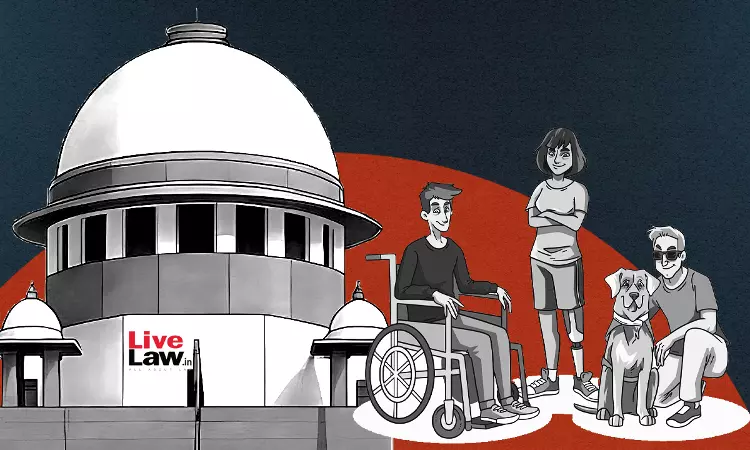
"True equality at the workplace can be achieved only with the right impetus given to disability rights as a facet of Corporate Social Responsibility"
The Supreme Court has said that the rights of persons with disabilities have to be viewed through the prism of Corporate Social Responsibility (CSR) to protect the human rights of individuals belonging to such groups. It is through this that true equality at the workplace can be achieved. These observations were made by a bench comprising Justice JB Pardiwala and Justice KV Viswanathan...
This is a premium content
Available exclusively to
Our subscribers
Subscribe Premium 
INR 1099+GST
Your support helps us to bring you more content at
an affordable subscription scheme !!!
All payment options available
The Supreme Court has said that the rights of persons with disabilities have to be viewed through the prism of Corporate Social Responsibility (CSR) to protect the human rights of individuals belonging to such groups. It is through this that true equality at the workplace can be achieved.
These observations were made by a bench comprising Justice JB Pardiwala and Justice KV Viswanathan while hearing the case of an appellant who was denied the right to employment by Coal India Limited (CIL) just because she suffered from multiple disabilities.
While directing that the CIL must create a supernumerary post for her, the bench emphasised the importance of reading CSR with the Rights of Persons with Disabilities Act, 2016, to further the rights of persons with disabilities. It relied on the UN Guiding Principles on Business and Human Rights, as endorsed by the United Nations Human Rights Council in 2011, on the aspect of corporate responsibility to respect human rights.
As per this, the business enterprises have a responsibility to respect human rights, especially those belonging to specific groups of the population that require particular attention. These include the rights of indigenous people, women, children, persons with disabilities, migrant workers, etc.
It also cited the working paper 'Disability and CSR Reporting: An analysis comparing reporting practices of 40 selected multinational enterprises,' produced by the International Labour Organisation Global Business and Disability Network. As per this, the rights of persons with disabilities are human rights, and enterprises have an obligation not just to respect but also to avoid infringement.
Considering all this, the bench observed: "Thus, it is abundantly clear that rights of persons with disabilities have to be viewed from the prism of Corporate Social Responsibility in order to protect and further such rights. True equality at the workplace can be achieved only with the right impetus given to disability rights as a facet of Corporate Social Responsibility."
As per the brief facts, the appellant applied for the post of Management Trainee in Personnel and HR Discipline as a reserved candidate in the Visually Handicapped category.
When she had qualified for the interview, she was called for the document verification and initial medical examination. However, during the medical examination, it was found that the appellant not only suffered from visual disability but also suffered from 60% low vision in both eyes and Residual Partial Hemiparesis. She filed a writ petition before the Calcutta High Court.
The single judge quashed the medical examination result and held that the public sector corporation could not have refused the appointment. However, since the appellant had approached the High Court after completion of the recruitment process, the single judge allowed her to participate in the 2023 recruitment process from the stage of medical examination. By an interim order, one post was ordered to be kept vacant in the cadre for her.
However, Coal India Limited filed an appeal, and the division bench set aside the order. It said that the writ petition was filed after the recruitment process, and it was untenable to direct the authorities to consider her in the same or next recruitment process.
The appellant filed a civil appeal before the Supreme Court. During the hearing here, the Respondent contended that the Appellant suffered from 30% disability and therefore does not fall within the ambit of "persons with benchmark disability" to claim the reservation under Section 34 of the RPwD Act.
The Supreme Court directed the Director of All India Institute of Medical Sciences (AIIMS), New Delhi, to constitute a Board, which included Dr Satendra Singh as one of the members, to assess whether she qualified the benchmark disability mark and whether she suffered from multiple disabilities.
On January 1, the AIIMS report was submitted before the Court, according to which the appellant suffers from 57% of disability, which is above the benchmark disability of 40%.
Headnote
Rights of Persons with Disabilities Act, 2016 – Section 2(y) and Section 2(s) – Concept of Reasonable Accommodation – Intersectionality of Disability and Gender – The Supreme Court set aside the Division Bench order of the Calcutta High Court which had denied employment to a female candidate with 57% disability (visual impairment and partial hemiparesis) on the technical grounds of the recruitment panel having expired - held that "reasonable accommodation" is a fundamental "gateway right" rooted in Articles 14, 21, and 41 of the Constitution, essential for substantive equality - Technicalities such as the expiry of a recruitment panel cannot obstruct "complete justice" when the denial of employment was due to the employer's failure to recognize multiple disabilities and provide necessary adjustments.
Constitutional Law – Articles 14, 21, and 41 – Directive Principles of State Policy – Article 142 of the Constitution – Supreme Court noted that Fundamental Rights (Part III) and Directive Principles (Part IV) are "two wheels of a chariot," where the principles of Article 39(a) (right to livelihood) and Article 41 (right to work in cases of disablement) must guide the interpretation of fundamental rights - The right to work is recognized as a precious liberty that enables a person to live with dignity beyond "mere animal existence." – Exercising its power to do complete justice, directed the creation of a supernumerary post for the appellant at North Eastern Coalfields CIL - The employer was directed to provide "reasonable accommodation" in the form of a suitable desk job with a computer and keyboard designed as per "universal design" under Section 2(ze) of the RPwD Act. [Relied on Omkar Ramchandra Gond v. Union of India; 2024 INSC 775; Anmol v. Union of India 2025 SCC OnLine SC 387; Om Rathod v. Director General of Health Services 2024 SCC OnLine SC 3130; Rajive Raturi v. Union of India 2024 16 SCC 654; Paras 13- 24]
Intersectionality and Gender Justice – Supreme Court highlighted that disability based discrimination is often intersectional, particularly for women, who face multiple axes of discrimination. Redressal of disadvantage must account for these intersecting identity markers to ensure substantive equality is not rendered unworkable by a "parochial understanding of discrimination." - Disability inclusion is a vital component of the "Social" dimension in the Environmental, Social, and Governance (ESG) framework - Enterprises have an obligation to view disability rights from a non-discrimination angle and as a strategic advantage rather than just a compliance issue.
Case Details: SUJATA BORA Vs COAL INDIA LIMITED|C.A. No. 120/2026
Citation : 2026 LiveLaw (SC) 46
Tags
Gursimran Kaur Bakshi
Gursimran is the Principal Correspondent with LiveLaw for the Supreme Court. She can be reached out at: simrankaurbakshi@livelaw.in

