



- Home
- /
- Supreme court
- /
- Supreme Court Acquits 3 Men In 1979...
Supreme Court Acquits 3 Men In 1979 Murder Case, Cites Glaring Infirmities In Prosecution
Yash Mittal
15 July 2026 9:10 PM IST
Two other accused died during the pendency of the appeal in the SC, and another accused died while the appeal was pending in the High Court.
The Supreme Court on Tuesday acquitted three men convicted in a 1977 murder case from Uttar Pradesh, holding that the prosecution failed to establish their guilt beyond reasonable doubt. The Court found serious infirmities in the prosecution case, including unexplained delays in forwarding the FIR to the Magistrate, inconsistencies regarding the registration of the FIR, and circumstances...
This is a premium content
Available exclusively to
Our subscribers
Subscribe Premium 
INR 1099+GST
Your support helps us to bring you more content at
an affordable subscription scheme !!!
All payment options available
The Supreme Court on Tuesday acquitted three men convicted in a 1977 murder case from Uttar Pradesh, holding that the prosecution failed to establish their guilt beyond reasonable doubt. The Court found serious infirmities in the prosecution case, including unexplained delays in forwarding the FIR to the Magistrate, inconsistencies regarding the registration of the FIR, and circumstances casting doubt on the presence of the alleged eyewitnesses.
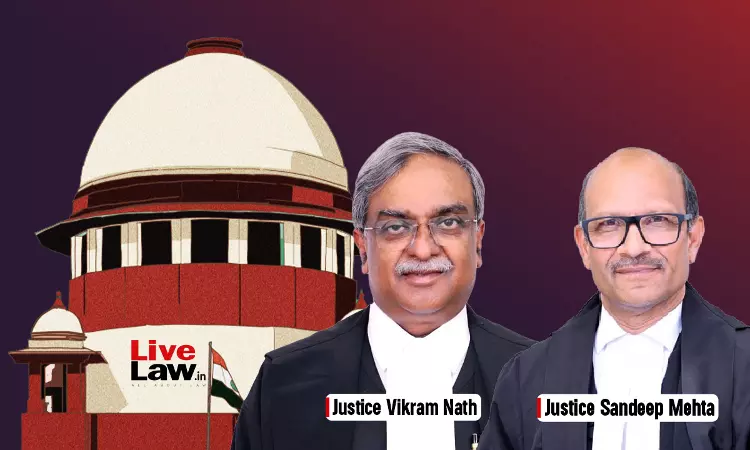
A Bench of Justice Vikram Nath and Justice Sandeep Mehta allowed the appeals filed by Subedar, Hira Lal and Raj Bux, setting aside the judgments of the trial court and the Allahabad High Court which had convicted them under Sections 148 and 302 read with Section 149 of the IPC. The appeals against two other accused had earlier abated owing to their deaths. One accused had died during the pendency of the appeal before the High Court.
The case arose from the murder of Harihar Saran in Gonda district on June 28, 1977. According to the prosecution, the deceased was attacked by six accused armed with spears, lathis and other weapons while returning from a cattle fair. The trial court convicted the accused in 1981 and the High Court affirmed the conviction in 2011.
However, the Supreme Court found multiple circumstances that undermined the prosecution version.
The Court noted that although the FIR was allegedly lodged at 7.10 p.m. on the day of the incident, the deceased's body remained at the scene throughout the night without being secured either by the police or the family. It also found no satisfactory explanation for the post-mortem being conducted only on June 30, nearly two days after the alleged occurrence.
The Bench further observed that the prosecution witnesses gave contradictory accounts regarding who accompanied the complainant to the police station to lodge the FIR. While the complainant claimed only one witness had accompanied him, the General Diary recorded the presence of two other relatives. According to the Court, this inconsistency struck "at the very genesis of the prosecution case."
FIR delay
Another significant circumstance was the delay in the FIR reaching the jurisdictional Magistrate. Though purportedly registered on June 28, the FIR reached the Magistrate only on June 30. The Court held that while delay alone is not fatal, it assumes importance where surrounding circumstances suggest the possibility of ante-timing or manipulation of the prosecution version.
“Mere delay in forwarding the FIR to the Magistrate cannot, by itself, be treated as fatal to the prosecution case... However, where allegations of ante-timing, ante-dating and fabrication are not merely speculative but find substantive support from attendant circumstances appearing on the record, and are coupled with surrounding facts generating genuine suspicion regarding the fairness and integrity of the investigation, such delay acquires considerable significance.", observed a bench of Justice Vikram Nath and Justice Sandeep Mehta, while setting aside the Allahabad High Court's Lucknow bench judgment of conviction.
The Court questioned the genuineness and credibility of the prosecution's case upon noting that “FIR was ante-timed and the prosecution story was subsequently tailored to create the presence of the alleged eye-witnesses at the crime scene.”
“…we find that the delayed transmission of the FIR to the Magistrate does not stand in isolation. It is accompanied by a series of highly unusual circumstances, namely, the admitted fact that the dead body of the deceased-victim remained lying at the place of occurrence throughout the intervening night without any effort either by the family members or the police authorities to preserve its sanctity; the inquest proceedings being postponed to the next day; the post-mortem examination being conducted after a delay of about 48 hours without any plausible cause; contradictions regarding the persons who accompanied the complainant (PW-1) to the police station; and the absence of any satisfactory explanation for these lapses.”, the Court noted.
The case arose from the alleged murder of a deceased man on June 28, 1977, near Kanchanpur village in Uttar Pradesh's Gonda district.
The court questioned how it would be possible that the body remained unattended for several hours despite being near the police station. The Court described this circumstance as "striking and glaring," observing that neither the investigating agency nor the victim's family made any effort to secure or preserve the body after the alleged registration of the FIR.
“…there is no discernible justification, as to why almost two days elapsed and why the Investigating Officer took nearly 48 hours to get the post-mortem examination conducted on the dead body, despite the incident having allegedly been reported on 28th June, 1977 itself. No plausible explanation for such inordinate delay has been forthcoming from the prosecution. This circumstance, when considered alongside the unusual manner in which the dead body was left unattended throughout the night, lends considerable support to the defence plea that the prosecution version regarding the time of occurrence is not free from doubt.”, the Court observed.
The Court said that although delayed FIR registration is not always fatal to the prosecution's case, however it assumes significance when there exists some unusual circumstances.
Applying the law, the Court observed:
“Viewed cumulatively, these circumstances are not mere procedural irregularities but constitute serious infirmities affecting the very genesis and credibility of the prosecution case. They create a substantial dent in the prosecution version and render the defence plea not only plausible but reasonably probable.”
The court further held that if the eyewitnesses had genuinely seen the murder and the police had been informed within hours, there was no conceivable reason for the victim's body to remain abandoned at the scene overnight.
The Court concluded that the conduct attributed to the eyewitnesses, villagers, family members and investigating officials was wholly inconsistent with normal human behaviour and accepted investigative practice.
The Court also rejected the prosecution's reliance on the alleged recovery of two bicycles from the scene, observing that no reliable evidence established their ownership or connected them to any particular accused.
"The theory of such recovery is, in our view, wholly flimsy," the Court said, noting that the prosecution failed to prove which of the six accused, if any, owned or possessed the bicycles.
Holding that the prosecution had failed to prove beyond reasonable doubt that the incident occurred in the manner alleged, the Bench concluded that the presence of the eyewitnesses at the scene had become "not merely doubtful but highly improbable."
"Once a reasonable doubt arises regarding the presence of the alleged eye-witnesses and the truthfulness of the prosecution version regarding the genesis and timing of the occurrence, the very substratum of the prosecution case stands eroded," the Court observed.
Accordingly, the Court acquitted the surviving appellants of all charges. Since the acquittal was based on the prosecution's failure to prove its case beyond reasonable doubt, the Bench found it unnecessary to examine the plea of juvenility raised on behalf of one of the appellants
Appearances :
For the Appellants: Mr. Jabar Singh, Advocate; Mr. Parmod Kumar, Advocate; Mr. Shubham, Advocate; M/s V. Maheshwari & Co., AOR; Ms. Sharmila Upadhyay, AOR; Mr. M.C. Dhingra, Senior Advocate; Mr. Gaurav Dhingra, AOR; Mr. Shashank Singh, Advocate; and Mr. Randhir Kumar Ojha, AOR.
Adv Namit Saxena for the State of UP
Headnote
Indian Penal Code, 1860 - Sections 147, 148, 149 and 302 – Murder – Delay in forwarding FIR to Magistrate – Ante-timed FIR – Post-investigation document - The Supreme Court set aside the concurrent findings of conviction passed by the Trial Court and the High Court, extending the benefit of doubt to the surviving accused appellants - The prosecution failed to establish the time and manner of the occurrence beyond a reasonable doubt - Key Legal Principles Highlighted – i. Delay in Forwarding FIR to the Magistrate - Effect of Unexplained Delay - While a mere delay in transmitting the FIR to the jurisdictional Magistrate under Section 157 CrPC is not automatically fatal in isolation, it assumes immense significance when there are serious allegations of ante-timing, ante-dating, and manipulation - Cumulative Assessment - Where such delay is accompanied by other grave investigative lapses and suspicious attendant circumstances, it ceases to be a mere procedural irregularity - The delay must be assessed cumulatively to test the authenticity and spontaneity of the prosecution's narrative; ii. Investigative Lapses and Unnatural Conduct - Failure to Secure Dead Body - The dead body of the deceased remained lying abandoned at the place of occurrence throughout the intervening night despite the police station being merely miles away and the police having arrived at the spot on the night of the incident - Such inaction, alongside the total lack of interest by family members to guard the body, is entirely inconsistent with ordinary human behavior and standard police procedure - Delayed Inquest and Post Mortem: Inquest proceedings were postponed to the next morning, and the post mortem examination was delayed by nearly 48 hours without any plausible justification - Contradictions in Police Records: The complainant (PW-1) explicitly denied that certain relatives accompanied him to the police station - the contemporaneous General Diary entry recorded their arrival, striking at the very genesis of the prosecution case. [Relied on Pala Singh v. State of Punjab (1972) 2 SCC 640; Jafarudheen v. State of Kerala (2022) 8 SCC 440; Paras 44-64]
Cause title: Deo Prasad and Another v. State of Uttar Pradesh
Citation : 2026 LiveLaw (SC) 680
Tags

Yash Mittal
Yash Mittal is a Correspondent with LiveLaw, covering the Supreme Court of India

