



Supreme Court Flags AI-Generated Fake Judgments In Compilation Filed By Party
LIVELAW NEWS NETWORK
15 Oct 2026 9:38 PM IST
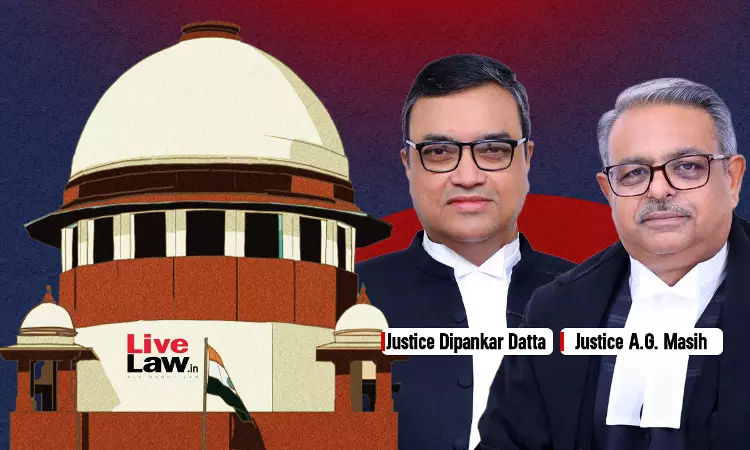
The Supreme Court has flagged an “undesirable incident” involving the alleged use of AI-generated, non-existent judgments in a compilation of cases submitted on behalf of the appellants, expressing concern over the conduct of the lawyers involved in the matter.
A Bench of Justice Dipankar Datta and Justice Augustine George Masih, while dismissing appeals filed by GSTAAD Hotels Pvt. Ltd. and Neo Capricorn Plaza Pvt. Ltd. against the initiation of insolvency proceedings against them, recorded that the respondents had immediately objected to the compilation, alleging that it contained judgments that did not exist.
“When queried by the Court, the Advocate-on-Record for the appellants sought to shift the entire blame on the appellants while at the same time feigning ignorance of what the compilation contained,” the Court observed.
The judgment further recorded that senior counsel appearing for the appellants subsequently took responsibility for the incident and sought forgiveness on behalf of the appellants. The Court had initially considered imposing exemplary costs but, after being informed of the death of the first appellant, deleted the proposed costs and directed that there would be no order as to costs.


The Court made these observations while deciding appeals filed by the companies challenging the National Company Law Appellate Tribunal's decision upholding the admission of insolvency petitions under Section 7 of the Insolvency and Bankruptcy Code, 2016 (IBC).
Disputes Over Quantum Of Debt Do Not Prevent Insolvency Admission: Supreme Court
On the merits, the Supreme Court held that at the admission stage of an insolvency petition, a financial creditor is required to establish the occurrence of default through a summary assessment of documentary evidence and need not prove the exact outstanding liability after an exhaustive reconciliation of the corporate debtor's accounts.
“The trigger for initiation of the CIRP is the occurrence of a default, not the final adjudication of the creditor's entire claim,” the Court said.
The Bench clarified that disputes over the precise amount of outstanding debt, including the computation of interest, penal charges or other accounting entries, do not negate an established default or prevent admission of a Section 7 application, provided the statutory threshold under Section 4 of the IBC is satisfied.
“The standard applicable at the admission stage is one of preponderance of probabilities upon the documentary material placed on record,” the Court observed, adding that the threshold was deliberately modest and required a summary, prima facie finding of financial debt and default rather than a full trial into disputed facts.
The Court explained that the IBC envisages a two-stage process: a summary determination of default at the threshold, followed by detailed verification and quantification of claims during the corporate insolvency resolution process (CIRP).
Requiring the adjudicating authority to conclusively determine the precise outstanding liability at the admission stage would render the functions entrusted to the Resolution Professional under Section 18 of the Code and the IBBI (CIRP) Regulations otiose, it said.
The Court also laid down a hierarchy of documentary evidence for establishing default under Section 7. An authenticated record of default issued by an Information Utility carries a presumption of high evidentiary value and can, by itself, prima facie establish default unless displaced by clear, cogent, credible and compelling material. Other documents, including loan agreements, account statements and acknowledgements of liability, must be assessed collectively.
Background
The appeals arose from insolvency proceedings initiated against GSTAAD Hotels Pvt. Ltd., which operates a JW Marriott hotel in Bengaluru, and Neo Capricorn Plaza Pvt. Ltd., which operates a Crowne Plaza hotel in Pune.
The companies had jointly obtained loan facilities worth ₹600 crore from Piramal Finance Ltd. in December 2017 and subsequently availed additional facilities under the Government's Emergency Credit Line Guarantee Scheme. The loan facilities were later assigned to Omkara Assets Reconstruction Pvt. Ltd.
After alleging defaults in repayment, Omkara approached the National Company Law Tribunal (NCLT) in March 2023, seeking initiation of insolvency proceedings against the two companies.
The companies challenged the proceedings, arguing, among other things, that arrangements for managing hotel revenues and funds earmarked for debt servicing had not been properly considered and that the outstanding dues had been incorrectly calculated. They also relied on the profitability of their businesses.
The NCLT admitted the insolvency petitions, and the NCLAT upheld the decision. Dismissing the appeals, the Supreme Court affirmed the orders and directed that the corporate insolvency resolution process against both companies proceed in accordance with law.
Related - Supreme Court Sets Aside ₹425-Crore Penalty As Customs Authority Used AI-Generated Fake Case Laws
For Appellants:
Mr. C. Aryama Sundaram, Senior Advocate; Mr. Arunabh Chaudhary, Senior Advocate; Mr. Farrukh Rasheed, AOR; Mr. Khalid Israr, Mr. Zahid Hussain, Mr. Mohd. Zahid Hussain, Ms. Harshita Singhal and Mr. Shakil Ahmed, Advocates.
For Respondents:
Mr. Abhishek Anand, Advocate; Mr. Mandeep Kalra, AOR; Ms. Chitrangada Singh, Mr. Yashas J, Mr. Vaibhav Yadav, Mr. Paras Mohan Sharma, Mr. Karan Kohli, Mr. Palak Kalra, Ms. Ridhima Mehrotra, Ms. Vanshika Dhoot, Ms. Ira S. Mahajan, Mr. Varad Kohle, Mr. Saumitr Kumar, Ms. Radhika Narula and Ms. Anushna Satapathy, Advocates; Ms. Kanika Singhal, AOR.


