



- Home
- /
- Supreme court
- /
- Supreme Court Flags Stray Cattle...
Supreme Court Flags Stray Cattle Menace On Roads, Says States Must Compensate Victims
LIVELAW NEWS NETWORK
31 July 2026 4:02 PM IST
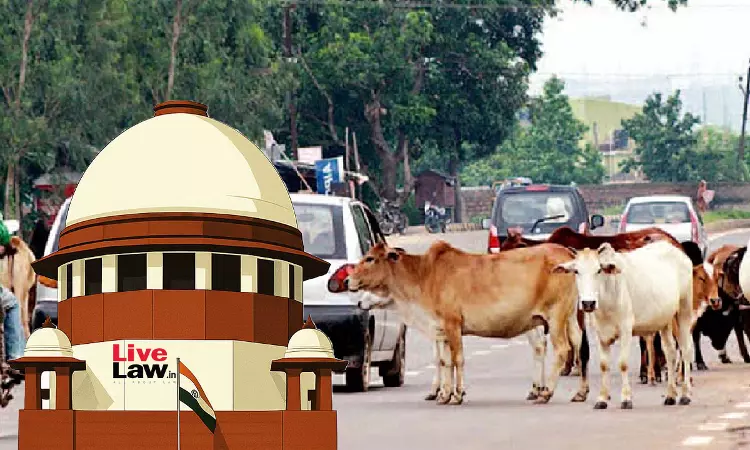
The Court also suggested a slew of other measures, such as the tagging of animals and creation of shelters.
The Supreme Court on Friday expressed serious concern over the growing number of road accidents involving stray cattle and urged the Centre and State Governments to strengthen enforcement of existing laws while introducing a comprehensive mechanism to prevent such incidents and compensate victims.Observing that bovine-related accidents are "not few and far between", the Court said stray...
This is a premium content
Available exclusively to
Our subscribers
Subscribe Premium 
INR 1099+GST
Your support helps us to bring you more content at
an affordable subscription scheme !!!
All payment options available
The Supreme Court on Friday expressed serious concern over the growing number of road accidents involving stray cattle and urged the Centre and State Governments to strengthen enforcement of existing laws while introducing a comprehensive mechanism to prevent such incidents and compensate victims.
Observing that bovine-related accidents are "not few and far between", the Court said stray cattle wandering on roads and highways pose a serious threat to both human and animal life.
"They are not meant to be natural speed breakers, placed willy-nilly on the National Highways, roads and streets," a Bench of Justice Sanjay Karol and Justice N Kotiswar Singh remarked while deciding an appeal arising from the death of a man who was attacked by a stray bull in Punjab.
The Court noted that such incidents are commonplace across the country and referred to official statistics showing over 1,300 deaths annually in recent years due to animal attacks. It said the issue warrants a coordinated policy response from governments rather than being viewed as isolated incidents.
The Bench extensively examined the constitutional and statutory framework relating to animal welfare, including Article 48, Article 51A(g), the Prevention of Cruelty to Animals Act, 1960, the Cattle Trespass Act, 1871 and various State laws governing cattle preservation, gaushalas and animal shelters. It observed that although several States have enacted legislation to regulate stray cattle and establish shelters, effective implementation remains a challenge.
The Court identified the abandonment of cattle after they cease to be economically useful as one of the principal causes of the growing stray cattle menace. It observed that animals reared for a particular purpose are often let loose once their productivity declines, eventually ending up on roads and highways. While acknowledging that many farmers and dairy owners struggle to feed all their animals, the Bench said those who choose to rear animals have a responsibility to care for them throughout their lives and ensure that abandoned or infirm cattle are transferred to authorised shelters instead of being left to roam freely. The Court remarked that in a "deeply flawed, human world", animals are abandoned after their utility diminishes, even as society simultaneously finds it offensive when they are used for food, describing this contradiction as one that has contributed to the present problem.
To address the issue, the Court suggested a series of measures for consideration by the Centre and States.
Suggestions made by the Court
1 All States that have enacted their own laws pertaining to cattle should take steps to ensure complete and immediate implementation thereof in letter and spirit;
2 Necessary amendments may be carried out or rules promulgated, as is deemed fit by the competent authority, to develop a mechanism for payment of compensation in accidents caused as a result of bovine/cattle, in both categories of cases i.e., pedestrian or vehicular;
3 Tagging of all animals be mandated. This furthers the ability to keep track of them, ensuring their long-term health service, linking to veterinary check-ups and vaccinations;
4 The reality of animals being let go after they cease to serve a useful, economic purpose cannot be denied. The owners choosing to make such a decision should be held responsible and ensure safe transfer of such animals to the shelters run by the appropriate authority. The authorities at such shelters should issue a receipt acknowledging such transfer and cause the details of such animal to be entered/altered in the database of tagging;
5 In order to ensure that the tagging, digitisation of records and smooth running of these shelters is duly undertaken, the authorities may depute a particular officer in every Corporation/Department who shall be the nodal officer for such purpose.
The Bench directed that a copy of the judgment be forwarded to the Chief Secretaries of all States, Administrators of Union Territories and Member Secretaries of the State Legal Services Authorities for appropriate action on its recommendations
The observations came while allowing an appeal filed by Nisha, whose husband Vijay Kumar suffered fatal injuries after being attacked by a stray bull in Sangrur, Punjab, in 2007. The Punjab and Haryana High Court had set aside an earlier order granting compensation on the ground that the claim involved disputed questions of fact and should be pursued before a civil court.
Reversing that decision, the Supreme Court held that after nearly two decades, relegating the family to a civil suit would leave them "remediless". It noted that the occurrence of the incident had never been disputed by the authorities and awarded the appellant a lump sum compensation of ₹15 lakh, directing payment within four weeks. The Court clarified that the compensation was granted in the peculiar facts of the case and would not constitute a precedent.
Headnote
Constitution of India — Article 226 — Maintainability of Writ Petition — Disputed Questions of Fact — Efflux of Time & Remediless Claimants - Where a writ petition challenging non-payment of compensation for injuries/death caused by stray cattle was filed in 2010 and remitted after 15 years, the High Court's Division Bench erred in setting aside the Single Judge's award solely on the ground of “disputed questions of fact” and relegating the claimants to a Civil Court - The Supreme Court held that after such an extraordinary efflux of time, relegating the claimants to a civil suit would leave them completely remediless - On this short ground alone— i.e., the passage of time—the impugned High Court judgment warranted interference and adjudication on merits in the interest of justice.
Constitution of India — Articles 48 & 51-A(g) — Animal Welfare — Stray Cattle Menace & Compassion for Living Creatures - Directive Principles of State Policy (Article 48) impose a duty on the State to organize agriculture/animal husbandry and prevent cattle slaughter - Under Article 51-A(g), it is the fundamental duty of every citizen to have compassion for living creatures, which in its wider fold embraces cattle spoken of in Article 48 - Stray cattle roaming on public roads cause severe accidents leading to human casualties and unnecessary pain and suffering to animals. [Relied on State of Gujarat v. Mirzapur Moti Kureshi Kassab Jamat, (2005) 8 SCC 534; Animal Welfare Board of India v. Union of India, (2023) 9 SCC 322; Mohd. Hanif Quareshi v. State of Bihar, 1958 SCC OnLine SC 176; Paras 11-16]
Compensation — Stray Cattle Attack/Accidents — Quantum Determination & Pre 2020 Ambiguity - While the Motor Vehicles Act, 1988 principles cannot be applied as a universal rule in every non-vehicular stray animal accident case, claimants facing pre-2020 incidents (prior to quantified statutory schemes like the Punjab Bye-Laws, 2020/2023) are entitled to an equitable lump-sum compensation evaluated on the specific attending facts of the case - Considering the prolonged litigation and severe injuries sustained, the Supreme Court awarded a lump sum compensation of ₹15,000,000 (Rupees Fifteen Lakhs) to the appellant. [Para 21-25]
Directives / Guidelines Issued to Centre and States on Stray Bovines - Implementation of Laws - All States must strictly implement their respective cattle preservation, protection, and stray control statutes in letter and spirit - Compensation Mechanism - Centre and States/UTs are advised to frame rules or enact necessary amendments to establish a clear mechanism for awarding compensation in accidents caused by bovines/cattle (covering both pedestrian and vehicular accidents) - Mandatory Tagging: Tagging of all animals must be mandated with a 12-digit code to enable digital tracking, link to health/vaccination records, and identify owners who abandon them - Regulated Abandonment / Safe Transfer - Owners choosing to let go of cattle after their economic utility diminishes must ensure safe transfer to recognized shelters/gaushalas, accompanied by an official receipt and database updates - Nodal Officers - Corporations/Departments must depute dedicated Nodal Officers to oversee tagging, digitization of records, and smooth operation of animal shelters. [Paras 19 - 26]
Case : Nisha v. Municipal Council Sangrur
Citation : 2026 LiveLaw (SC) 746
Click here to read the judgment


