



- Home
- /
- Supreme court
- /
- Supreme Court Flags Systemic...
Supreme Court Flags Systemic Disparity In Evaluation Of Women Officers For Permanent Commission In Armed Forces; Grants Relief
Debby Jain
24 March 2026 1:31 PM IST
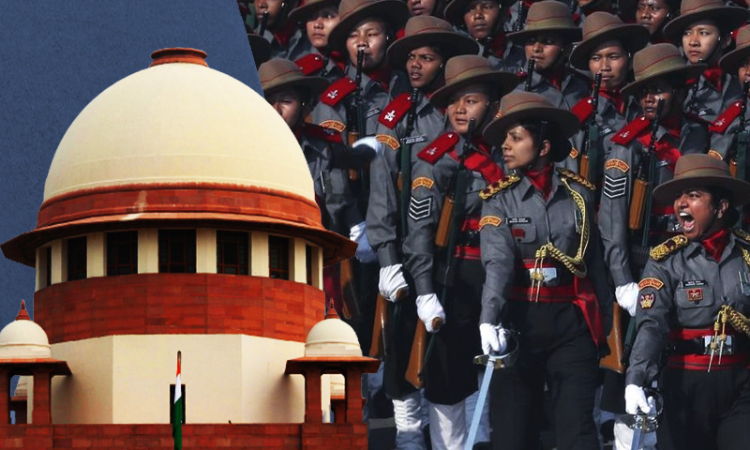
The Court noted that the evaluation systems were based on an assumption that women will have limited career progression.
The Supreme Court has flagged systemic disparity in the evaluation of women Short Service Commission Officers (SSCOs) across the Army, Navy, and Air Force, holding that institutional practices developed during periods of ineligibility for Permanent Commission (PC) distorted performance assessments and created structural disadvantages once women were later made eligible for long-term...
This is a premium content
Available exclusively to
Our subscribers
Subscribe Premium 
INR 1099+GST
Your support helps us to bring you more content at
an affordable subscription scheme !!!
All payment options available
The Supreme Court has flagged systemic disparity in the evaluation of women Short Service Commission Officers (SSCOs) across the Army, Navy, and Air Force, holding that institutional practices developed during periods of ineligibility for Permanent Commission (PC) distorted performance assessments and created structural disadvantages once women were later made eligible for long-term service.
A bench comprising Chief Justice of India Surya Kant, Justice Ujjal Bhuyan and Justice NK Singh, in three judgments, each addressing the cases of officers from Army, Navy and the Air Force, found that Annual Confidential Reports (ACRs) and selection processes in all three services were shaped by long-standing assumptions that women and certain categories of officers would not have sustained careers, resulting in uneven playing fields in comparative merit assessments.
Across all three services, the Court identified a common structural problem: evaluation systems developed in an institutional environment that assumed limited career prospects for women officers.
These assumptions influenced performance grading, training opportunities, and promotion pathways, producing systemic disparities that only became visible once women were later made eligible for Permanent Commission.
While the Court declined to order wholesale reinstatement or fresh reconsideration in every case, it granted tailored corrective relief, including pensionary benefits and directions for transparency in future selection processes.
The judgments followed the decisions in The Secretary, Ministry of Defence Versus Babita Puniya & Ors.(2020) and Lt Col Nitisha and othes v Union of India and others (2021) which opened the doors for women officers to seek permanent commisison in the forces.
Army: Casual Grading And Unequal Opportunity Structures Held To Create Structural Disadvantage
In the Army-related batch of cases, the Court held that women officers were evaluated within a service framework that historically denied them realistic prospects of Permanent Commission, leading to casual grading of performance records and limited access to career-enhancing opportunities.
The Court noted that ACRs carried decisive weight in determining suitability for Permanent Commission, and that years of grading practices normalized lower or average scores for women officers because there was little institutional incentive to assess long-term leadership potential.
It observed that the consequences of these practices became apparent when women officers were later made eligible for Permanent Commission and were evaluated alongside male officers whose records had been developed in a career-oriented environment.
The bench rejected the contention that anonymization of records at the selection stage cured the defect, emphasizing that the disadvantage originated at the stage of initial evaluation rather than during final decision-making.
Another significant finding concerned unequal access to appointments and training opportunities. The Court noted that women officers were often denied criteria appointments and professional courses that influenced merit rankings, particularly in close competitions where differences of fractions of a mark determined outcomes.
The Court concluded that such disparities constituted systemic inequality in the opportunity structure rather than isolated administrative errors.
While declining to invalidate the policy capping the number of Permanent Commission vacancies, the Court clarified that such ceilings cannot operate as absolute barriers to remedial action where evaluation processes are found to be unfair.
Navy: Non-Disclosure Of Selection Criteria Undermined Fairness
In the Navy-related appeals, the Court examined the legality of the selection process adopted for grant of Permanent Commission following earlier judicial directions extending eligibility to women officers.
The Court held that the failure to disclose evaluation criteria, vacancy computation methodology, and assessment parameters prior to the Selection Boards conducted in 2020 and 2022 violated fundamental norms of transparency and fairness.
It noted that officers were required to participate in the selection process without knowing the standards against which they would be assessed, leaving them unable to address adverse entries or challenge procedural defects in time.
The Court drew attention to the disparity between the Navy and other services, observing that while the Army and Air Force had promulgated detailed instructions governing selection processes, the Navy confined such material to internal approval mechanisms.
Apart from procedural opacity, the Court also found structural defects in the evaluation framework itself.
It held that ACRs prepared during periods when officers were ineligible for Permanent Commission were influenced by the assumption that such officers would not remain in service long term. Consequently, higher gradings were often reserved for officers perceived to have sustained career prospects.
When these officers were later considered for Permanent Commission pursuant to judicial intervention, the Court found that historical grading practices had effectively converted past ineligibility into perceived unsuitability for career progression.
Despite identifying procedural defects, the Court declined to direct yet another round of reconsideration, noting that the officers had already undergone multiple cycles of litigation and evaluation spanning several years.
The bench emphasized that continuing litigation would neither serve the interests of the officers nor the institution and opted to conclude the dispute through final corrective directions.
Air Force: Retrospective Use Of Performance Records Held Arbitrary
In the Air Force case, the Court addressed the denial of Permanent Commission to women officers commissioned in 2007, holding that the evaluation process was arbitrary because it relied on performance records prepared in a regime where such officers had no realistic expectation of long-term career progression.
The Court observed that performance assessments during this period were designed primarily to determine short-term service continuation rather than long-term leadership potential.
It held that using such records to determine eligibility for Permanent Commission at a later stage created a structural mismatch in evaluation:
An assessment undertaken to evaluate performance within a limited service horizon could not be treated as an assessment of suitability for permanent absorption.
The Court also found fault with the implementation of new eligibility criteria introduced under the 2019 policy.
It noted that the first Selection Board under the new framework was convened shortly after the policy's introduction, leaving officers with insufficient time to meet newly prescribed requirements relating to professional categorization and course qualifications.
This, the Court held, effectively deprived officers of a meaningful opportunity to satisfy eligibility conditions and undermined the fairness of the selection process.
While declining to order reinstatement or fresh consideration for Permanent Commission, the Court granted a one-time measure deeming affected officers to have completed 20 years of qualifying service, thereby entitling them to pension and consequential benefits.
The Court emphasized that fairness in service jurisprudence requires evaluation processes to reflect actual career prospects rather than historical limitations imposed by policy frameworks.
It observed that when officers are assessed in an environment where long-term progression is not contemplated, performance records inevitably reflect that assumption, making later comparisons with career-oriented records inherently inequitable.
The Court ultimately stressed the need to bring finality to prolonged litigation while ensuring systemic reform in future selection processes.
It noted that many officers had spent more than a decade in litigation seeking equitable consideration for Permanent Commission and that repeated reconsideration exercises could not remedy structural defects embedded in historical records.
Accordingly, the Court issued prospective directions requiring greater transparency in selection procedures, including disclosure of evaluation criteria and vacancy positions in advance of future Selection Boards.
Senior Advocate Rekha Palli, along with Advocates Punam Singh Bhavya Sharma, Vaidushya Parth, Niyati Razdan and Anish Venkatesh Bindlish appeared for appellants.
Headnote [Lt Col Pooja Pal v Union of India (Army)]
Constitution of India, 1950 – Article 142 – Gender Equality in Armed Forces – Grant of Permanent Commission (PC) to Short Service Commission Women Officers (SSCWOs) – Assessment of Merit – Casual Grading of ACRs – The Supreme Court held that the Annual Confidential Reports (ACRs) of women officers commissioned between 2010 and 2012 were authored under the systemic assumption that they were ineligible for career progression beyond 14 years - This institutional mindset resulted in "middling" or "average" grades being assigned to women while "outstanding" grades were reserved for male counterparts whose future depended on them - Supreme Court observed that such a structural disadvantage, embedded in years of service assessments, cannot be neutralized by mere procedural safeguards like anonymization of data at the final evaluation stage.
Service Law – Selection Criteria – Criteria Appointments and Career-Enhancing Courses – Supreme Court found that SSCWOs were systematically denied criteria appointments and access to important courses (e.g., Junior Command Course) due to their perceived lack of a "future" in the Army - While these may not have a high numerical weightage in computerized evaluation, they significantly influence the "Value Judgement" component (5 marks), which often becomes determinative when officers miss the cut-off by narrow margins.
Service Law – Vacancy Cap – Sanctity of 250-Vacancy Ceiling – Supreme Court rejected the Union's contention that the annual cap of 250 vacancies for PC is sacrosanct - Historical data revealed the cap was frequently breached for exigencies like the Kargil War or policy transitions - held that the vacancy cap cannot act as a shield against remedial action where the method of assessment is found to be unfair and discriminatory - Male officers cannot claim a legitimate expectation to compete only against other males for PC vacancies - Following the Delhi High Court's 2010 judgment in Babita Puniya, all parties were aware that women were entitled to PC consideration - Any expectation that runs contrary to the constitutional mandate of gender equality is inherently illegitimate. [Relied on Lt. Col. Nitisha v. Union of India (2021) 15 SCC 125; Paras 32-64]
Key Directions issued – i. Deemed Service for Pension: SSCWOs released from service during the pendency of litigation (excluding JAG and AEC cadres) are deemed to have completed 20 years of substantive qualifying service and are entitled to pension and consequential benefits; ii. Grant of PC: SSCWOs currently in service who secured the 60% cut-off in the 2020/2021 Selection Boards shall be granted Permanent Commission, subject to medical and disciplinary clearance; iii. Policy Review: The Army is directed to review the method of evaluation of ACRs and cut-offs for future batches to address the disproportionate impact on women officers. [Para 66, 67]
Case : Lt Col Pooja Pal v Union of India (Army)
Citation : 2026 LiveLaw (SC) 283
Click here to read the judgment
Case : Wg Cdr Sucheta EDN v Union of India and others (Air Force)
Headnote [Wg Cdr Sucheta EDN v Union of India and others (Air Force)]
Short Service Commission — Grant of Permanent Commission (PC) — Indian Air Force — Retrospective evaluation based on Annual Confidential Reports (ACRs) — Validity of Minimum Performance Criteria — Pregnancy and Medical Category - The Supreme Court has held that evaluating Short Service Commission Officers (SSCOs) for Permanent Commission based on ACRs authored during a period when they were ineligible for PC is inherently unfair and arbitrary - Supreme Court held that the evaluative lens applied by assessing officers is conditioned by the available career trajectory; thus, reports intended only to assess suitability for short-term extension cannot be retrospectively treated as reliable indicators for long-term retention or advanced leadership potential - While declining reinstatement for released officers due to operational effectiveness, Supreme Court directed that SSCOs considered in the 2019–2021 Boards be deemed to have completed 20 years of substantive qualifying service for pensionary benefits as a one-time measure - For future Boards, the Air Force must disclose vacancies and detailed evaluation criteria prior to the selection process.
Key Findings - i. Structural Distortion in Evaluation: ACRs authored in an environment where SSCOs had no future in the service are "structurally distorted" and cannot be deployed to their disadvantage when they are suddenly placed in a competitive fray for PC; ii. Arbitrary Implementation of Policy: The hurried implementation of Human Resource Policy (HRP) 01/2019, which introduced new criteria like "Categorisation" and "Mandatory In-Service Courses" (MISCs) without providing a reasonable gestation period, deprived officers of a meaningful opportunity to meet eligibility requirements; iii. Pregnancy and Gender Equality: The failure to accommodate officers who lost a round of consideration due to a temporary lowering of medical category on account of pregnancy amounts to arbitrariness - The choice to become a parent cannot be equated with an unwillingness to pursue professional advancement. [Relied on Yogendra Kumar Singh v. Union of India and Ors (Civil Appeal No. 14681/2024); AU Tayyaba v. Union of India (2023) 5 SCC 688; Lt. Col. Nitisha & Ors v. Union of India & Ors (2021) 15 SCC 125; Paras 14-17, 26-32, 35-39]
Citation : 2026 LiveLaw (SC) 284
Click here to read the judgment
Case : Yogendra Kumar Singh v Union of India (Navy)
Citation : 2026 LiveLaw (SC) 285
Click here to read the judgment
Headnote [Yogendra Kumar Singh v Union of India (Navy)]
Service Law – Indian Navy – Grant of Permanent Commission (PC) to Short Service Commission Officers (SSCOs) – Selection Process Fairness – Annual Confidential Reports (ACRs) – Appeal against Armed Forces Tribunal (AFT) order directing fresh Selection Boards for SSCOs who were denied PC in 2020 and 2022 – Appellants contended that ACRs were "casually graded" during periods when they were ineligible for PC, leading to an inherently skewed merit assessment - Held, the appraisal process was inevitably affected from its inception because Reporting Officers were conscious that these officers had no avenue for career progression – High gradings in a bell-curve system were reserved for those with future prospects, while ineligible officers received average marks serving no institutional purpose – The conversion of "Not Recommended for PC" endorsements (recorded when officers were ineligible as a matter of policy) into substantive disqualifications once they became eligible is arbitrary – This circularity, where past ineligibility was transformed into "deemed unsuitability," resulted in an uneven playing field. [Para 16-17]
Service Law – Vacancy Computation – Dynamic Vacancy Model – Validity of the methodology used in the December 2020 Selection Board – Held, the "Dynamic Vacancy Model" was a rational one-time mechanism to distribute vacancies across 24 batches while maintaining the Navy's pyramidal structure and operational agility – The use of '15' as a divisor is anchored in service realities, representing the approximate years of service accompanying a grant of PC – The methodology does not suffer from arbitrariness or discrimination - Held, unlike the Army and Air Force, the Navy's failure to disclose the evaluation framework and vacancy computation methodology prior to the 2020 and 2022 Boards violated basic norms of fairness and transparency. [Para 25, 38-48]
Relief – One-time Measure to Prevent Protracted Litigation – Supreme Court noted this was the third round of litigation and a fourth round (fresh Selection Board) would not yield equitable results due to inherently skewed ACRs – Supreme Court modified AFT directions to grant PC directly to specific categories: (a) SSCWOs inducted prior to January 2009; (b) SSCWOs inducted after January 2009 in branches other than Law, Education, and Naval Architecture; and (c) Male SSCOs barred by initial terms, subject to medical and disciplinary clearance – Released officers within these categories deemed to have completed 20 years of service for pensionary benefits. [Relied on Union of India v. Annie Nagaraja (2020) 13 SCC 1; Lt. Col. Nitisha & Ors v. Union of India (2021) 15 SCC 125; Amit Kumar Sharma v. Union of India (2023) 20 SCC 486; Shankarsan Dash v. Union of India (1991) 3 SCC 47; Para 54-56]
Tags

Debby Jain
Debby Jain is a Correspondent with LiveLaw, covering the Supreme Court of India

