



- Home
- /
- Supreme court
- /
- Supreme Court Lays Down Principles...
Supreme Court Lays Down Principles On Promissory Estoppel, Says It Can't Be Invoked For Benefits Never Intended
Yash Mittal
26 May 2026 11:20 AM IST
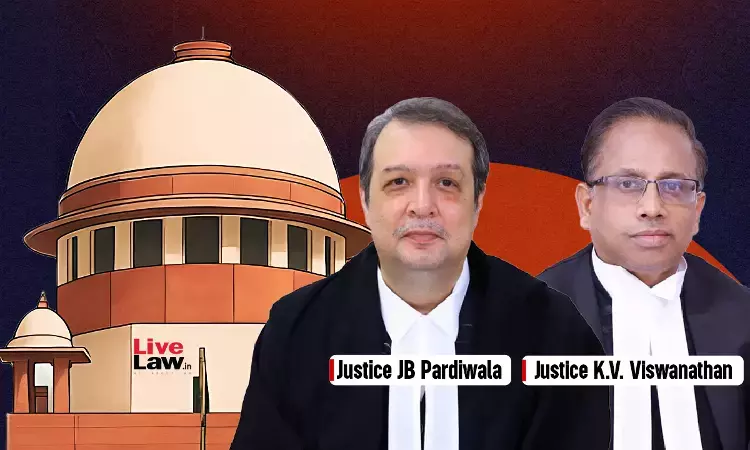
The Supreme Court on Monday (May 25) observed that the doctrine of promissory estoppel cannot be invoked to claim benefit under a government policy which was never aimed to benefit a specific class of industrial unit. A bench of Justice J.B. Pardiwala and Justice K.V. Viswanathan set aside the Himachal Pradesh High Court's judgment directing the State to extend concessional electricity...
This is a premium content
Available exclusively to
Our subscribers
Subscribe Premium 
INR 1099+GST
Your support helps us to bring you more content at
an affordable subscription scheme !!!
All payment options available
The Supreme Court on Monday (May 25) observed that the doctrine of promissory estoppel cannot be invoked to claim benefit under a government policy which was never aimed to benefit a specific class of industrial unit.
A bench of Justice J.B. Pardiwala and Justice K.V. Viswanathan set aside the Himachal Pradesh High Court's judgment directing the State to extend concessional electricity tariff benefits under the Industrial Policy, 2019 to the respondent-company, an existing manufacturer engaged in industrial metal processing and stamping, on the basis of substantial expansion undertaken by it.
The Court said that the High Court overlooked the fact that the policy was not aimed to cover the existing industrial units, but only to all new industrial enterprises. Hence, the benefit of doctrine of legitimate expectation cannot be claimed by the Respondent, which is an existing industrial unit, regardless of the fact that it had done substantial expansion based on the industrial policy but can't claim electricity at a concessional tariff rates under the State's industrial policy.
“The doctrine of promissory estoppel cannot be invoked to compel the State to grant a benefit which was never intended for the class of industry to which the respondent belonged. Once it is held that Clause 16(a) was never meant to extend the concessional tariff benefit to existing industrial enterprises undergoing substantial expansion, the very foundation of the respondent's plea substantially falls.”, the court observed.
The respondent-industry, established in 2005-06, had undertaken substantial expansion in 2020 by increasing its plant and machinery by 88.69% and generating additional employment. It argued that since Clause 16(a) of the policy originally used the expression “eligible enterprises”, the concessional tariff benefit was also available to existing industries undergoing substantial expansion.
However, the State contended that the use of the word “eligible” was merely a drafting error and that the policy always intended to differentiate between new industries and existing expanding industries.
Aggrieved by the High Court's decision to extend the policy benefit to the Respondent, the State appealed to the Supreme Court.
Allowing the appeal, the judgment authored by Justice Pardiwala noted that mere expansion done by the Respondent-unit under the guise of policy would be immaterial while invoking the doctrine of promissory estoppel, when the policy was never intended to cover the existing industrial units.
“Once it is held that Clause 16(a), properly construed, was never intended to extend the concessional tariff benefit to existing industrial enterprises undergoing substantial expansion, the respondent cannot invoke the equitable doctrine of promissory estoppel to create an entitlement contrary to the true scope and intent of the Policy itself.”, the court observed.
Moreover, the Court noted that when the Respondent having already availed the benefit under Clause 16(b) of the Policy, by taking the rebate incentive of 15% on the energy charges for additional power consumption, then conferring an additional benefit of concessional tariff would amount to double benefit to the Respondent.
“More importantly, when the respondent has already received the benefit legitimately attachable to its category under Clause 16(b), no enforceable equity survives in its favour. Any interpretation to the contrary would result in conferring a double benefit upon the same category of industries, contrary to the scheme of the Policy, public interest, and fiscal discipline governing industrial incentives.”, the court observed.
Principles governing the doctrine of promissory estoppel laid down
Also, taking guidance from its earlier decision in IFGL Refractories Ltd. v. Orissa State Financial Corporation, 2026 LiveLaw (SC) 18, the following principles governing the doctrine of promissory estoppel were laid down by the Court:-
(i) The doctrine of promissory estoppel is a principle evolved by equity to avoid injustice. It operates not in the realm of contract, nor within the technical confines of estoppel under the law of evidence, but upon the broader considerations of fairness, justice and good conscience;
(ii) Where one party, by words or conduct, makes to another a clear, unequivocal and unambiguous promise, intended to create legal relations or affect a legal relationship to arise in the future, knowing or intending that it would be acted upon, and it is in fact so acted upon, the promise becomes binding upon the promisor;
(iii) The doctrine of promissory estoppel is a doctrine whose foundation is that an unconscionable departure by one party from the subject matter of an assumption which may be of fact or law, present or future, and which has been adopted by the other party as the basis of some course of conduct, act or omission, should not be allowed to pass muster. And the relief to be given in cases involving the doctrine of promissory estoppels contains a degree of flexibility which would ultimately render justice to the aggrieved party;
(iv) The doctrine is not merely defensive in nature. Under Indian law, it may itself furnish a cause of action and can be affirmatively enforced where equity so requires;
(v) It is not necessary, in order to attract the doctrine, that the promisee should prove actual detriment. It is sufficient that the promisee has altered his position, acting in reliance upon the promise;
(vi) The alteration of position may consist in making substantial investments, incurring liabilities, establishing industrial infrastructure, entering into agreements, or otherwise rearranging one's affairs on the faith of the representation;
(vii) The doctrine applies with full force against the State, its departments, statutory corporations and instrumentalities, including authorities falling within Article 12 of the Constitution, which cannot arbitrarily resile from a solemn representation upon which another has acted;
(viii) Where the State or its instrumentalities frame industrial or fiscal incentive schemes with the avowed object of attracting investment and establishing industries, the representations contained therein are intended to induce entrepreneurs to act upon them, and such representations are enforceable. Once an entrepreneur, relying upon such representation, establishes an industrial unit, commences commercial production, or otherwise satisfies the eligibility conditions during the currency of the scheme, and the State agencies recognise them as being eligible, the promise crystallises, and an enforceable equity arises in its favour. Whether a benefit has accrued or not in such cases depends on the facts and circumstances of each case;
(ix) The grant of an exemption, concession or incentive under a statutory scheme is ordinarily defeasible, and the Government is competent to modify or revoke the same in exercise of the very power under which it was granted. Thus, what is granted can ordinarily be withdrawn. However, the Government may be precluded from doing so on the ground of promissory estoppel, which principle itself remains subject to considerations of equity and public interest.
(x) Where a specific sanction or approval of incentive, or eligibility certificate has been issued in favour of an individual enterprise, and the enterprise has acted thereon by making a substantial investment, the promisor is all the more firmly bound by its representation;
(xi) The doctrine rests upon the larger constitutional principle that State action must be fair, non-arbitrary, and consistent; governmental assurances are not empty declarations, but solemn representations on the faith of which citizens regulate their affairs; and
(xii) The ultimate object of the doctrine is to prevent manifest injustice and to ensure that a party, particularly the State, does not act inconsistently to the prejudice of one who has relied upon its promise and altered his position irretrievably.
In terms of the aforesaid, the appeal was allowed.
Headnote
Himachal Pradesh Industrial Policy, 2019; Clause 16(a) and Clause 16(b) — Rules regarding grant of incentives, concessions, facilities for investment promotion in Himachal Pradesh, 2019; Rule 16(i)(a) and Rule 16(i)(b) — Applicability of Concessional Electricity Rates to Existing Industries undergoing Substantial Expansion — Clarificatory Amendment Notification dated 29.04.2022 — Retrospective Operation — Doctrine of Promissory Estoppel - The Supreme Court was inter-alia considering whether existing industrial enterprises undergoing substantial expansion are entitled to a 15% discount on approved energy charges under Clause 16(a) of the Industrial Policy of 2019 (meant for new enterprises) in addition to the 15% rebate on incremental power consumption under Clause 16(b) – Held that Clause 16(a) of the Industrial Policy of 2019 and Rule 16(i)(a) of the 2019 Rules were always intended to apply exclusively to "new industrial enterprises" and not to "existing industrial enterprises undergoing substantial expansion" - The overall scheme of the Policy and the contemporaneous tariff orders indicate a clear classification: new enterprises receive general concessional tariffs under Clause 16(a) to attract fresh investment, while existing units undergoing expansion are incentivized via consumption-linked rebates on additional power consumption under Clause 16(b) - Allowing expanding units to claim benefits under both clauses would result in an unintended overlapping or dual benefit, imposing an unjustified fiscal burden on the State. [Paras 44-48, 50-64]
Nature and Effect of the 2022 Amendment Notification - The amendment notification dated 29.04.2022, which substituted the word "eligible" with "new" in Clause 16(a) and Rule 16(i)(a), was merely clarificatory in nature to remove an inadvertent drafting error - It did not create or extinguish any substantive rights but merely reinforced the original intent of the Policy. Being clarificatory, it operates retrospectively and relates back to the inception of the original policy - the amendment introducing a three-year limitation on the duration of benefits under Clause 16(b) was introduced for the first time, making it substantive and prospective in operation. [Paras 50-51, 60-64]
Vested Rights and Promissory Estoppel - The mere issuance of a Commencement of Commercial Production (COP) Certificate does not automatically create a vested or crystallised right to specific tariff concessions under Clause 16(a) - Per Rule 27 of the 2019 Rules, incentives must be formally sanctioned and disbursed by the Director of Industries, which was never done for the respondent under Clause 16(a) - the doctrine of promissory estoppel cannot be invoked to compel the State to grant a benefit that was never intended for the recipient's class of industry - Since the respondent had already legitimately availed itself of the expansion rebate under Clause 16(b), no case of inequity or enforceable equity survives. Promissory estoppel cannot be stretched to defeat public interest, fiscal discipline, or the true scope of a state policy. [Relied on IFGL Refractories Ltd. v. Orissa State Financial Corporation, 2026 SCC OnLine SC 28; Shree Sidhbali Steels Ltd. v. State of U.P., (2011) 3 SCC 193; State of Rajasthan v. J.K. Udaipur Udyog Ltd., (2004) 7 SCC 673; Arvind Industries v. State of Gujarat, (1995) 6 SCC 53; Paras 60-64]
Cause Title: State of Himachal Pradesh & Ors. v. M/s Kundlas Loh Udyog
Citation : 2026 LiveLaw (SC) 541
Click here to download judgment
Appearance:
For Petitioner(s) :Mr. P Chidambaram, Sr. Adv. Mr. Kapil Sibal, Sr. Adv. Mr. Anup Rattan, Sr. Adv. Mr. Vaibhav Srivastava, A.A.G. Ms. Sugandha Anand, AOR Mr. Ashish Joshi, Adv. Mr. Puneet Rajta, Adv.
For Respondent(s) :Mr. Navin Pahwa, Sr. Adv. Mr. Sarthak Gaur, AOR Mr. Manik Sethi, Adv. Ms. Shriya Sethi, Adv. Mr. Abhishek Goel, Adv. Mr. Dinesh Vishwakarma, Adv.

Yash Mittal
Yash Mittal is a Correspondent with LiveLaw, covering the Supreme Court of India

