



- Home
- /
- Supreme court
- /
- If Closure Report Is Filed,...
If Closure Report Is Filed, Magistrate Can't Direct Police To File Chargesheet : Supreme Court
Yash Mittal
15 July 2026 4:27 PM IST
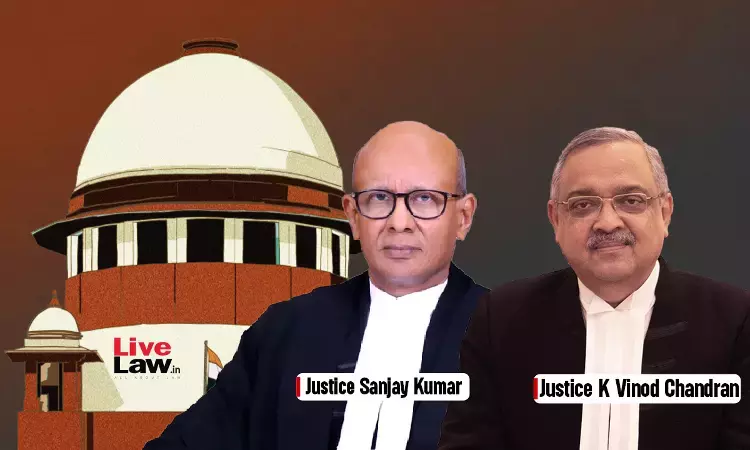
The Court observed that the Magistrate has the option of taking cognizance on a closure report.
The Supreme Court has reaffirmed that upon receipt of a closure report from the police, a Magistrate cannot direct the investigating agency to file a charge-sheet against its opinion. The Court reiterated that the formation of opinion as to whether a case for trial is made out lies exclusively with the Investigating Officer. While the Magistrate retains the discretion to accept the report,...
This is a premium content
Available exclusively to
Our subscribers
Subscribe Premium 
INR 1099+GST
Your support helps us to bring you more content at
an affordable subscription scheme !!!
All payment options available
The Supreme Court has reaffirmed that upon receipt of a closure report from the police, a Magistrate cannot direct the investigating agency to file a charge-sheet against its opinion.
The Court reiterated that the formation of opinion as to whether a case for trial is made out lies exclusively with the Investigating Officer. While the Magistrate retains the discretion to accept the report, reject it and take cognizance, or order further investigation, it cannot direct the police to file a charge sheet.
“…the formation of opinion as to whether or not there is a case to place the accused on trial is exclusively with the officer in charge of the investigation. If a closure report is filed; finding no case made out, it is not open to the Magistrate to direct the police to file a charge sheet", observed the bench of Justice Sanjay Kumar and Justice K Vinod Chandran.
The court said that the Magistrate is empowered to take cognisance even on a closure report.
"If the Magistrate agrees with the report that there was no case made out for issuing process to the accused, he might accept the report and close the proceedings. If he came to the conclusion that further investigation was necessary he might make an order to that effect under Section 156(3). If ultimately the Magistrate was of the opinion that the facts set out in the police report constituted an offence he could take cognizance of the offence, notwithstanding the contrary opinion of the police expressed in the report."
Committal order not determinative of whether trial should be joint or separate
The Court also held that committal orders do not determine whether the trial should be single, separate or joint, which remains within the Court's discretion under the CrPC, provided no prejudice is caused to the accused.
"A committal order just gives the Sessions Court cognizance over the trial of the persons committed and is not the basis of the cognizance taken for trial”, the Court said, adding that “if there is no prejudice to the accused, multiple committal orders can be consolidated to try the accused at one trial, provided it is justified under Sections 233 to 239 of the CrPC”.
The Bench observed that “the above discussion makes it crystal clear that the opinion in the final report filed is not decisive of the cognizance and the committal order/s is/are not determinative of whether the trial is single/separate/joint; which is at the exclusive discretion of the Court.”
The Court examined the legal position while dealing with an unusual procedural history in the case, in which a man who spent nearly 26 years facing prosecution in a dowry death case.
The first investigating officer had found material against all 17 persons named in the FIR but, acting on the directions of the Superintendent of Police, filed a chargesheet only against the father-in-law and mother-in-law while continuing the investigation against the remaining 15 accused. A second investigating officer later filed a final report stating that no evidence had been found against the remaining accused.
Holding that the Superintendent of Police had acted without authority in directing that the chargesheet be restricted to only two accused despite the investigating officer finding a case against all 17, the Bench emphasised that the opinion on whether an accused should be put on trial rests exclusively with the investigating officer. The Court added that if further investigation was considered necessary, it should ideally have been undertaken under the orders of the court after the first report was submitted.
Referring to the settled legal position laid down in Abhinandan Jha v. Dinesh Mishra, H.S. Bains v. State (UT of Chandigarh), Ram Naresh Prasad v. State of Jharkhand and Ramswaroop Soni v. State of Madhya Pradesh, the Bench held that when the police submit a closure report, a Magistrate has three options: accept the report and close the proceedings, take cognizance of the offence on the basis of the materials collected during the investigation, or direct further investigation. However, the Magistrate cannot compel the investigating agency to file a chargesheet contrary to its opinion.
At the same time, the Court underscored that the Magistrate is not bound by the police's opinion. Even if the investigating agency concludes that no offence is made out, the Magistrate may independently examine the materials in the police report and take cognizance under Section 190 of the Code of Criminal Procedure or order further investigation. The Bench described this as reflecting the "primacy of the Court" in the process of taking cognizance.
Applying these principles, the Supreme Court held that although there had been procedural irregularities in the manner the investigation was conducted, the Magistrate's cognizance of the subsequent report could not be faulted because the first report, which was also before the court, had found the offences made out against all the accused. The Court ultimately acquitted the appellant on merits after finding that the prosecution had failed to prove the dowry death charges beyond reasonable doubt.
Also from the judgment - Supreme Court Acquits Husband In Dowry Death Case, Criticises Mechanical Trial Of 17 In-Laws
Headnote
Criminal Procedure Code, 1973 (CrPC) – Section 173(2), 173(8), 190(1)(b) & 218 – Cognizance and Consolidated/Split Trials – Primacy of the Court – Superior Officer's Intervention - The Superintendent of Police (S.P.) directed a charge sheet to be filed against only two accused who were in custody and ordered further investigation against the remaining fifteen accused despite the initial report finding offences made out against all seventeen - Held: The S.P.'s directive to split the investigation and halt the charge sheet against specific individuals was without authority - an invalid investigation does not nullify the subsequent cognizance or trial unless it results in a miscarriage of justice - The formation of an opinion on whether an accused must be placed on trial is the exclusive prerogative of the Investigating Officer, while the ultimate authority to accept a closure report, reject it, or take independent cognizance on the disclosed material rests solely with the Court. Multiple committal orders or separate final reports can be consolidated into a single trial or adjudicated via split trials at the discretion of the Court, provided no prejudice is caused to the accused. [Paras 10-19]
Indian Penal Code, 1860 (IPC) – Sections 304B & 498A – Dowry Death and Matrimonial Cruelty – Standard of Proof – Evaluation of Exculpatory Dying Declaration and Defence Evidence - Conviction of the husband reversed - The prosecution failed to present independent witnesses from the neighborhood to substantiate the generalized and bland allegations of a continuous ₹50,000 dowry demand - the defence effectively dismantled the prosecution's narrative by producing substantial documentary proof of significant joint financial investments, medical receipts showing immediate specialized treatment provided by the husband, and call records demonstrating prompt notification to the bride's family - The exculpatory dying declaration recorded by an Executive Magistrate, combined with the absolute lack of a post-mortem or medical forensic analysis of the burn patterns, created a compelling probability of an accidental fire rather than homicide or suicide. [Paras 27-35]
Criminal Trial – Appreciation of Defence Evidence – Hypothesis of Innocence - Trial courts must bestow equal attention and weight to defence evidence as they do to prosecution evidence - There is no legal baseline to approach evidence led by the accused with inherent distrust or scepticism - If the defence introduces a deeply probable hypothesis of innocence that establishes reasonable doubt, the absolute benefit must inure to the accused - To travel from the realm of "may be true" to "must be true," the prosecution's journey must be strictly paved with legal, reliable, and unimpeachable evidence. [Relied on Abhinandan Jha v. Dinesh Mishra, 1967 SCC OnLine SC 107; H.N. Rishbud v. State of Delhi, (1954) 2 SCC 934; Banwari v. State of U.P., 1962 SCC OnLine SC 98; Sharad Birdhichand Sarda v. State of Maharashtra, (1984) 4 SCC 116; Swaran Singh v. State of Punjab, (1957) 1 SCR 953; Para 34-39]
Cause Title: Brajesh Kumar @ Birjesh Kumar Singh Versus The State of Bihar
Citation : 2026 LiveLaw (SC) 670
Click here to download judgment
Appearance:
For Petitioner(s) : Mr. Neeraj Shekhar, AOR Mrs. Kshama Sharma, Adv. Mr. Rajesh Maurya, Adv. Mr. Ritwik Prasad, Adv. Mr. Rajat Singh Chandel, Adv. Mr. Ujjwal Ashutosh, Adv. Ms. Avi Sahai, Adv.
For Respondent(s) : Mr. Manish Kumar, AOR Mr. Divyansh Mishra, Adv. Mr. Kumar Saurav, Adv.
Tags

Yash Mittal
Yash Mittal is a Correspondent with LiveLaw, covering the Supreme Court of India

