



- Home
- /
- Supreme court
- /
- Supreme Court Mandates Magistrates'...
Supreme Court Mandates Magistrates' Approval For Re-Arrest After First Arrest Is Quashed For Not Furnishing Grounds
Amisha Shrivastava
21 Sept 2026 11:06 AM IST
The Magistrate can permit re-arrest only by an officer who is different from the officer who made the first illegal arrest.
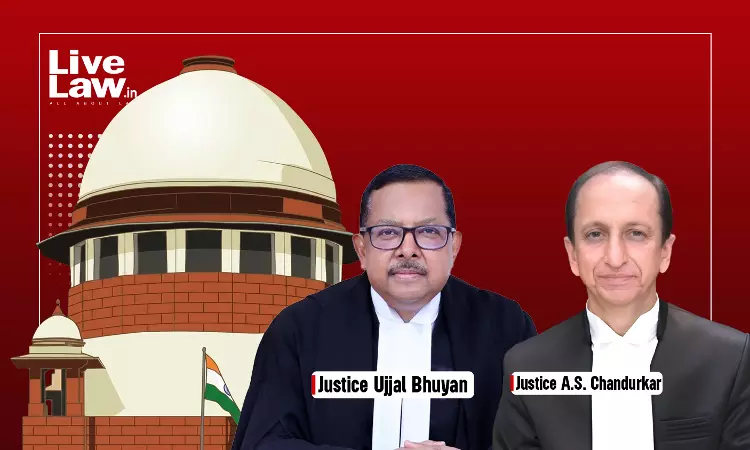
The Supreme Court on Monday pronounced an important judgment clarifying the procedure for the re-arrest of an accused, after the earlier arrest was declared illegal for not furnishing the grounds of arrest as mandated by Article 22(1) of the Constitution.A bench comprising Justice Ujjal Bhuyan and Justice Atul Chandurkar laid down that to re-arrest a person, who was released for the breach...
This is a premium content
Available exclusively to
Our subscribers
Subscribe Premium 
INR 1099+GST
Your support helps us to bring you more content at
an affordable subscription scheme !!!
All payment options available
The Supreme Court on Monday pronounced an important judgment clarifying the procedure for the re-arrest of an accused, after the earlier arrest was declared illegal for not furnishing the grounds of arrest as mandated by Article 22(1) of the Constitution.
A bench comprising Justice Ujjal Bhuyan and Justice Atul Chandurkar laid down that to re-arrest a person, who was released for the breach of Article 22(1), the police must file an application before the concerned Judicial Magistrate and obtain the Magistrate's sanction. The said application can be filed only after furnishing the grounds of arrest in writing to the accused. Also, the application must be endorsed by the immediate superior of the police officer who carried out the first arrest.
The application should also contain the explanation for non-supply of grounds of arrest to that used at the first instance.
The bench also directed that departmental disciplinary action be initiated against the police officer who made the first arrest in violation of Article 22(1).
"Once there is a breach of Article 22(1), the power of re-arrest should not be left to the discretion of the very same authority who violated the provision of the constitution. It must be judicially implemented," Justice Bhuyan pronounced.
The Court therefore directed that the Magistrate must decide the application expeditiously and the investigation must be handed over to another officer by the agency.
Re-arrest is permissible only if Magistrate is satisfied of bona-fide reasons.
"It is only when the magistrate is satisfied that for bona fide reasons, the grounds of arrest could not be furnished to the arrestee at the first instance, but furnished subsequent to his relief and on further satisfaction that the accused needs to be re-arrested, he may pass an order permitting the investigating agency to re-arrest. On the administrative side, the superior authority when presented with the application seeking his endorsement for custody of the accused who has been released for violation of Article 22(1), shall hand over the investigation of the case to another officer, further directing departmental inquiry for such a serious lapse. If the inquiry culminates in an adverse finding against the erring police officers, it would entail departmental action with entry in the service book of such officer," Justice Bhuyan pronounced.
The bench elaborated upon the principles laid down in the Mihir Rajesh Shah v State of Maharashtra (2025) judgment, and said that it was laying down further procedural safeguards regarding re-arrest to prevent abuse.
The Court clarified that Article 22(1) is not statute-specific, and applies to any arrest, even those under the special statutes.
Also, the accused need not show that he has suffered any prejudice because of the violation of this provision, since it is a fundamental right.
The Court further clarified that when a person is released after the quashing of arrest for breach of Article 22(1), it is not a release on bail.
Background
The petitioner Jaskaran Singh Deol, a Shiromani Akali Dal leader, was arrested by Punjab Police in connection with allegations of sexual assault of a minor.
Deol was arrested from his residence in Ludhiana on May 17, 2026. He was produced before the Magistrate at noon the following day, more than 24 hours after his arrest. He contended that he had not been furnished the grounds of arrest. The Magistrate consequently ordered his immediate release, holding that the failure to furnish the grounds of arrest violated Article 22(1) of the Constitution.
Subsequently, the investigating officer moved an application seeking his custody. The application was subsequently dismissed as not maintainable. Deol then approached the Punjab and Haryana High Court seeking to restrain the Investigating Agency from re-arresting him.
The High Court, however, held that there was no fetter on the investigating officer's power to re-arrest Deol after his release on account of the violation of Article 22(1). It said that he could take legal action separately against the police officials responsible for keeping him in custody beyond 24 hours.
Report to be updated after the judgment is uploaded.
Case: JASKARAN JEET SINGH DEOL Vs STATE OF PUNJAB | Crl.A. No. 4234/2026 Diary No. 35041 / 2026
Click Here To Read/Download Judgment
Citation : 2026 LiveLaw (SC) 967
Appearances: Senior Advocate Siddharth Agarwal for the petitioner; Addl Advocate General Rajat Bharadwaj for the State of Punjab; Senior Advocate Gopal Sankaranarayanan for the complainant.
Tags

Amisha Shrivastava
Amisha Shrivastava is a Senior Correspondent with LiveLaw, covering the Supreme Court of India. She can be reached at amisha@livelaw.in

