



- Home
- /
- Supreme court
- /
- Mere Absence Of Train Ticket Cannot...
Mere Absence Of Train Ticket Cannot Defeat Railway Compensation Claim : Supreme Court Reiterates
Saima Anjum
26 Sept 2026 4:54 PM IST
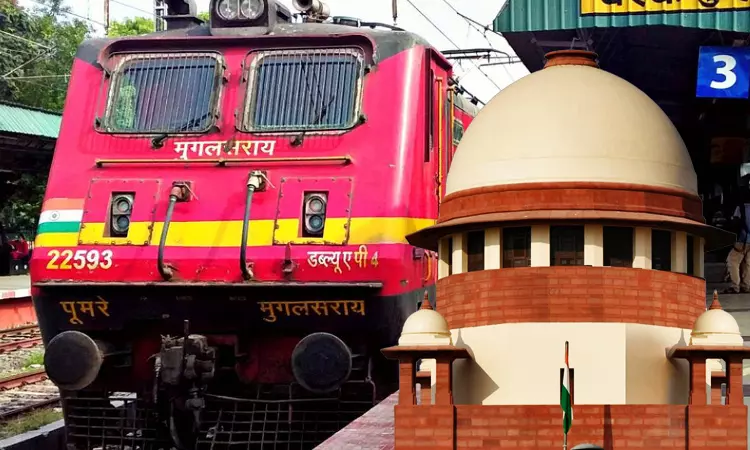
The Supreme Court on Friday (25 September) has held that mere absence of a railway ticket with an accident victim cannot by itself defeat a claim for compensation, especially where the victim remained hospitalised for over a month before succumbing to his injuries, making it “quite unlikely” that the ticket would have survived. A bench of Justice Ujjal Bhuyan and Justice Atul S...
This is a premium content
Available exclusively to
Our subscribers
Subscribe Premium 
INR 1099+GST
Your support helps us to bring you more content at
an affordable subscription scheme !!!
All payment options available
The Supreme Court on Friday (25 September) has held that mere absence of a railway ticket with an accident victim cannot by itself defeat a claim for compensation, especially where the victim remained hospitalised for over a month before succumbing to his injuries, making it “quite unlikely” that the ticket would have survived.
A bench of Justice Ujjal Bhuyan and Justice Atul S Chandurkar observed so while hearing an appeal filed by the parents of a deceased passenger. The bench restored the compensation granted by the Railway Claims Tribunal, which had been set aside by the Gujarat High Court.
While travelling to Surat via Ahmedabad, the appellants' son fell down due to a sudden jerk, sustaining grievous injuries, in September 2017. He was hospitalised and succumbed to his injuries in October 2017.
Subsequently, his parents filed a claim application under Section 16 of the Railway Claims Tribunal Act, 1987, wherein the Tribunal held that the deceased was the victim of an “untoward incident” within the meaning of Section 123(c)(2) of the Railways Act, 1989. A compensation of Rs 8 Lakhs with 9% interest per annum was awarded from the date of the incident.
Pursuant to this, the Union government filed an appeal before the High Court under Section 23 of the 1987 Act , wherein it was held that there was no evidence of the victim having fallen from a train, and that the incident could therefore not be termed an “untoward incident.”
Aggrieved by the High Court's ruling, the parents (appellants) of the deceased filed an appeal before the Supreme Court.
Before the Supreme Court, Senior Advocate Nachiketa Joshi argued for the appellants that it was specifically pleaded in the claim application that the deceased passenger's ticket was lost along with other personal belongings. It was contended that once this was pleaded, the burden shifted to the Railways to prove that the victim was travelling without authority, which they had failed to do. Relying on Kalandi Charan Sahoo & Anr v General Manager, South-East Central Railways, Bilaspur, it was argued that the Railways' report prepared under Rule 6 of the Railway Passengers (Manner of Investigation of Untoward Incidents) Rules, 2003, was prepared more than seven months after the incident, instead of being prepared immediately as required under Rule 7, and hence it could not be relied upon.
Per contra, Additional Solicitor General Kanakamedala Ravindra Kumar supported the Gujarat High Court's order, submitting that no eye witnesses was examined, no ticket was recovered, and the Station Superintendent had deposed that no train movement was recorded at the relevant time, which amounted to a “self-inflicted injury” not covered under Section 124-A of the 1989 Act.
The deceased passenger's father deposed on oath that his son used to always purchase the ticket before travelling, and that this was why he had stated in his affidavit that the ticket had been purchased, which was lost.
“It is true that my deceased son's railway travelling ticket, a handkerchief, a wrist watch, a pocket comb and a cash of Rs. 800/- to 900/- and etc. is lost,” the father had pleaded in the claim application.
Notably, the two witnesses examined by the Railways admitted in cross-examination that they had not searched the victim's pockets for a ticket.
The Supreme Court reiterated the holding of Union of India v Rina Devi that “mere absence of a ticket with the victim would not negate the claim that the victim was a bona fide passenger. The initial burden can be discharged by the claimant by filing an affidavit of the relevant facts, after which the burden would shift on the Railways.”Applying this, the Court held that the father's testimony discharged the initial burden, and since the Railways' witnesses admitted they never checked the victim's pockets, the Railways failed to discharge the burden that had shifted on them.
Further, the bench reasoned that since the victim was hospitalised for over a month before dying, “it is quite unlikely that the railway ticket would have been preserved by the claimants.” The bench also observed that the High Court failed to appreciate this while giving “undue importance to the absence of the railway ticket without taking into consideration the statement made on oath by the victim's father and the fact that the victim had been hospitalised for a period of more than one month.”
The bench also noted that the Railways' investigation report under Rule 6 of the 2003 Rules was prepared only in May 2018 (nearly seven months after the incident), and only after the claim application had been filed. Relying on Kalandi Charan Sahoo, it held that such unexplained delay worked against the Railways, and it was accordingly “inclined to ignore the said investigation report.”
Further, it was also held that on a preponderance of probabilities, the victim was a bona fide passenger, and the principle of strict liability under Section 124-A of the 1989 Act is attracted, as recognised in Union of India v Prabhakaran Vijaya Kumar & Ors.
In the light of aforesaid, the bench set aside the Gujarat High Court's order and restored the Railway Claims Tribunal's award, directing that the award be satisfied by the Railways within thirty days.
Case: Sukhabhai Nanjibhai Makwana & Anr v Union of India
Citation : 2026 LiveLaw (SC) 994
Appearance:
For Appellants: Mr. Nachiketa Joshi, Sr. Adv.; Mr. Prashant Rawat, AOR; Ms. Sucheta Joshi, Adv.; Ms. Sagrika Arya, Adv.; Mr. Satadru Majumder, Adv.; Ms. Ruchil Raj, Adv.; Mr. Mohd Umar Iqbal Khan, Adv.; Mr. Kabir Singh, Adv.
For Respondents: Mr. Kanakamedala Ravindra Kumar, ASG; Mr. Amrish Kumar, AOR; Mr. Devraj Bhattacharjee, Adv.; Mr. Amit Sharma-v, Adv.; Mr. Suyash Pandey, Adv.; Mr. Dheeraj Jani, Adv.; Dr. Arun Kumar Yadav, Adv.
Click Here To Read/Download Order
Tags


