



- Home
- /
- Supreme court
- /
- Merely Lodging A False FIR Is Not...
Merely Lodging A False FIR Is Not Abetment Of Suicide: Supreme Court
Saima Anjum
20 Aug 2026 3:58 PM IST
Merely because a dejected husband, or lover, out of frustration, ends his life and puts the blame on the accused, in his suicide note, is not enough to conclude that a prima facie case is made out.
The Supreme Court on Tuesday (18.08.2026) has held that lodging an FIR or serving a notice seeking maintenance, even if such proceedings are later found to be false, does not by itself amount to instigating the person against whom such proceedings are initiated, to commit suicide. The Court quashed an FIR registered against the in-laws of a man who died by suicide, holding that neither the...
This is a premium content
Available exclusively to
Our subscribers
Subscribe Premium 
INR 1099+GST
Your support helps us to bring you more content at
an affordable subscription scheme !!!
All payment options available
The Supreme Court on Tuesday (18.08.2026) has held that lodging an FIR or serving a notice seeking maintenance, even if such proceedings are later found to be false, does not by itself amount to instigating the person against whom such proceedings are initiated, to commit suicide. The Court quashed an FIR registered against the in-laws of a man who died by suicide, holding that neither the FIR nor the suicide note left behind by the deceased dislosed the necessary ingredients of abetment under Section 107 of the Indian Penal Code, 1860 (IPC, now Section 45 of the Bharatiya Nyaya Sanhita, 2023).
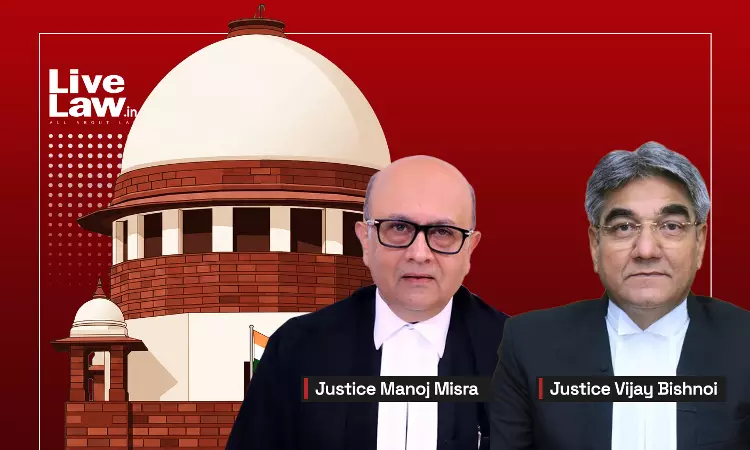
A bench of Justice Manoj Misra and Justice Vijay Bishnoi ruled so while hearing an appeal against an order of the Gujarat High Court which had dismissed a plea seeking quashing of the FIR registered against the deceased's mother-in-law, father-in-law, and brother-in-law under Sections 306 and 114 of the IPC (now Sections 108 and 54 of the Bharatiya Nyaya Sanhita, 2023).
The deceased was married to appellants' daughter, who lodged an FIR against her deceased husband under Sections 498A and 323 IPC (now Sections 85 and 115 of the Bharatiya Nyaya Sanhita, 2023), alleging that he had assaulted her, following which she left the matrimonial home with her son and was later found in distress at railway station. Pursuant to the registration of the FIR, a medical examination was conducted which found multiple contusions on her body.
Subsequent to this, an FIR was registered, alleging that the appellants had harassed the deceased by registering a false FIR against him, which allegedly drove him to commit suicide. The appellants' plea to quash the FIR was dismissed by the Gujarat High Court. Therefore, the appellants appealed before the Supreme Court.
Perusing the suicide note, which sugested that his married life had been ruined by the appellants, though he bore no grudge against his wife, the Court observed that what was “missing” in the note was any allegation of act by the appellants constituting instigation ot harassment of a degree that would leave the deceased with no option but to end his life.
“It is a clear case where the deceased committed suicide on account of his own frustrations and not because there had been any instigation by the accused constituting abetment,” the bench observed. It rejected the view that initiating legal proceedings against a person could amount to abetment if that person later commits suicide.
“Lodging an FIR, even if it is false, against a person, per se, does not amount to instigating that person to commit suicide..every individual has a right to take recourse to appropriate proceedings under law to protect his or her rights. Therefore, if a person sets the criminal justice delivery system in motion, he cannot be held liable for abetment to commit suicide, if the person against whom proceedings were initiated commits suicide,” the bench stated.
It also noted that the appellants were residing separately from the deceased, and therefore, it could not be said to have had such an “overbearing influence” over him as to instigate or drive him to commit suicide.
Reiterating Section 107 IPC, the bench explained that a person abets the doing of a thing if he instigates another to do it, or engages in a conspiracy for its doing, or intentionally aids its commission by an act or illegal omission. Applying this to the presumption of abetment of suicide of a married woman under Section 113A of the Indian Evidence Act, 1872 (now Section 117 of the Bharatiya Sakshya Adhiniyam, 2023), the Court held that the accused must, prima facie, be shown to have committed one of these acts as enumerated under Section 107.
“Merely because a dejected husband, or lover, out of frustration, ends his life and puts the blame on the accused, in his suicide note, is not enough to conclude that a prima facie case is made out against those who are blamed. The court would have to consider whether the conduct of the accused in ordinary circumstances would have driven an ordinary person, not an over sensitive person, to take that drastic step to end his life,” it was observed.
The Court further observed that matrimonial disputes often lead spouses to blame each other and initiate proceedings against one another, and that such initiation of proceedings cannot by itself be treated as instigation to commit suicide, it is ultimately for courts to determine whether such proceedings are bona fide or mala fide.
Holding that the FIR and the suicide note, even read together, did not disclose the necessary elements to make out a case against the appellants, the Court held that the High Court “ought not to have refrained from examining the matter at some depth, particularly, when the reasons for suicide were spelt out in the FIR as well as the suicide note.”
Allowing the appeal, the Supreme Court set aside the High Court's order and quashed the FIR.
Case: Patel Joshnaben Pravinkumar Patel & Ors. v State of Gujarat & Anr
Citation : 2026 LiveLaw (SC) 835
Appearance:
For Appellant: Mr Somesh Chandra Jha, AOR; Ms Pyoli, Adv.; Mr Brijesh Raj, Adv.; Mr Animesh Rajoriya, Adv.
For Respondent: Ms Swati Ghidiyal, AOR; Ms Deepanwita Priyanka, Adv.; Mr Nimesh Bhatt, Adv
Tags


