



Supreme Court Quashes Cheating Case Over Unpaid Steel Dues, Calls Criminal Cases In Civil Disputes An Abuse Of Process Of Law
Saima Anjum
7 Oct 2026 8:59 PM IST
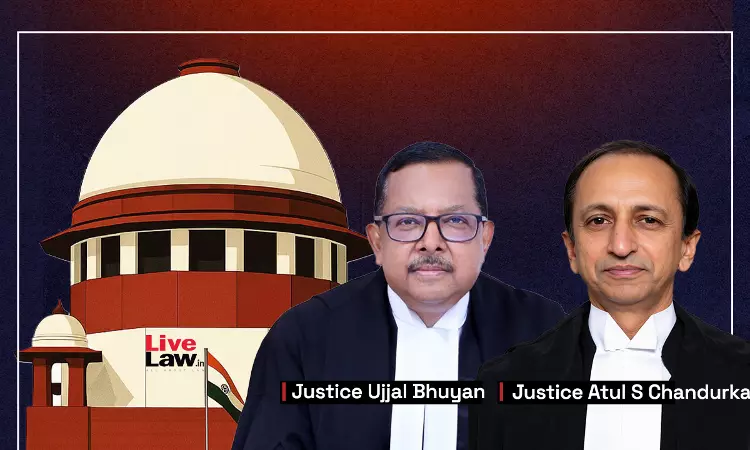
A bench of Justice Ujjal Bhuyan and Justice Atul S Chandurkar held so while setting aside the Gujarat High Court's order, which had discharged the appellants of criminal breach of trust under Section 406 of the Indian Penal Code, 1860 (IPC, now Section 316(2) of the Bharatiya Nyaya Sanhita, 2023/BNS) but sustained the charge of cheating under Section 420 IPC (now Section 318(4) of the BNS 2023) read with Section 114 IPC (now Section 54 of the BNS 2023).
The appellants are directors of Shivamy Enterprises Pvt Ltd., a company in the steel business. The informant (R2) is an employee of Hans Ispat Ltd. Since 2006, Shivamy Enterprises was buying steel bars from Hans Ispat Ltd. and selling them to third parties. It is alleged that the directors of Shivamy Enterprises (appellants) had purchased Thermo-Mechanically Treated (TMT) bars worth Rs 1,19,00,000 pursuant to which Hans Ispat Ltd (company in which R2 is an employee) raised the bills. The directors issued post-dated cheques which were dishonoured and the bills remained unpaid.


Thereafter, an FIR was registered against the appellants and a chargesheet was filed. Subsequently, the appellants' discharge application was rejected by the Magistrate. Their revision application before the Gujarat High Court was also dismissed in March 2021 as not maintainable. Later, in 2024, the Supreme Court held that the revision was maintainable and directed the High Court to decide it on merits.
In 2026, the High Court partly allowed the revision and discharged the appellants under Section 406 IPC. However, it directed the Magistrate to frame a modified charge for offences under Section 420 read with Section 114 IPC.
Aggrieved by the modification order, the appellants then filed a Special Leave Petition (SLP) before the Supreme Court, which stayed the trial in April this year.
Before the Supreme Court, Senior Advocate Nikhil Goel argued for the appellants (directors) that the dispute was entirely civil. It was contended that the informant had used the criminal process to recover the unpaid amount instead of filing a civil suit. The directors relied on the FIR and informant's statement, which showed that a deposit of Rs 2,00,00,000 made by Shivamy Enterprises was lying with Hans Ispat Ltd, which was not returned despite repeated requests. The appellants, therefore, withheld the payments of Rs. 1,19,00,000 to set off the outstanding dues, the bench was apprised.
The respondent (state/R1) also conceded that the dispute may have “its genesis in business transaction having a civil flavour,” however, the appellants' subsequent conduct of “withholding payments certainly has got criminal overtones.” It was submitted that the police had investigated the case and found it fit for trial. None appeared for the informant (R2).
The Supreme Court perused Sections 405, 406, 415, 420 and 114 IPC and referred to G Saminathan v State, wherein it was observed that the “sine qua non for attracting Section 415 IPC is 'fraudulence', 'dishonesty' or 'intentional inducement'. Absence of the aforesaid elements would debase the offence of cheating.”
The Court then examined the informant's statement given under Section 161 of the Code of Criminal Procedure, 1973 (CrPC, now Section 180 of the Bharatiya Nagarik Suraksha Sanhita, 2023/BNSS 2023), wherein he had stated that Hans Ispat Ltd was earlier owned by one Barnala Group, from which Electrotherm India Pvt. Ltd. bought it in 2010, after which Hans Ispat Ltd. took over. He admitted that Rs 2,00,00,000 was paid by the appellants to the company when the Barnala Group owned it, but this amount was to be taken care of by the Barnala Group and not by the new owners.
With regards to this, the Court observed as follows:
“From the above, it is evident that the money was paid by the appellants to the company when the Barnala group owned the company. Appellants are insisting on repayment, failing which they have adjusted the dues of Respondent No. 2. According to respondent No. 2 this amount should be repaid by the Barnala group and not by the present owners. Therefore, the amount due to him should be paid by the appellants. Thus, the dispute raised by Respondent No.2 is pre-eminently a civil one. However, no civil suit has been instituted by Respondent No.2 against the appellants.”
The Court relied on earlier decisions in Delhi Race Club v State of Uttar Pradesh wherein it was held that a complainant claiming an amount due should have filed a civil suit for recovery and could not have gone to the Court of the Additional Chief Judicial Magistrate by filing a complaint of cheating and criminal breach of trust. It noted that continuation of such proceedings “would be nothing but abuse of the process of law.” It also recorded that the two offences of cheating and criminal breach of trust are independent and distinct and cannot coexist simultaneously in the same set of facts. It further referred to Lalit Chaturvedi v State of Uttar Pradesh to note that even assuming the complaint's assertions were correct, an offence under Section 420 read with Section 415 IPC “is not established in the absence of deception by making false and misleading representation, dishonest concealment or any other act or omission, or inducement of the complainant to deliver any property at the time of the contract(s) being entered.” It added that the “police does not have the power and authority to recover money or act as a civil court for recovery of money.” Further reliance was placed on Shailesh Kumar Singh alias Shailesh R Singh v State of Uttar Pradesh to reiterate that “money cannot be recovered, more particularly, in a civil dispute between the parties by filing a First Information Report and seeking the help of the Police. This amounts to abuse of process of law.”
Referring back to G Saminathan, the Court reiterated that where a dispute is essentially civil, “a case of cheating or criminal breach of trust per se would not arise.”
Applying the aforesaid, the Supreme Court held as follows:
“Having given our anxious consideration to the submissions made at the Bar, relevant materials on record and the decided cases, we have no hesitation in coming to the conclusion that the grievance raised by Respondent No.2 is essentially civil in nature. Instead of availing his civil remedy, Respondent No. 2 has resorted to criminal proceedings to recover the amounts stated to have been withheld by the appellants. This certainly cannot be the object of a criminal proceeding.”
“We are of the view that allowing the criminal proceedings to continue would be nothing but an abuse of the process of the Court,” the Court, thus, quashed the criminal proceedings against the directors.
Appearance:
For Appellants: Mr. Nikhil Goel, Sr. Adv.; Mr. Ashutosh Ghade, AOR; Ms. Saloni Meshram, Adv.
For Respondents: Mr. Prashant Bhagwati, Adv.; Ms. Swati Ghildiyal, AOR; Mr. Nimesh Bhatt, Adv.


