



- Home
- /
- Supreme court
- /
- Supreme Court Recommends Law To...
Supreme Court Recommends Law To Govern Court Deposits, Urges Law Commission To Examine
Yash Mittal
19 Sept 2026 3:33 PM IST
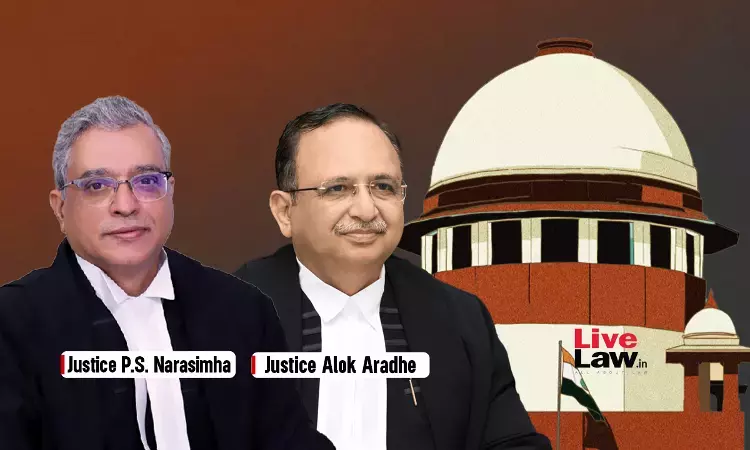
The Court flagged the non-uniform procedure followed by various courts and tribunals in handling deposits made before them.
The Supreme Court has urged the Law Commission of India to examine the lack of uniformity in how money deposited before Courts and Tribunals is administered, invested, and released. “We are of the opinion that it is necessary to evolve and formulate a suitable legislation on the subject.”, observed a bench of Justice PS Narasimha and Justice Alok Aradhe while hearing an appeal against...
This is a premium content
Available exclusively to
Our subscribers
Subscribe Premium 
INR 1099+GST
Your support helps us to bring you more content at
an affordable subscription scheme !!!
All payment options available
The Supreme Court has urged the Law Commission of India to examine the lack of uniformity in how money deposited before Courts and Tribunals is administered, invested, and released.
“We are of the opinion that it is necessary to evolve and formulate a suitable legislation on the subject.”, observed a bench of Justice PS Narasimha and Justice Alok Aradhe while hearing an appeal against the Delhi High Court's judgment, which had upheld the award-debtor's liability to pay interest on the deposit of an arbitral award amount from the date of passing of the arbitral award until the deposited amount was transferred to the award-holder.
The Court noted significant differences among Courts and Tribunals regarding the percentage of the award or decree required to be deposited, the bank or financial institution where the money is kept, the investment instrument, interest earned, and the withdrawal, renewal, and reinvestment of deposits.
The judgment noted that different High Courts have adopted different mechanisms for dealing with deposited amounts.
The Delhi High Court requires money deposited to be held by its Registry in fixed deposits, while the Allahabad High Court provides for deposits with the State Bank of India. The Bombay High Court has adopted arrangements involving the Prothonotary and Senior Master, with subsequent judicial directions concerning fixed deposits in nationalised banks.
The Punjab and Haryana High Court has directed executing courts to place deposited monies in fixed deposits with nationalised banks. Deposits before the Supreme Court are maintained through government deposits with nationalised banks, while the Calcutta and Madras High Courts have mechanisms involving the Reserve Bank of India.
“We have…noticed the asymmetry that exists in our country with regard to the method and manner by which deposits are directed to be made before the Courts/Tribunals when appeals are being considered. We have requested the Law Commission of India to examine the issues which we have highlighted in this judgment and in the process, the Law Commission has also been requested to consider the laws which other countries have enacted and to consult the Reserve Bank of India, Ministry of Finance and also the Nodal Ministry of Law and Justice.”, the Court observed.
According to the Court, such asymmetry results in similarly situated litigants receiving different treatment depending on the forum and also generates further litigation concerning investment, accounting and interest.
The Court emphasised the time value of money attached to the deposits, observing that there must be clarity and uniformity in the manner in which court deposits are handled.
It suggested that standardisation could potentially be achieved through a common platform under which monies deposited before different Courts and Tribunals are pooled and invested in an appropriate financial instrument.
“In order to preserve the economic integrity of any deposit and to provide interest, there must be clarity and uniformity in the method and manner in which the deposit itself is handled. Lack of standardisation in the process by which sums deposited into the court are to be handled undermines this essential underlying principle of the time value of money as well as the accrual of interest in a certain and clear manner…This practice of standardisation must take place through a common platform wherein monies deposited in different Courts/Tribunals are pooled into one unified scheme and then accordingly put into the most beneficial financial instrument for the litigating parties. This common platform will not only create certainty in the interest rates and increase the ease of accessibility for litigants but will also ease the burden on Courts/Tribunals regarding how this money deposited is to be invested and dealt with.”, the Court observed.
The Court also referred to its earlier decision in K.L. Suneja v. Dr. (Mrs.) Manjeet Kaur Monga 2023 LiveLaw (SC) 68, where the need for uniform guidelines concerning money deposited with court registries had been highlighted. In KL Suneja, the Court emphasized that “all courts and judicial forums should frame guidelines providing that where the amounts are deposited with the office/registry of the court/tribunal, such amounts should mandatorily be deposited in a bank or some financial institution to ensure that no loss is caused in the future. It was further held that the guidelines should be embodied in the form of appropriate rules, or regulations of each court, tribunal, commission, authority, agency etc., exercising adjudicatory power.”
As a result, with a need to establish a more consistent approach to administration of court deposits, the Court requested the Law Commission to examine the issues identified in the judgment, including the laws adopted by other countries.
The Registry was directed to send a copy of the judgment to the Chairman of the Law Commission of India, Governor of the RBI, and Secretaries of the Ministries of Finance and Law and Justice
Headnote
Arbitration and Conciliation Act, 1996 — Section 36 — Code of Civil Procedure, 1908 (CPC) — Order XXI Rules 1 & 4, Order XLI Rules 5 & 6 — Enforcement of Arbitral Award — Conditional Court Deposit vs. Satisfaction of Decree — Cessation of Post Award Interest - Deposit in Court Not Synonymous with Payment - A deposit is not payment; placing money beyond the debtor's reach neither extinguishes liability nor places it at the creditor's disposal - Under Section 36(1) of the Arbitration Act, an award is enforced as a decree under the CPC - For a deposit in court to arrest the accrual of interest under Order XXI Rule 1, it must be made unconditionally, accompanied by notice under Rule 1(2), and be freely and immediately available for withdrawal by the award-holder. [Paras 21-25]
Conditional Withdrawal Does Not Halt Interest: Where the award-debtor resists the release of deposited funds, or where the court permits withdrawal only upon furnishing security (such as title deeds), the deposit does not constitute satisfaction of the award under Order XXI Rule 1 - liability to pay interest continues to run until the date the awarded funds are unconditionally made available to the award-holder – i. Distillation of Principles Govering Interest on Court Deposits - The Supreme Court synthesized nine binding principles governing interest liability during deposit in court - (i) The 1996 Act incorporates CPC principles for enforcement under Section 36; (ii) Court must have regard to CPC provisions on money decree stays when staying an award [Section 36(3)]; (iii) Deposit merely places money beyond reach of the parties; (iv) Deposit must be unconditional and freely withdrawable; (v) Withdrawal permitted only against security is not payment in satisfaction of the decree; (vi) If deposit is non-compliant with Order XXI Rule 1, interest continues to run; (vii) Failure by the decree-holder to seek withdrawal when funds are freely available amounts to deemed refusal, stopping interest; (viii) If deposited sums are placed in a fixed deposit at the decree-holder's instance, only FD interest accrues; (ix) Partial unconditional deposit arrests interest only pro tanto on the deposited component. [Paras 21-28]
Asymmetry in Handling Court Deposits & Reference to Law Commission - Highlighting severe disparities and lack of uniform rules across various High Courts regarding court deposits, registry investments, and the time value of money, the Supreme Court requested the Law Commission of India to study global frameworks (such as the US Court Registry Investment System [CRIS] and the Canadian Consolidated Revenue Fund model), consult the RBI, Ministry of Finance, and Ministry of Law & Justice, and propose comprehensive legislation. [Relied on Gurpreet Singh v. Union of India, (2006) 8 SCC 457; Delhi Development Authority v. Bhai Sardar Singh & Sons, 2020 SCC OnLine SC 1450; Nepa Ltd. v. Manoj Kumar Agrawal, 2022 SCC OnLine SC 1736; DLF Limited & Anr. v. Koncar Generators & Motors Limited, (2025) 1 SCC 343; Paras 27–46]
Cause Title: NATIONAL SEEDS CORPORATION LTD. VERSUS NATIONAL AGRO SEED CORPORATION (INDIA)
Citation : 2026 LiveLaw (SC) 958
Tags

Yash Mittal
Yash Mittal is a Correspondent with LiveLaw, covering the Supreme Court of India

