Supreme Court Rejects Plea To Rotate SC/ST Reservations Of Assembly & Parliament Seats, Affirms Validity Of S.9(1)(c) Delimitation Act
Amisha Shrivastava
4 Nov 2026 1:05 PM IST
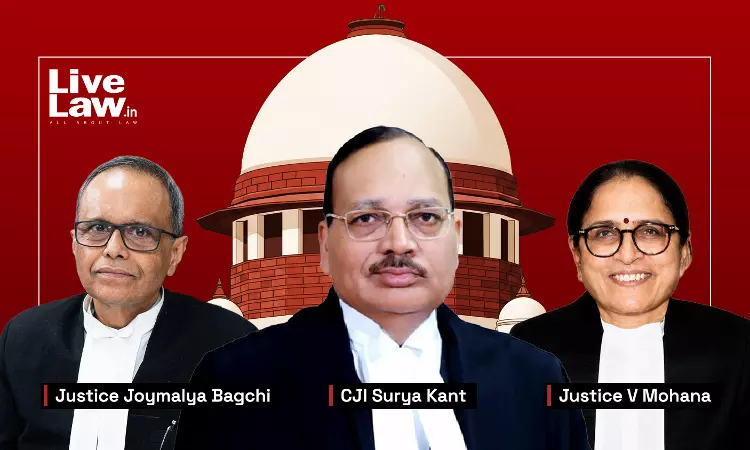
The Court declined interference, observing that it was a matter of legislative policy.
The Supreme Court on Wednesday rejected a plea seeking mandatory rotation of seats reserved for Scheduled Castes (SCs) and Scheduled Tribes (STs) in State Legislative Assemblies and Parliament, holding that the issue falls within the legislative domain of Parliament and cannot be directed by the courts.
The Court was dealing with a petition challenging Section 9(1)(c) of the Delimitation Act, 2002, which requires reserved constituencies to be located in areas where the proportion of SC/ST population is comparatively large. After the Allahabad High Court upheld Section 9(1)(c) and refused to order rotation of reserved seats, the petitioner approached the Supreme Court.
The bench of Chief Justice of India Surya Kant, Justice Joymalya Bagchi and Justice V Mohana refused to interfere with the High Court's judgment, observing that it was a matter for the legislature to decide. The Court allowed the petitioner to file a representation before the elected representatives seeking a change in the law.
The petitioner, Jagdish Singh, an elector of the 191-Kadipur Assembly Constituency in Sultanpur district of Uttar Pradesh, had argued that the seat had remained reserved for SCs for nearly seven decades since its creation. He contended that the continuous reservation without rotation violated Articles 14, 15 and 19 of the Constitution, diluted the right to vote by compelling voters to choose only from SC candidates, and benefited only a few families rather than the broader community. He sought a system of rotation similar to that provided for panchayats and municipalities under Articles 243D and 243T.


During the hearing, the bench observed that voters in a multiparty democracy are expected to vote on the basis of political ideology rather than caste or religion. Justice Bagchi noted that whether concentrating reserved seats in areas with larger SC/ST populations creates caste divisions is a matter for the legislature to examine and does not by itself render the law unconstitutional. The Court distinguished the constitutional right to vote from any claimed right to contest from a particular constituency, pointing out that general-category candidates can contest from non-reserved seats.
"In a political democracy, there are multiple political parties having different ideologies. The voters are expected to vote for the party, not for the religion. You may like or dislike a particular political ideology. Who is representing that ideology becomes irrelevant. You vote for that ideology. So that also defeats your argument," Justice Bagchi observed.
CJI Surya Kant remarked that the petitioner was “dialling the wrong number” as the demand for rotation should be raised before Parliament. "This is a good season of protests, naarebaazi. So this is also a good ground for protest," CJI commented in a lighter vein.
The petitioner highlighted that the High Court had also accepted that rotation of seats was the ideal method but refrained from ordering so, citing judicial restraint. However, Justice Bagchi disagreed with the logic that the majority community in a constituency will anyway get elected, and hence SC reservation is unnecessary in a constituency with high SC population. "That proceeds on the idea that a majority community will vote on community or caste lines. They may not vote on community and caste lines. The High Court cannot judicially pronounce on a democratic choice. That is for the voters to decide," Justice Bagchi said.
The bench clarified that it could not rewrite the Constitution or the statute by introducing a rotation requirement absent in Articles 330 and 332 or the Delimitation Act.
In its order, the Supreme Court stated:
"The challenge to section 9(1)(c) of the Delimitation Act has been turned down in the impugned judgment. The case of the petitioner is that the Assembly seats should be reserved on rotational basis for members of ST and SC communities as in municipal corporations.
The High Court has turned down the case observing that although ideally rotation ought to be followed, such a recourse cannot be directed by the court and it is in the ambit of the Parliament. We see no ground to take a different view. The petitioner may approach the public representatives to build consensus with a view to persuade them to follow the rotation principle which the petitioner relies upon on the basis of the reservation made by the delimitation commission in 2008."
The Allahabad High Court (Justices Alok Mathur and Amitabh Kumar Rai) had held that Articles 330 and 332 merely prescribe the number of reserved seats in proportion to population and leave the methodology of identification to Parliament under Article 327. It found Section 9(1)(c) neither ultra vires nor violative of fundamental rights, and ruled that courts cannot issue a mandamus directing the legislature to insert a rotation provision. While acknowledging that rotation could better advance social and political justice by allowing SC/ST candidates to contest even from constituencies with smaller reserved-category populations, the High Court emphasised that this policy choice rests exclusively with Parliament.