



- Home
- /
- Supreme court
- /
- Supreme Court Restores ₹162 Crore...
Supreme Court Restores ₹162 Crore Penalty On Power Generator For Failure To Demonstrate Declared Capacity
Yash Mittal
21 May 2026 5:03 PM IST
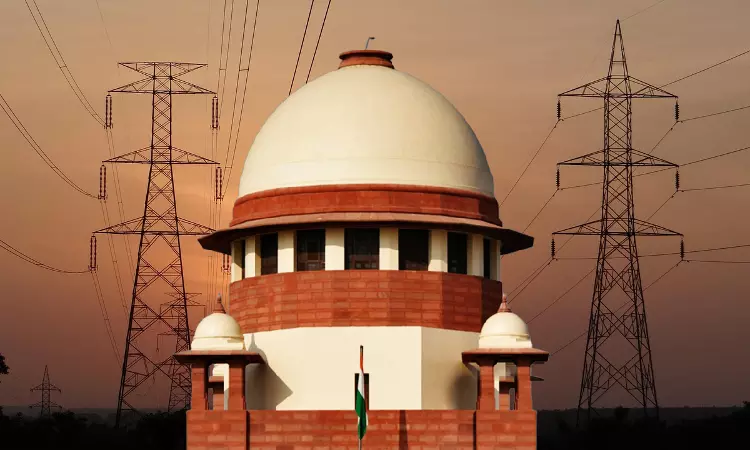
The Supreme Court on Wednesday (May 20) held that a power-generating station's failure to demonstrate its declared electricity generation capacity attracts strict liability and does not require proof of mens rea or deliberate wrongdoing. The Court observed that since generating stations receive fixed charges based on their declared capability, failure to establish such declared capacity...
This is a premium content
Available exclusively to
Our subscribers
Subscribe Premium 
INR 1099+GST
Your support helps us to bring you more content at
an affordable subscription scheme !!!
All payment options available
The Supreme Court on Wednesday (May 20) held that a power-generating station's failure to demonstrate its declared electricity generation capacity attracts strict liability and does not require proof of mens rea or deliberate wrongdoing. The Court observed that since generating stations receive fixed charges based on their declared capability, failure to establish such declared capacity within the prescribed time framework would automatically invite penal consequences.
A bench of Justice Sanjay Kumar and Justice K Vinod Chandran restored the Punjab State Electricity Regulatory Commission (SERC) order of imposing a penalty of approximately ₹162 Crore on Talwandi Sabo Power Limited for failure to demonstrate its declared power generation capability within the stipulated time under the Punjab State Grid Code, 2013.
“Demonstration of DC is a measure of ensuring that the (State Generating Stations) has the ability to generate the capacity declared on a real time basis and that the declaration is made faithfully, especially when fixed charges are paid on the declared capability and incentives earned for annual generation in excess of 80% of the declared capability.”, the court observed.
Background
The dispute arose out of allegations that Talwandi Sabo Power Limited had repeatedly declared higher generation capacity than what it could actually supply during January 2017.
The generating station operates three units of 660 MW each and supplies electricity to Punjab under a Power Purchase Agreement (PPA). Under the tariff structure, fixed charges are payable on the basis of “Declared Capacity” (DC), irrespective of actual power drawal by the procurer.
The Punjab State Load Despatch Centre later asked the company to “demonstrate” or prove that it could actually produce the declared amount of electricity. Under the rules, the company had to show this within four “time blocks” (each block is 15 minutes, so roughly within one hour).
According to the State authorities, the generating station failed to achieve the declared capacity within the fourth time block after receiving demonstration notices on four separate occasions, January 15, 17, 24 and 31, 2017.
The Punjab State Electricity Regulatory Commission upheld findings of misdeclaration and imposed a penalty of approximately ₹162.74 crore. Around ₹74 Crore was deducted from the pending bills of the generating company.
However, the Appellate Tribunal for Electricity later set aside the SERC order, upon accepting the company's argument that there was no deliberate cheating or manipulation (“gaming”), prompting the Punjab State Power Corporation Ltd. (PSPCL) to appeal to the Supreme Court.
Decision
Setting aside the APTEL's decision, the judgment authored by Justice Chandran rejected the company's contention that there was no 'gaming' involved. Explaining the difference between the 'gaming' and failure to demonstrate the capability, the Court said that where the company simply fails to produce the promised electricity when asked, it cannot be categorised as gaming to avoid its strict liability, as in gaming, a company intentionally manipulates declarations to make illegal profit, which entails a detailed enquiry followed by the principle of natural justice.
The Court said that once the company could not produce the declared power within the required four-time blocks, a penalty followed automatically under the regulations. The Court added that if the Respondent-company was not ready with the declaration, then it should have sought time to re-check its capabilities, which it failed to do so.
“The State Load Dispatch Centre who has finalized the generation schedule of the SGS and the drawal schedule of the procurer hence is empowered to seek demonstration, to verify the veracity of the capability declared. The failure of the SGS would be because of absence of sufficient stock of coal, repair of machinery or any other reason which the SGS should have reckoned before intimating the station-wise power plant capabilities, as per the SG Code, or seek revision if a reduction of capability is occasioned on a real time basis.”, the court observed.
Resultantly, the appeal was allowed, while restoring the Punjab SERC order imposing a penalty on the Respondent-generating station.
Cause Title: Punjab State Power Corporation Limited Versus Talwandi Sabo Power Limited & Ors.
Citation : 2026 LiveLaw (SC) 525
Click here to download judgment
Appearance:
For Appellant(s) Ms. Poorva Saigal, Adv. Mr. Pramod Dayal, AOR Mr. Rishabh Saxena, Adv. Ms. Kaavya Madaan, Adv. Ms. Shirin Gupta, Adv. Mr. M.G. Ramachandran, Sr. Adv. Mr. Shubham Arya, Adv. Mr. Nikunj Dayal, AOR Ms. Reeha Singh, Adv. Ms. Pallavi Saigal, Adv. Ms. Shree Dwivedi, Adv. Ms. Harsha Parakh, Adv.
For Respondent(s) Mr. Sajan Poovayya, Sr. Adv. Mr. Vishrov Mukerjee, Adv. Mr. Pratyush Singh, Adv. Ms. Garima Adlakha, Adv. Ms. Nishtha Kumar, AOR Mr. Palash Maheshwari, Adv. Ms. Sindura N. Swamy, Adv. Ms. Raksha Agarwal, Adv. Ms. Sunieta Ojha, AOR

Yash Mittal
Yash Mittal is a Correspondent with LiveLaw, covering the Supreme Court of India

