



- Home
- /
- Supreme court
- /
- Registered Sale Deed Does Not...
Registered Sale Deed Does Not Require Proof Of Attestation As Per Section 68 Evidence Act : Supreme Court
Yash Mittal
15 July 2026 10:00 AM IST
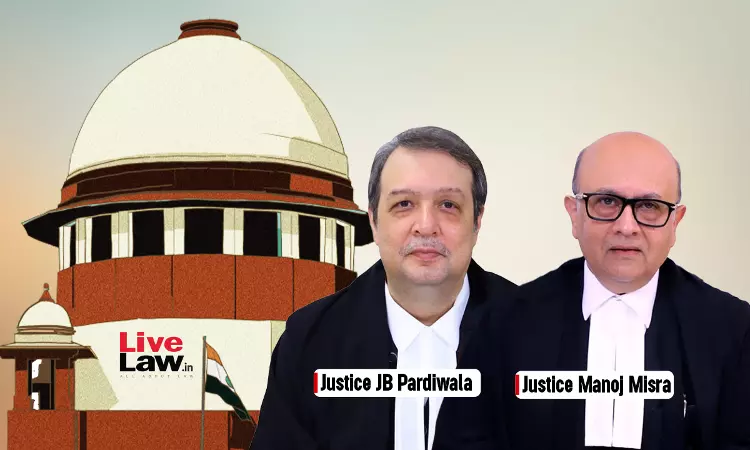
The Supreme Court on Tuesday (July 14) has ruled that the proviso to Section 68 of the Indian Evidence Act, 1872 has no application to a registered sale deed, since the law does not mandatorily require a sale deed to be attested by witnesses.“The proviso to Section 68 stipulates that it shall not be necessary to call an attesting witness in proof of the execution of any document, not being...
This is a premium content
Available exclusively to
Our subscribers
Subscribe Premium 
INR 1099+GST
Your support helps us to bring you more content at
an affordable subscription scheme !!!
All payment options available
The Supreme Court on Tuesday (July 14) has ruled that the proviso to Section 68 of the Indian Evidence Act, 1872 has no application to a registered sale deed, since the law does not mandatorily require a sale deed to be attested by witnesses.
“The proviso to Section 68 stipulates that it shall not be necessary to call an attesting witness in proof of the execution of any document, not being a Will, which has been registered in accordance with the provisions of the Indian Registration Act, 1908 (16 of 1908), unless its execution by the person by whom it purports to have been executed is specifically denied. A sale deed being not required by law to be attested, the provisions of Section 68 of the Indian Evidence Act on the face of it is not applicable,” observed a bench of Justice JB Pardiwala and Justice Manoj Misra, while setting aside a Kerala High Court judgment that had erroneously applied the proviso to Section 68 to a sale deed transaction.
The Bench clarified the limited scope of the proviso to Section 68, noting that the provision applies only to those documents that require a mandatory attestation.
“The 'execution of any document, except a Will' means those documents which require compulsory attestation like a Gift deed, Mortgage deed, Settlement deed, etc., but it is not mandatory to examine any attesting witnesses in proof of such documents unless its execution is specifically denied."
Background
A dispute arose over 13 cents of land in Kerala. Under a 1978 partition deed, 6.5 cents went to Rajeswari and 6.5 cents to Ashok Kumar and Lalitha. In December 1978, Rajeswari sold her share to Vanajakshi (Ext. A3). On December 31, 1979, Ashok Kumar, Lalitha, and Vanajakshi jointly sold the entire 13 cents to the plaintiff (Ext. A1).
The dispute arose when one Rajeswari executed another sale deed on January 24, 1996 (Ext. A4) for the same 6.5 cents in favour of the appellants, who took forceful possession and started construction.
The Trial Court decreed the suit for the plaintiffs. The First Appellate Court reversed the trial court's order, holding that the plaintiffs failed to prove Ext. A3.
In a plaintiff's second appeal, the High Court restored the Trial Court's decree without formulating substantial questions of law and erroneously applied a proviso to Section 68 of the Evidence Act to a registered sale deed. The High Court said that since the defendants didn't specifically deny the execution of the sale deed in a separate suit or counterclaim, the sale deed in the plaintiffs' favor stood proved.
Aggrieved by the High Court's decision, the defendants approached the Supreme Court, arguing that the High Court erred in applying Section 68 of the Evidence Act to the registered sale deed, as the proviso to Section 68 only applies to documents required by law to be attested, but registered sale deed.
Decision
Allowing the appeal, the Court made it clear that Section 68 applies only to documents that are mandatorily required by law to be attested, such as Wills (under Section 63 of the Indian Succession Act, 1925), Gift Deeds (under Section 123 of the Transfer of Property Act), and Mortgage Deeds. A sale deed, however, does not fall into this category. Section 54 of the Transfer of Property Act, 1882, requires a sale deed to be registered, but does not mandate its attestation.
“Prima facie it appears that the High Court misconstrued the expression “execution of any document, not being a Will” appearing in the proviso to Section 68 of the Evidence Act. The High Court construed “execution of any document” to include a registered sale deed also. We are of the view that the High Court committed an error in understanding the true purport of the proviso to Section 68 of the Evidence Act. The “execution of any document, except a Will” means those documents which require compulsory attestation like a Gift deed, Mortgage deed, Settlement deed, etc., but it is not mandatory to examine any attesting witnesses in proof of such documents unless its execution is specifically denied. In the case of a Will, the examination of one of the attesting witnesses is a necessary requirement, irrespective of whether its execution has been specifically denied or not. This is all that the proviso to Section 68 of the Evidence Act seeks to convey or clarify.”, the court observed.
The Court reiterated the cardinal rule of statutory interpretation that a proviso must be read in relation to the main provision it qualifies. "The proviso to Section 68 carves out an exception only in respect of documents that are required to be mandatorily attested by law. A sale deed does not fall in the category of such documents," the Court observed.
Since, the High Court committed an egregious error in not framing the substantial question of law under Section 100 CPC, the Court remitted back the matter to the High Court to rehear the matter after framing a substantial question of law.
Appearances:
For the Appellant: Mr. Prakash Ranjan Nayak, AOR; Ms. Anupama Kumar, Advocate; Mr. Debasis Jena, Advocate.
For the Respondents: Mr. M. Gireesh Kumar, Advocate; Mr. Ankur S. Kulkarni, AOR; Mr. A.S. Naushad, Advocate; Mr. Sanjay Singh, Advocate; Ms. Sneha Mathew, Advocate.
Headnote
Civil Procedure Code, 1908 — Section 100 & Order XLII Rule 2 — Mandate to Formulate Substantial Questions of Law — The formulation of a substantial question of law is a mandatory condition precedent for admitting, maintaining, and entertaining a second appeal on merits under Section 100 of the CPC - The High Court cannot hear and decide a second appeal on merits or reverse the judgment of the First Appellate Court without expressly formulating such question(s) of law - A judgment delivered without satisfying this mandatory requirement stands vitiated in law. [Paras 23-27]
Indian Evidence Act, 1872 — Section 68 Proviso — Applicability to Registered Sale Deeds — Interpretation of Proviso — Scope of "Specific Denial" — A registered sale deed does not require compulsory attestation under Section 54 of the Transfer of Property Act, 1882 - Section 68 of the Evidence Act applies exclusively to documents that are mandatorily required by law to be attested - neither the main section nor its proviso applies to a registered sale deed - There is no requirement in law to examine an attesting witness to prove a sale deed, even if it contains signatures of marginal witnesses - The High Court erred in expanding the proviso to include a registered sale deed and in holding that an executant must specifically deny the document by way of a separate suit or counter-claim rather than a written statement - The proviso to Section 68 cannot create an independent rule or travel beyond the main provision to cover documents not requiring compulsory attestation by law. [Relied on Nazir Mohamed v. J. Kamala and Others, (2020) 19 SCC 57; Government of Kerala v. Joseph, 2023 INSC 693 / (2001) 3 SCC 179; Bayanabai Kaware v. Rajendra s/o Baburao Dhote, (2018) 1 SCC 585; Rohitash Kumar & Ors. vs. Om Prakash Sharma & Ors., (2013) 11 SCC 451; Paras 31- 46]
Cause Title: R. VERONICA & ANR. VERSUS RUDRAYANI DEVAKI(D) THROUGH LRS. S. SATHA KUMAR & ORS.
Citation : 2026 LiveLaw (SC) 676
Tags

Yash Mittal
Yash Mittal is a Correspondent with LiveLaw, covering the Supreme Court of India

