Supreme Court Sets Aside Gift Deed Executed Over Share Given Up In Family Settlement
Yash Mittal
15 Oct 2026 5:07 PM IST
The Supreme Court has held that a person having parted with his share in a property via a compromise deed cannot later execute a gift deed in relation to the same property. The Court faulted the Telangana High Court's order for overlooking a compromise deed before upholding the execution of a gift deed by a man who had already relinquished his share via a compromise deed.
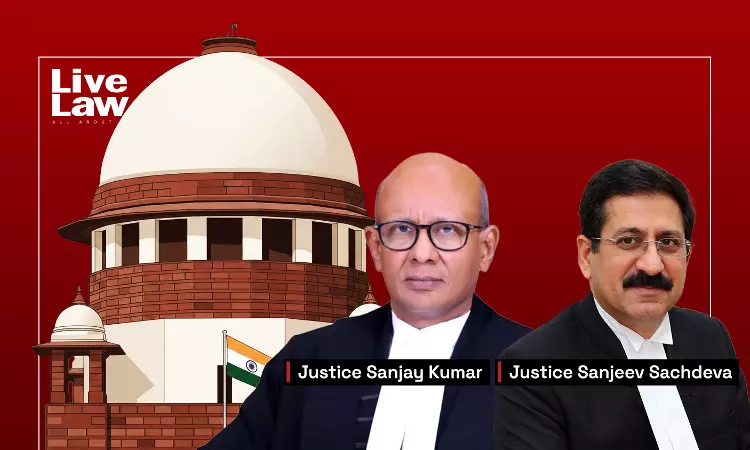
A bench of Justice Sanjay Kumar and Justice Sanjeev Sachdeva heard a case in which a man, despite having relinquished his claim over properties allotted to his mother under a 1986 compromise in exchange for absolute rights over a house property, subsequently executed a gift deed in 2007 in respect of the same properties.
The core legal issue before the Court was whether a gift deed could be upheld without properly appreciating the effect of an earlier family settlement and a compromise decree that had recognised the parties' respective rights over the properties.
The dispute arose from a family settlement executed on April 19, 1959, dividing ancestral properties among family members. Under the settlement, Madhusudhan Reddy received specific properties, while certain lands in Karkalpahad village were allotted to his mother, Manikyamma.


Subsequently, during the pendency of litigation concerning the family properties, Madhusudhan Reddy entered into a compromise with Anasuyamma and her adopted son, Venkatraji Reddy, in February 1986. Under the settlement, he relinquished his claim over the properties allotted to his mother and secured absolute rights over the Himayatnagar house. The compromise was recorded by the High Court, which allowed the appeal in terms of the settlement in September 1990.
However, in April 2007, Madhusudhan Reddy executed a registered gift deed in favour of Siddhartha Reddy, transferring several parcels of land in Karkalpahad village. The appellants contended that the lands covered by the deed had not been allotted to Madhusudhan Reddy under the 1959 family settlement and were among the properties over which he had relinquished his claims under the 1986 compromise.
Anasuyamma, Venkatraji Reddy and another family member subsequently filed a suit seeking a declaration of title, a declaration that the gift deed was null and void, mutation of revenue records and a permanent injunction.
The trial court dismissed the suit in 2012, and the Telangana High Court upheld the decision in 2022.
Setting aside the concurrent findings of the trial court and High Court, the judgment authored by Justice Sanjay Kumar found that both courts had failed to draw the correct inferences from the family settlement and the compromise approved by the High Court.
“This finding was based on the failure of the learned Judge to note the contents of the family settlement dated 19.04.1959, which was accepted by Madhusudan Reddy also, and the compromise dated 24.02.1986, whereby Madhusudhan Reddy gave up his claim for a share in the properties allotted to Manikyamma in the family settlement of 1959 and secured full rights in the house property at Himayatnagar, Hyderabad.”, the Court said.
“Founded on such fundamental errors, the judgments of the High Court and the Trial Court cannot be sustained.”, the Court said.
As a result, the appeal was allowed, thereby decreeing the suit.
For Petitioner(s) Mr. L. Narasimha Reddy, Sr. Adv. Mr. P. Venkat Reddy, Adv. Mr. Prashant Kumar Tyagi, Adv. Mr. P.srinivas Reddy, Adv. Mr. P. V. Narasimha Reddy, Adv. M/s Venkat Palwai Law Associates, AOR
For Respondent(s) None