



- Home
- /
- Supreme court
- /
- Supreme Court Suggests Expanding...
Supreme Court Suggests Expanding S.306 Succession Act To Allow Survival Of Tortious Claims On Legal Heirs
Yash Mittal
20 May 2026 10:09 AM IST
The Court recommended that the Law Commisison of India may examine this issue.
The Supreme Court has recently recommended that the Law Commission of India re-examine Section 306 of the Indian Succession Act, 1925, to consider expanding its scope to include the tortious claims against deceased wrongdoers. At present, Section 306 of the Indian Succession Act (“Act”) follows an old legal principle called “actio personalis moritur cum persona”, which means a...
This is a premium content
Available exclusively to
Our subscribers
Subscribe Premium 
INR 1099+GST
Your support helps us to bring you more content at
an affordable subscription scheme !!!
All payment options available
The Supreme Court has recently recommended that the Law Commission of India re-examine Section 306 of the Indian Succession Act, 1925, to consider expanding its scope to include the tortious claims against deceased wrongdoers.
At present, Section 306 of the Indian Succession Act (“Act”) follows an old legal principle called “actio personalis moritur cum persona”, which means a personal legal action dies with the person. In simple terms, in many personal injury or tort cases, if the accused/negligent person dies before the adjudication of the case, the case may also come to an end.
Section 306 of the Indian Succession Act, 1925 basically says that after a person dies, their legal rights and liabilities generally continue through their legal heirs or representatives. However, there are certain exceptions, such as cases involving defamation, assault, or other personal injuries that do not result in death, and cases where the relief becomes meaningless after the person's death. In the present case, the Court was mainly concerned with understanding and interpreting these exceptions.
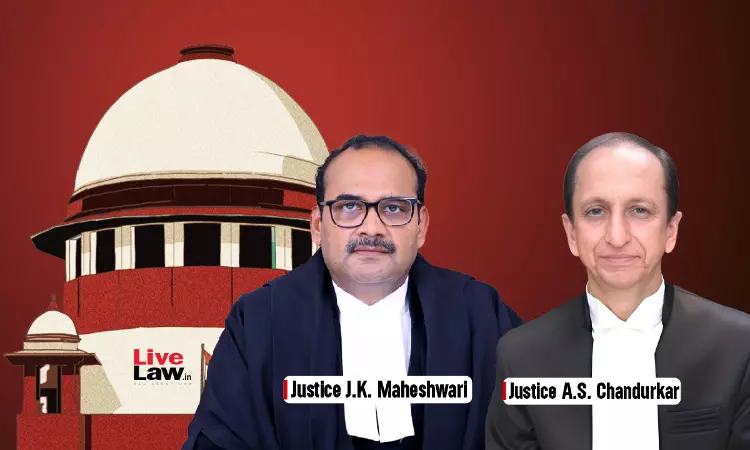
Giving reference to the English Law which has preserved the deceased's dependents liability of the deceased tortuous acts, a bench of Justice J.K. Maheshwari and Justice Atul S. Chandurkar observed:
“We feel that it is appropriate to engage policy experts to debate the need and necessity of expanding scope of Section 306 of 1925 Act. The policy consideration is best left to the Law Commission to see whether there is a need to have a re-look at these provisions for future.”
Background
The observations came while the Court was deciding a medical negligence dispute where the doctor against whom proceedings were initiated died during the pendency of the case before the National Consumer Disputes Redressal Commission (NCDRC).
His legal heirs i.e., the Appellants challenged the NCDRC's order before the Supreme Court, contending that the alleged medical negligence was committed by their deceased father, for which any pecuniary damages arising out of his alleged personal negligent act could not be foisted on them, as upon his death, for which he should be personally liable, should have been extinguished and could not be claimed through his legal heirs in view of the exceptions contained in Section 306 of the Act.
Affirming the NCDRC's findings, the judgment authored by Justice Maheshwari observed that “it is clear that the exceptions provided under Section 306 of 1925 Act have to be limited to those espousing personal cause which do not continue once the plaintiff dies, such as personal claims arising ex delicto like defamation, personal injury etc., however, any claim on pecuniary interest of the deceased estate continues.”
It was against the restrictive scope of Section 306 of the Act, limiting the deceased's dependents liability on the pecuniary losses caused to the victim/complainant, the Court recommended the Law Commission to re-examine the provision to make it align with the English Law, which supports transcending the liability upon the deceased's dependents in matters of pecuniary losses caused by the deceased due to the personal negligent act of the deceased.
In essence, the Court said that it seems illogical to not allow estate claims against the deceased's estate with respect to the categories of exceptions under Section 306 of the Act, such as defamation, assault, and other personal injuries which does not cause the death of the party.
The Court clarified that the dependents of the deceased would be liable to an extent of the share devolved upon them in the deceased's property, not more or less.
Headnote
Consumer Protection Act, 1986 — Section 13(7) (corresponding to Section 38(12) of the Consumer Protection Act, 2019) — Civil Procedure Code, 1908 — Order XXII Rules 2 & 4 — Indian Succession Act, 1925 — Section 306 — Medical Negligence — Death of the Doctor/Opposite Party pending proceedings — Survivability of claims against Legal Heirs — The Supreme Court held that upon the death of an alleged medically negligent doctor during the pendency of a consumer dispute (including at the appellate/revisional stage), their legal heirs can be impleaded and brought on record - the continuation of the "right to sue" under Order XXII of the CPC is fundamentally governed by the substantive law enshrined in Section 306 of the Indian Succession Act, 1925 - When adjudicating claims under the first exception to Section 306 of the 1925 Act, purely personal injury claims (such as damages for pain, suffering, or loss of reputation) lapse and abate with the death of the doctor - Conversely, distinct claims for pecuniary loss or economic damages that affect or are maintainable against the estate of the deceased doctor survive - The Consumer Commissions are duty-bound to first adjudicate the negligence aspect of the deceased doctor before recovering surviving estate-linked claims. [Relied on M. Veerappa Vs. Evelyn Sequeira, (1988) 1 SCC 556; Melepurath Sankunni Ezhuthassan Vs. Thekittil Geopalankutty Nair, (1986) 1 SCC 118; Vinayak Purshottam Dube Vs. Jayashree Padamkar Bhat, (2024) 9 SCC 398; Paras 55-71]
Cause Title: Kumud Lall VERSUS Suresh Chandra Roy (Dead) Through LRs and Others (with connected matter)
Citation : 2026 LiveLaw (SC) 454
Click here to download judgment
Also From Judgement: Doctor's Legal Heirs Liable For Medical Negligence Under Consumer Protection Act : Supreme Court
Tags

Yash Mittal
Yash Mittal is a Correspondent with LiveLaw, covering the Supreme Court of India

