



Supreme Court Upholds Condonation Of 423-Day Delay In Plea To Set Aside Ex Parte Decree On Condition To Deposit Rs 75 Lakh
Saima Anjum
3 Nov 2026 10:44 AM IST
The Supreme Court has recently upheld a Madras High Court Division Bench's order condoning a delay of 423 days in filing an application under Order IX Rule 13 of the Code of Civil Procedure, 1908 (CPC) to set aside an ex-parte decree. It also modified the condition imposed for condonation, holding that the Rs 75,000 which was directed to be paid to the plaintiff must instead be deposited with the High Court, subject to the final outcome of the proceedings.
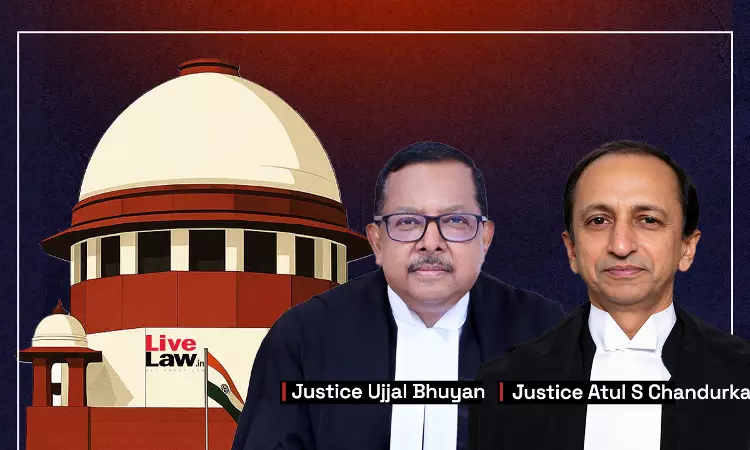
A bench of Justice Ujjal Bhuyan and Justice Atul S Chandurkar ruled so while disposing of two cross-appeals. One was filed challenging the condition imposed, and the other was filed against the condonation of delay.
The plaintiff (Integrated Finance Company Limited) claimed to have entered into several hire-purchase agreements and a lease agreement with partnership firm Business India (Defendant 1/D1) represented by Defendant Nos. 2 to 4 (D2 to D4). It filed a recovery suit for Rs 21,88,11,451.96 in March 2010, with future interest at 36%. Despite service, the defendants did not appear before the trial court (Single Judge of the Madras High Court), and Defendant Nos. 1, 2 and 4 were set ex-parte in August 2021, while Defendant No. 3 (D3) had died in the meantime. The suit was decreed in November 2021.


The Single Judge dismissed the application seeking condonation of delay in March 2023, finding that D4 had appeared through counsel and filed a common affidavit with the other defendants, and knew about the suit before it was decreed.
In appeal, D4 also urged that he was under bona fide belief that the second defendant was looking after the proceedings and that the claim was being settled. In August 2024, the Division Bench held that his bona fides in filing the application belatedly could not be doubted, though he had failed to act with due diligence. Noting that the entire claim had been decreed ex-parte with interest at 36% per annum, it set aside the Single Judge's order and condoned the delay, on the condition that he must pay Rs 75,00,000 to the plaintiff within four weeks so that the amount could be disbursed to various depositors. He was permitted to file his written statement within four weeks, and the suit was directed to be disposed of expeditiously. Thereafter, cross-appeals were filed before the Supreme Court.
Before the Supreme Court, Senior Advocate Siddharth Bhatnagar (representing D4), argued that once the court was satisfied that he deserved an opportunity to contest the suit, the delay ought to have been condoned unconditionally. He further argued that in any case, the amount could not have been directed to be paid to the plaintiff for disbursement to depositors, as the claim was seriously disputed and his contentions had not been considered.
On the contrary, the plaintiff argued that the Division Bench erred in condoning the delay, since none of the grounds warranted acceptance and D4 had improved his case in appeal by raising grounds not urged before the Single Judge. It was also submitted that the Rs 75,00,000 had been directed in view of a submission made on behalf of D4 before the Division Bench, so he could not now wriggle out of that position, and that the amount was on the lower side given the nature of the claim and decree.
The Court took note of its earlier order of September 2024, wherein it had observed that the only fault in the impugned order was that the amount was directed to be paid directly to the plaintiff, and that the Court ought to have directed the petitioner to deposit the said amount with the Registry which could have been invested for the time being. Execution of the ex parte decree was stayed on condition that he deposited Rs 75,00,000 with the High Court, to be invested in an interest-bearing fixed deposit. The Court recorded that the amount now stands deposited, “albeit after some delay.”
With regards to condonation of delay, the bench held that having considered the grounds raised before the Single Judge and the supplemental grounds raised before the Division Bench, the discretion exercised “cannot be said to be so arbitrary or irrational requiring this Court to interfere in exercise of its jurisdiction under Article 136 of the Constitution of India.”
“An opportunity to contest the proceedings on merits having been granted to the fourth defendant by the impugned order, that exercise does not deserve to be thwarted,” it added.
With regards to the condition, the Court agreed that requiring a deposit of Rs 75,00,000 for condoning the delay was reasonable, but held that directing payment to the plaintiff at this stage was unwarranted. “The further direction to pay that amount to the plaintiff at this stage appears to be unwarranted, especially when the fourth defendant seeks setting aside of the ex parte decree. While condoning delay of 423 days, the Division Bench could have directed deposit of the sum of Rs 75,00,000, which deposit could have abided by the final outcome of the proceedings,” it was added.
It therefore made its interim direction passed in September 2024 absolute, requiring the amount to remain in deposit subject to the final outcome of the proceedings.
Rejecting the plaintiff's plea that the amount was too low, the Supreme Court said it did not find so and that the discretion exercised did not warrant interference. Instead, the ends of justice would be met by reserving liberty to the plaintiff to ask the Court to impose appropriate conditions on the fourth defendant while considering his prayer for stay of execution of the ex parte decree. The bench left it open that D4 may oppose any such request.
The Court also clarified that the observations made by the Division Bench in the impugned judgment “shall not weigh with the learned Single Judge while considering the prayer for setting aside the ex parte decree.” That prayer is to be considered on its own merits, “uninfluenced by any observations made in the impugned judgment as well as in the present judgment,” and the parties' contentions in that regard are left open.
The Court, thus, modified the direction to pay Rs 75,00,000 to the plaintiff for disbursement to depositors, requiring the D4 instead to deposit the amount with the High Court, subject to the final outcome of the proceedings, to be invested in an interest-bearing deposit.
Both appeals were, accordingly, dismissed.
Appearance:
For Petitioner: Mrs. Pragya Baghel, AOR; Mr. Surjendu Sankar Das, AOR
For Respondent: Mr. Siddharth Bhatnagar, Sr. Adv.; Mr. Surjendu Sankar Das, AOR; Ms. Annie Mittal, Adv.; Mr. Vishwajeet Singh Shekhawat, Adv.; Mr. Asif Lampwala, Adv.; Mr. Chirag Sancheti, Adv.; Mr. Aditya Sidhra, Adv.; Mr. VP Raman, Adv.; Mrs. Pragya Baghel, AOR; Mr. K. Seshasayee, Adv.; Mr. Yuvraj Kashyap, Adv.


