



- Home
- /
- Supreme court
- /
- Supreme Court Urges Railways To...
Supreme Court Urges Railways To Prevent Overcrowding In Trains, Suggests Dropping 'Second Class Passenger' Term
LIVELAW NEWS NETWORK
18 July 2026 8:15 AM IST
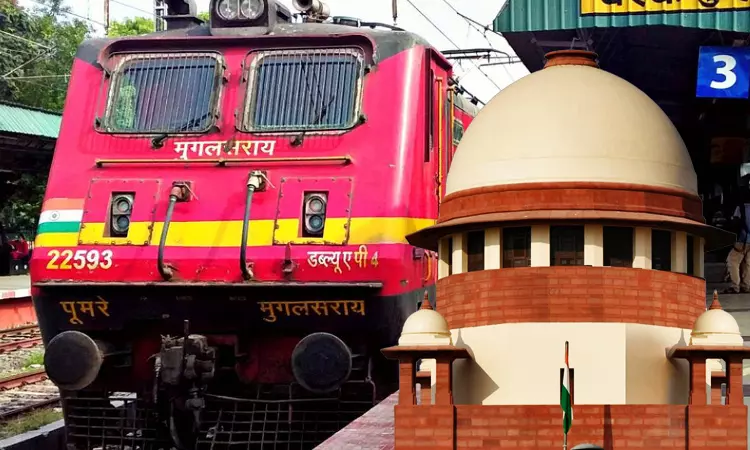
The Supreme Court on Friday urged the Indian Railways to take effective measures to curb overcrowding in trains, observing that such incidents frequently lead to passengers falling from moving trains and losing their lives. The Court also suggested that the Railways discontinue the use of the expression "second class passenger" in its manuals, stating that the class distinction should be...
This is a premium content
Available exclusively to
Our subscribers
Subscribe Premium 
INR 1099+GST
Your support helps us to bring you more content at
an affordable subscription scheme !!!
All payment options available
The Supreme Court on Friday urged the Indian Railways to take effective measures to curb overcrowding in trains, observing that such incidents frequently lead to passengers falling from moving trains and losing their lives. The Court also suggested that the Railways discontinue the use of the expression "second class passenger" in its manuals, stating that the class distinction should be attached to the coach and not to the passenger, in keeping with the constitutional ethos.
A Bench of Justice Sanjay Karol and Justice Nongmeikapam Kotiswar Singh made these observations while allowing an appeal filed by the widow of a man who died after falling from a running train in 2015. The Court awarded her compensation of ₹8 lakh after holding that the absence of the deceased's ticket could not by itself defeat a genuine claim under the Railway Act.
Observing that deaths due to passengers falling from overcrowded trains are "not a rare occurrence", the Bench said that although such incidents may appear statistically insignificant in the context of the Railways' vast operations, they are life-altering tragedies for affected families.
The Court referred to recent incidents of overcrowding, including the Mumbai suburban train accident in June 2025 in which four commuters died after falling from overcrowded local trains, the New Delhi railway station stampede during the Maha Kumbh rush, and several other accidents across the country. It noted that these incidents underscore the continuing safety concerns arising from overcrowding.
Examining the Indian Railway Commercial Manual, the Court noted that the Railways has already framed detailed guidelines requiring station masters, guards and ticket checking staff to prevent overcrowding, distribute passengers evenly across coaches, warn stations ahead when trains become overcrowded, and arrange additional coaches where necessary.
"The forethought is clearly visible, but the execution leaves much to be desired," the Bench remarked.
The Court further observed that implementation of many of these measures would require substantially greater manpower. In this context, it suggested that the Railways consider employing more young people.
"While we are in the era of modernisation, we may suggest that it may be only felicitous both for the Organisation and the country as a whole if the youth of today are employed by the Organisation, not only giving them a stable source of livelihood but also preserving human lives," the judgment said.
At the same time, the Bench said passengers also share responsibility for their own safety.
"It would be entirely unfair to cast sole responsibility upon the Railways. The passengers themselves have an equal responsibility... Sometimes practical considerations must give way to the preservation of life," the Court observed, referring to the risks undertaken by passengers while boarding or travelling on overcrowded trains.
The Court also took exception to the terminology used in Railway manuals describing travellers as "second class passengers."
"While it is ostensibly linked to the expenditure incurred by the passenger to travel, we may suggest that the class connotation be attached to the coach and not to the passenger, in recognition of the history of class divisions in our country and the same being offensive to the spirit of the Constitution of India," the Bench observed.
On the facts of the case, the Court held that the Railway Claims Tribunal and the Madhya Pradesh High Court had wrongly denied compensation merely because the deceased's journey ticket was not recovered. His widow had consistently stated that the ticket was kept in his travel bag, which went missing after the accident.
Reiterating that Section 124A of the Railways Act embodies a beneficial "no-fault liability" regime, the Court held that the claimant had discharged the initial burden by filing an affidavit stating that the deceased possessed a valid ticket. Merely because the ticket was lost in the accident could not negate his status as a bona fide passenger.
Accordingly, the Court set aside the orders of the Tribunal and the High Court and directed the Railways to pay compensation of ₹8 lakh within four weeks, failing which the amount would carry interest at 8% from the date of filing of the claim petition.
Appearances :
For Petitioner(s) :Ms. Shweta Priyadarshini , AOR
For Respondent(s) : Mr. Brijender Chahar, A.S.G. Ms. Seema Bengani, Adv. Mr. Prashant Singh-ii, Adv. Ms. Sweksha, Adv. Ms. Radhika Mishra, Adv. Mr. Amrish Kumar, AOR
Headnote
Railways Act, 1989 – Sections 123(c)(2) and 124A – Claims for Compensation – Untoward Incident – Bona Fide Passenger – Absence of Journey Ticket – The Supreme Court set aside the concurrent findings of the Railway Claims Tribunal and the High Court which had rejected a compensation claim on the grounds that the deceased's ticket was not recovered and his bona fides as a passenger were not established – Held, Section 124A provides for "no-fault liability" and carries a beneficial statutory intent - It must receive a purposive and liberal interpretation rather than a restrictive, literal approach - The standard of proof governing such claims is the preponderance of probabilities, not proof beyond reasonable doubt - Technical approaches or procedural lapses should not defeat the humanitarian and welfare objective of the statute.
Status of Passenger when Ticket is Missing – Quantum of Compensation - Reaffirming established precedent, the Supreme Court held that the mere absence of a ticket on the person or body of an injured or deceased passenger is not conclusive proof to negative a claim or classify them as a ticketless traveller - The initial burden on the claimant can be effectively discharged by filing an affidavit of relevant facts, after which the burden shifts to the Railways to disprove the claim based on the attending circumstances - In the present case, since the claimant filed an undisputed affidavit detailing that the deceased purchased a ticket which was subsequently misplaced along with his untraceable luggage during the accident, the initial burden stood discharged - In terms of Schedule I to the Railway Accidents and Untoward Incidents (Compensation) Rules, 1990 (as amended), the compensation for death was awarded at ₹8,00,000/- with a direction to pay within four weeks, failing which it shall carry an interest rate of 8% per annum from the date of filing the claim petition. [Relied on Union of India v. Rina Devi, (2019) 3 SCC 572; Paras 9-21]
Case : Lata v Union of India
Citation : 2026 LiveLaw (SC) 689


