



- Home
- /
- Supreme court
- /
- 'There Can't Be Part Acceptance &...
'There Can't Be Part Acceptance & Part Rejection Of Prosecutrix's Statement' : Supreme Court Acquits Man In Rape Case
Yash Mittal
25 Sept 2026 6:49 PM IST
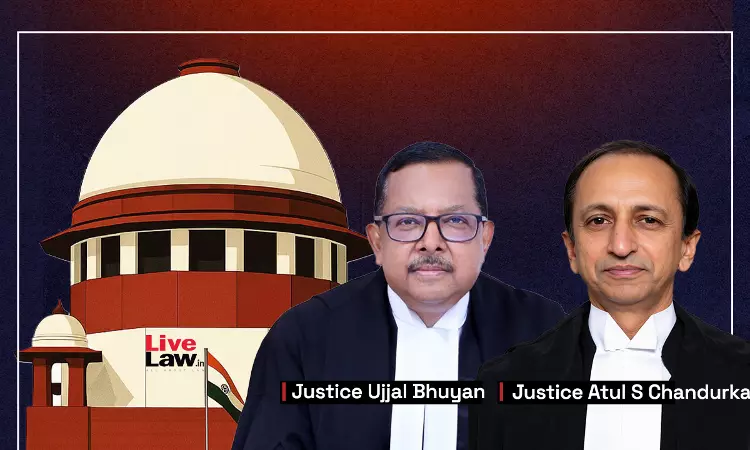
The Supreme Court on Friday (September 25) acquitted a man of rape charges, observing that a court cannot partially reject the testimony of a prosecutrix while deciding one charge and then partially accept the same testimony to convict the accused for rape. A Bench of Justice Ujjal Bhuyan and Justice Atul S. Chandurkar set aside the Punjab & Haryana High Court's judgment, which had...
This is a premium content
Available exclusively to
Our subscribers
Subscribe Premium 
INR 1099+GST
Your support helps us to bring you more content at
an affordable subscription scheme !!!
All payment options available
The Supreme Court on Friday (September 25) acquitted a man of rape charges, observing that a court cannot partially reject the testimony of a prosecutrix while deciding one charge and then partially accept the same testimony to convict the accused for rape.
A Bench of Justice Ujjal Bhuyan and Justice Atul S. Chandurkar set aside the Punjab & Haryana High Court's judgment, which had sustained the Appellant's rape conviction ordered by the Sessions Court. The conviction was based on that part of the prosecutrix's testimony in which she denied consent to a physical relationship, even though the same testimony had been rejected by the Sessions Court while acquitting the Appellant of the offence of kidnapping.
“There cannot be partial rejection of the evidence of the prosecutrix for the purpose of Section 366 IPC and partial acceptance of the very same statement for the purpose of proving the charge under Section 376 IPC. If the evidence of the prosecutrix is of unimpeachable character, it has to be accepted in its entirety. There cannot be part acceptance and part rejection of the statement of the prosecutrix.”, observed the Court, stressing that the prosecutrix's denial of consent is not enough to sustain conviction; rather, her testimony must be seen in the overall context.
“If her evidence is taken as a whole, certainly a view can be taken that her version that the accused appellant had sexual intercourse with her forcibly without her consent does not merit acceptance. The version of the prosecutrix is not believable at all.”, the Court added.
The case arose from an allegation that the Appellant had taken the prosecutrix, who was studying in Class VIII, first to a flat in Ludhiana and thereafter to an abandoned factory in Malerkotla, where he allegedly had sexual intercourse with her against her will.
The Sessions Court acquitted the Appellant of the charge under Section 366 IPC, finding that the prosecution had failed to establish that the prosecutrix was a minor or that she had been kidnapped or abducted. However, it convicted him under Section 376 IPC and sentenced him to 10 years' rigorous imprisonment.
The High Court affirmed the conviction, relying, inter alia, on the presumption under Section 114A of the Evidence Act after the prosecutrix denied consent, following which the accused moved to the Supreme Court.
Allowing the appeal, the judgment authored by Justice Bhuyan criticised the reasoning adopted by the Sessions Court, being upheld by the High Court, to reconcile its findings under Sections 366 and 376 IPC.
“We are afraid the learned Sessions Judge has gone completely wrong while justifying the conviction of the accused-appellant under Section 376 IPC. The High Court also fell in error in accepting such convoluted logic.”, the Court said.
Disagreeing with the High Court's reliance on Section 114A of the Evidence Act to convict the Appellant for rape, the Court held that the prosecutrix's denial of consent could not be examined in isolation from the rest of her testimony, when her testimony brings in material contradiction. The statutory presumption had to be considered in the overall evidentiary context.
According to the Court, there is no legal rule requiring corroboration of the testimony of a prosecutrix in every rape case. However, where conviction is sought on her sole testimony, the evidence must be of such quality as to inspire the confidence of the court.
The Court found several material inconsistencies in the prosecutrix's evidence.
Among other things, she gave contradictory accounts about whether she and Appellant returned from Malerkotla by car or train. The Court also noted that during the journey from Ludhiana to Malerkotla, she travelled through busy streets and intersections but did not raise an alarm or attempt to get off the scooter, when she claimed to have been forcibly taken by the Appellant.
The Court also took note of the medical evidence. The doctor who examined the prosecutrix found no external injuries and no injuries on her private parts. The Court observed that the mere presence of spermatozoa in the vaginal swab, in the circumstances of the case, could not by itself establish rape.
“Despite passing through busy streets and intersections, she did not raise any hue and cry. Neither did she make any attempt to alight from the scooter to escape from the accused-appellant. Learned Sessions Judge rightly pointed out that if she had not voluntarily gone with the accused-appellant, she could have easily raised a hue and cry or disembarked from the scooter. PW-1 did not do so. Therefore, her statement that she had raised hue and cry when she was in the room at Malerkotla is extremely difficult to accept. Her evidence is riddled with contradictions. Mere presence of spermatozoa in the vaginal swab of the prosecutrix would not prove rape given the surrounding circumstances.”, the Court said.
Moral assessments cannot replace proof
The Court, further, cautioned against allowing moral assessments to substitute proof of a criminal offence. “While the conduct of the appellant may be immoral and unethical, that by itself would not justify a conviction under Section 376 IPC without any clinching evidence.”, the Court said.
“Such a charge must be proved on the basis of hard evidence and not on the basis of the surmises and conjectures based on the value judgment of the presiding judge. Immorality of an act sans credible evidence cannot justify a conviction.”, the Court added.
As a result, the appeal was allowed, holding that the conviction and sentence of the appellant under Section 376 IPC by the Sessions Judge and affirmed by the High Court cannot be sustained.
Cause Title: PARAMJIT SINGH BEDI VERSUS STATE OF PUNJAB
Citation : 2026 LiveLaw (SC) 992
Click here to download judgment
Appearance:
For Appellant(s): Mr. Rajiv Kataria, Adv. M/S. Delhi Law Chambers, AOR Ms. Debjani Das Purkayastha, Adv. Mrs. Deepshikha Shah, Adv.
For Respondent(s): Ms. Nupur Kumar, AOR
Tags

Yash Mittal
Yash Mittal is a Correspondent with LiveLaw, covering the Supreme Court of India

