



- Home
- /
- Supreme court
- /
- TRAI's Direction To Comply With...
TRAI's Direction To Comply With Regulations Is Not 'Adjudication' : Supreme Court
Yash Mittal
25 July 2026 11:33 AM IST
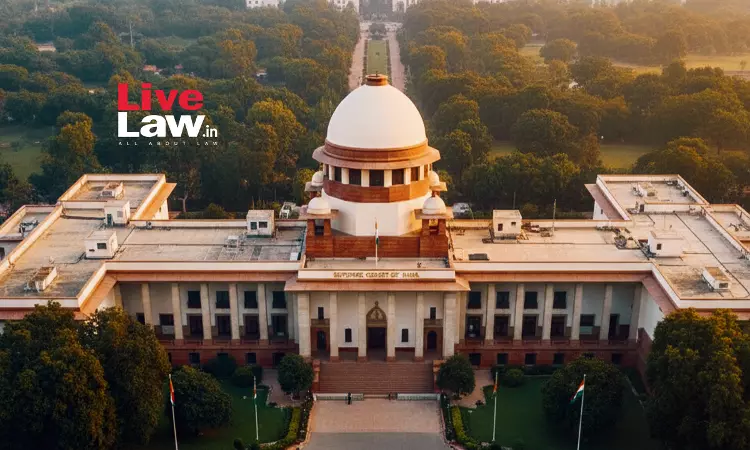
The Supreme Court on Friday (July 24) held that a direction of the Telecom Regulatory Authority of India (TRAI) to comply with the provisions of the Act cannot be termed as 'adjudication' under the Telecom Regulatory Authority of India Act, 1997. “A direction to obey a regulation operates upon the regulated entity in the discharge of TRAI's regulatory function under Section 11(1)(b) read...
This is a premium content
Available exclusively to
Our subscribers
Subscribe Premium 
INR 1099+GST
Your support helps us to bring you more content at
an affordable subscription scheme !!!
All payment options available
The Supreme Court on Friday (July 24) held that a direction of the Telecom Regulatory Authority of India (TRAI) to comply with the provisions of the Act cannot be termed as 'adjudication' under the Telecom Regulatory Authority of India Act, 1997.
“A direction to obey a regulation operates upon the regulated entity in the discharge of TRAI's regulatory function under Section 11(1)(b) read with Section 13; it is not a determination of a lis inter se…Accordingly, neither the direction nor the Show Cause Notice bears the essential attributes of “adjudication”, and TRAI has not trespassed upon the exclusive adjudicatory jurisdiction of the TDSAT.”, observed a bench of Justice SVN Bhatti and Justice NV Anjaria, while setting aside the TDSAT findings, which held against the TRAI's regulatory power to issue direction under the Act.
The case relates to the issuance of a show cause notice by the TRAI to the Multi-System Operator (“MSO”) based on the Local Cable Operators' complaint to TRAI that the MSO had abruptly disconnected the cable television signals for which the LCOs had contracted.
Based on a High Court's direction to look into the LCO's complaint, the TRAI issued a formal Direction commanding immediate restoration of signals to the Complainants and the filing of a compliance report within ten days.
To check the compliance of the direction, the TRAI later on, relying on the Police Commissioner report which recorded non-compliance of its direction, issued a show cause notice to the MSO seeking an explanation as to why a formal complaint should not be filed against it before a court under Section 34 of the TRAI Act for violating TRAI's directions.
Aggrieved by the TRAI's show cause notice, the MSO moved to the Telecom Disputes Settlement and Appellate Tribunal arguing that the issuance of the show cause notice by the TRAI amounted to adjudication of the dispute, which is impermissible under the Act.
The TDSAT allowed the MSO's plea holding that TRAI had no adjudicatory jurisdiction to issue the directions and that the Show Cause Notice was, therefore, void ab initio.
Aggrieved by the TDSAT ruling, TRAI moved to the Supreme Court arguing that a mere instruction to the MSO to comply with the regulations did not amount to adjudication of the dispute or usurp the Tribunal's jurisdiction.
Setting aside the impugned findings, the judgment authored by Justice Bhatti upheld TRAI's power as a regulator to issue directions to report compliance under the Act.
“TRAI has adjudicated nothing. It has not resolved the underlying commercial dispute between the MSO and the LCOs over the subscription arrangement; it has awarded no damages, quantified no arrears, moulded no relief and adjusted no equities between the contesting operators. What TRAI intended to do was to call upon the MSO to comply with a subsisting statutory safeguard, i.e., Regulation 4 of the IC Regulations, which forbids the disconnection of signals otherwise than in accordance with the prescribed procedure.”, the Court observed.
The Court summed up its considerations as follows:
“19.1 TRAI is empowered by Section 11(1)(b) and Section 13 to issue directions.
19.2 Section 36, by its plain interpretation, and as has been held in BSNL (supra) does not limit the power of TRAI but confers upon TRAI a wide and pervasive power to make regulations to carry out the purposes of the Act. This power being subject only to the provisions of the Act and the Rules framed under Section 35, and being neither controlled nor limited by Section 36(2) or by Sections 11, 12 and 13.
19.3 TRAI is authorised to issue directions, and disobedience of directions attracts the penalty stipulated by Section 29, which is to be determined by the competent court.
19.4 The direction issued by TRAI must be referable to, and confined to, securing compliance with a subsisting regulation, licence condition or other matter falling within Section 11(1)(b); it cannot travel beyond the regulatory field into the resolution of the parties' contractual claims.
19.5 TRAI may record, for the limited purpose of enforcement, a prima facie finding of non-compliance, but it cannot render a final and binding adjudication of the parties' inter se rights, award damages, quantify arrears, 18 entertain counterclaims or mould reliefs. These functions belong to the TDSAT.
19.6 Upon non-compliance with a valid direction, TRAI's role is confined to that of a complainant under Section 34; it can neither adjudge the guilt of the defaulter nor determine, levy or recover the fine under Section 29, which is the exclusive province of a Court not below that of a Chief Metropolitan Magistrate or a Chief Judicial Magistrate of the First Class.
19.7 Where the true substance of the grievance is a dispute between two service providers, as distinct from the breach of a regulation, the matter lies before the TDSAT under Sections 14 and 14A.”
In terms of the aforesaid, the appeal was allowed.
Headnote
Telecom Regulatory Authority of India Act, 1997 - Sections 11(1)(b), 13, 14, 29 & 34 – Nature of TRAI's Power – Enforcement of Statutory Regulations vs. Adjudication of Disputes - A statutory direction issued by the Telecom Regulatory Authority of India (TRAI) to a Multi-System Operator (MSO) to ensure compliance with the Telecommunication (Broadcasting & Cable Services) Interconnection Regulations is a regulatory and administrative action, not an "adjudication" of a dispute - Adjudication involves a true judicial determination presupposing a lis or controversy, resulting in a binding declaration of rights - Merely calling upon an entity to follow statutory safeguards (such as the procedure for disconnecting signals under the Interconnection Regulations) does not decide an underlying commercial dispute, award damages, or mould reliefs - such directions or preparatory show-cause notices do not trespass upon the exclusive adjudicatory jurisdiction vested in the Telecom Disputes Settlement and Appellate Tribunal (TDSAT) under Section 14 of the Act. [Paras 14 - 18]
Sections 29, 34 & Chapter IV – Regulatory Enforcement Mechanism – Limitations on TRAI - While TRAI is empowered to issue directions to secure compliance with subsisting regulations and can record a prima faciefinding of non-compliance for the limited purpose of enforcement, it cannot act as a judge in its own cause - Upon non-compliance, TRAI's role is strictly confined to that of a complainant under Section 34 before a competent criminal court (not below a Chief Metropolitan Magistrate or a Chief Judicial Magistrate of the First Class) - TRAI cannot itself adjudge the guilt, levy, or recover the fine stipulated under Section 29 - Final and binding adjudication of inter se contractual rights, counterclaims, and damages remains the exclusive province of the TDSAT. [Paras 17 - 19]
Sections 36(1) & 36(2) – Scope of Regulation-Making Power - The power vested in TRAI under Section 36(1) to make regulations to carry out the purposes of the Act is wide, pervasive, and general - It is subject only to the provisions of the TRAI Act and the rules framed under Section 35, and it is neither controlled nor restricted by the specific illustrative topics listed in Section 36(2) or by Sections 11, 12, and 13. [Relied on Bharat Sanchar Nigam Limited v. Telecom Regulatory Authority of India & Ors., (2014) 3 SCC 222; Bharat Bank Ltd. v. Employees of Bharat Bank, AIR 1950 SC 188; Indian National Congress (I) v. Institute of Social Welfare, (2002) 5 SCC 685; S. Sundaram Pillai v. V.R. Pattabiraman, (1985) 1 SCC 591; Paras 15 - 19]
Cause Title: TELECOM REGULATORY AUTHORITY OF INDIA VERSUS M/S POLIMER CABLE NETWORK AND OTHERS
Citation : 2026 LiveLaw (SC) 718
Click here to download judgment
Appearance:
For Appellant(s) Mr. Saket Singh, Sr. Adv.(Argued by) Mr. Sanjay Kapur, AOR Mr. Surya Prakash, Adv. Ms. Shubhra Kapur, Adv. Ms. Mahima Kapur, Adv.
For Respondent(s) [For Intervenor(s)] Mr. Amitesh Chandra Mishra, Adv. Ms. Vishakha Jha, Adv. Mr. Mrityunjai Singh, Adv. Ms. Tishya Pandey, Adv. M/s ACM Legal, AOR
Tags

Yash Mittal
Yash Mittal is a Correspondent with LiveLaw, covering the Supreme Court of India

