



- Home
- /
- Supreme court
- /
- Uncle-In-Law Can't Adopt Niece's...
Uncle-In-Law Can't Adopt Niece's Husband As 'Ghar damad' Under Oraon Tribe Custom : Supreme Court
Yash Mittal
9 July 2026 2:57 PM IST
In an important development concerning the customary inheritance practice of the Oraon tribal community, the Supreme Court on Thursday (July 9) held that an uncle-in-law cannot validly induct his niece's husband as a ghar damad (resident son-in-law) under the recognized customary law. “It is nowhere established that an uncle-in-law can adopt his niece's husband as his ghardamad within...
This is a premium content
Available exclusively to
Our subscribers
Subscribe Premium 
INR 1099+GST
Your support helps us to bring you more content at
an affordable subscription scheme !!!
All payment options available
In an important development concerning the customary inheritance practice of the Oraon tribal community, the Supreme Court on Thursday (July 9) held that an uncle-in-law cannot validly induct his niece's husband as a ghar damad (resident son-in-law) under the recognized customary law.
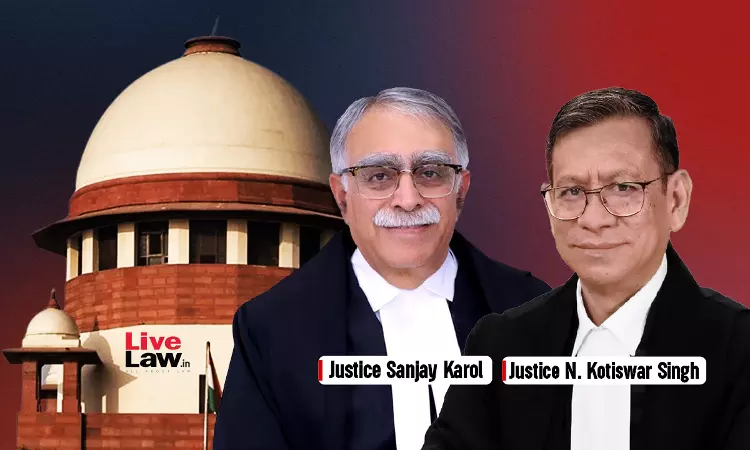
“It is nowhere established that an uncle-in-law can adopt his niece's husband as his ghardamad within the prevalent customary law.”, observed a bench of Justice Sanjay Karol and Justice Nongmeikapam Kotiswar Singh, while setting aside the concurrent findings of the trial court, first appellate court, and the Jharkhand High Court ruling which had approved the ghardamad arrangement by an uncle-in-law.
The dispute arose from ancestral property belonging to Sukhu Oraon, who had three sons, i.e., Dhungru, Ledura, and Bhoula. While Ledura died without children, Bhoula died leaving behind a daughter, Budhain. The plaintiff, Bejla Oraon, son of Dhungru, claimed that as the nearest male agnate, he inherited the property after the deaths of Ledura and Bhoula.
The defendants, however, contended that Budhain's husband, Punai, had been taken as ghar damad by Ledura and was therefore entitled to succeed to the property. They also relied upon a document dated February 27, 1975, described during the proceedings as a partition deed.
The trial court dismissed the suit after accepting the defendants' plea regarding the validity of the ghar damad arrangement. The first appellate court affirmed the decree, while the Jharkhand High Court dismissed the second appeal despite framing a substantial question of law on whether an uncle-in-law was entitled under Oraon customary law to keep a ghardamad, prompting the plaintiff to move to the Supreme Court.
Before the Supreme Court, the plaintiff contended that the Courts below have erred in deciding otherwise, despite no customary practices on record to approve the ghardamad arrangements by an uncle-in-law. He contended that upon the death of Ledura and Bhoula, the nearest male agnate i.e., he himself, is only entitled to inherit the property after the deaths of Ledura and Bhoula.
Finding force in the Appellant-plaintiff's contention, the judgment authored by Justice Karol observed that the defendants had failed to establish that the alleged ghar damad arrangement satisfied the requirements of the applicable custom. While the existence of the institution of ghardamad in Oraon customary law was not in dispute, the Court emphasized that the present case did not fit within that custom.
Relying on S.C. Roy's authoritative work, The Oraon of Chotanagpur, the Court noted that a ghar damad could acquire succession rights only when he was adopted into the household by the last male owner or his widow. In the present case, Punai (Ghar damad) was allegedly inducted by Ledura, who was merely the uncle of Budhain (niece of Ledura) and not her father.
“…in the absence of a ghardamad or any other male heir directly related to the land owner i.e. the male members of the family, the nearest male agnate will have the right in the property. Hence, the judgments of the courts below are set aside. Plaintiff's suit is decreed.”, the Court held.
The appeal was allowed.
Headnote
Customary Law (Oraon Tribe) – Succession and Inheritance – Right of Daughter and Son-in-law (Ghardamad) – Scope of Article 136 of the Constitution of India and Section 100 of the Code of Civil Procedure, 1908 – Interference with Concurrent Findings of Fact - Facts: The dispute pertained to ownership claims over the landed property of one Sukhu Oraon (grandfather), who had three sons: Dhungru, Ledura, and Bhoula - The Plaintiff (Sukhu, second son of Dhungru) claimed ownership over the entire ancestral land - The claim was resisted by Defendant No. 1 (Budhain, daughter of Bhoula) and Defendant No. 2 (Punai, husband of Budhain) on the ground that Ledura (who died issueless) had adopted Punai as his ghardamad (resident son-in-law) and that the properties were partitioned via a deed dated February 27, 1975 - The Munsif Court, First Appellate Court, and the High Court of Jharkhand concurrently dismissed the plaintiff's suit, accepting the ghardamad relationship - Held, concurrent findings of fact are not generally interfered with unless exceptional circumstances exist, such as the finding being perverse, based on no evidence, built on inadmissible evidence, ignoring material circumstances, or resulting in a miscarriage of justice - Held, the party alleging a custom must strictly prove its existence, long usage, certainty, and reasonableness - General observations cannot replace strict proof required under Section 48 of the Evidence Act, 1872 - Held, under the prevalent customary law of the Oraon community, daughters do not have a right of inheritance and are only entitled to maintenance if there is no son - While the custom of a ghardamad acquiring rights in the property of his father-in-law is established, it must be duly adopted by the last male owner or his widow - In the present case, Punai was the husband of Bhoula's daughter (Budhain) but was allegedly adopted as a ghardamad by the uncle-in-law (Ledura) - Customary law does not recognize or permit an uncle-in-law to adopt his niece's husband as a ghardamad - Held, relying upon authoritative scholarly works (The Oraons of Chotanagpur by S.C. Roy), in the absence of a son, an appropriately adopted ghardamad, or other direct male descendants, the property of an issueless Oraon male devolves upon the nearest male agnate - the plaintiff (nephew) is entitled to succeed to the property - The partition/lease deed executed between the niece and the uncle-in-law is non-est and irrelevant to the title - The High Court erred in failing to answer the formulated substantial question of law regarding the uncle-in-law's capacity to adopt a ghardamad merely on the count of concurrent findings below - Merely observing that there is no established bar against such adoption does not satisfy the requirements of Section 100 CPC - The onus was on the defendants to prove such a custom existed. [Relied on Srinivas Ram Kumar v. Mahabir Prasad, 1951 SCC 136; Bharwada Bhoginbhai Hirjibhai v. State of Gujarat, (1983) 3 SCC 217; Mithilesh Kumari v. Prem Behari Khare, (1989) 2 SCC 95; Ramachandran v. Vijayan, 2024 SCC OnLine SC 3384; Paras 6-13]
Cause Title: BEJLA ORAON VERSUS KALI DAS ORAON & ORS.
Citation : 2026 LiveLaw (SC) 657
Click here to download judgment
Appearance:
For Petitioner(s) Mr. Rajan Raj, Adv. Ms. Mohini Priya, AOR Ms. Sayesha Gambhir, Adv.
For Respondent(s) Mr. Vinod Chauhan, Adv. Mr. Pardeep Kumar, Adv. Mr. Ajeet Kumar Bhagat, Adv. Mr. Deepankar, Adv. Mr. Anubhav, AOR Mr. Rakesh Kumar, Adv. Mr. Shivam Munjal, Adv. Mr. Sahil Goyal, Adv. Mr. Umang Tripathi, Adv. Mr. Devansh, Adv. Mr. Ravindra Kumar, Adv. Ms. Shagun Mishra, Adv.
Tags

Yash Mittal
Yash Mittal is a Correspondent with LiveLaw, covering the Supreme Court of India

