



- Home
- /
- Supreme court
- /
- When Tender Acceptance Is Patently...
When Tender Acceptance Is Patently Contrary To NIT Conditions, Courts Can Interfere: Supreme Court
Yash Mittal
22 Sept 2026 5:14 PM IST
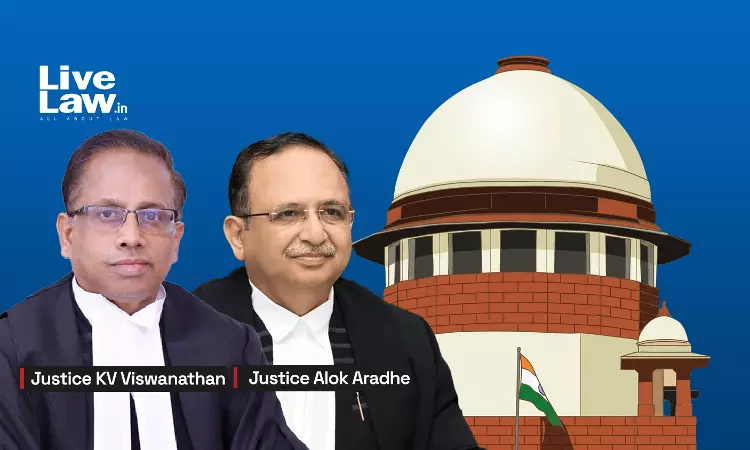
Revenue considerations cannot cure ineligibility of the bidder, the Court added.
The Supreme Court on Monday (September 21) held that while courts must ordinarily defer to the commercial wisdom of a tendering authority, such deference cannot extend to an interpretation of tender conditions that is contrary to the Notice Inviting Tender (NIT) or is patently arbitrary.A bench of Justice KV Viswanathan and Justice Alok Aradhe heard a case where a tender involved collection...
This is a premium content
Available exclusively to
Our subscribers
Subscribe Premium 
INR 1099+GST
Your support helps us to bring you more content at
an affordable subscription scheme !!!
All payment options available
The Supreme Court on Monday (September 21) held that while courts must ordinarily defer to the commercial wisdom of a tendering authority, such deference cannot extend to an interpretation of tender conditions that is contrary to the Notice Inviting Tender (NIT) or is patently arbitrary.
A bench of Justice KV Viswanathan and Justice Alok Aradhe heard a case where a tender involved collection of user charges from large numbers of vehicles entering the Mandi premises over 12 months, under a contract exceeding ₹16 crore.
The tender required experience in the successful execution of annual collection of User Charges/Parking Fees work in Government, Semi-Government or PSU organisations during the preceding two years.
The dispute arose when the tendering authority had treated Appellant's experience in organising cattle fairs as satisfying the requirement, thereby granting the Letter of Acceptance (“LoA”) in the Appellant's favour after finding it to be the highest bidder (“H1”).
The second highest bidder (“H2”) challenged the grant of the Letter of Acceptance in favour of the Appellant before the Punjab & Haryana High Court, which had allowed the Respondent's Writ Petition, thereby interfering with the tendering process, and quashed the LoA issued in the Appellant's favour. The High Court noted that the technical bid of the H1 Bidder did not meet the eligibility criteria; thus, it directed the tendering authority to issue a LoA in favour of the eligible tenderer in accordance with law.
Challenging the High Court's judgment, the H1 moved to the Supreme Court.
Affirming the impugned judgment, the judgment authored by Justice Aradhe noted that the High Court has rightly interfered with the tendering process, as the Appellant- H1 lacks the requisite eligibility as per the terms of the NIT.
According to the Court, the Appellant's experience in organising cattle fairs was not interchangeable with the requirement for granting them a LoA for a tender involving collection of user charges from large numbers of vehicles entering the Mandi premises.
“The H1 Bidder's experience, on its own showing, lies in organising cattle fairs as a fair contractor/lessee; it does not lie in collection of user charges or parking fees as a contractual duty owed to a Government, Semi-Government or PSU body. The two are not interchangeable, and the Committee's letter dated 09.03.2026, treating them as such without more, discloses no application of mind to the language of its own clause.”, the Court said.
The Court reiterated that though the tendering authority is ordinarily the best judge of its requirements and that courts should exercise restraint where two reasonable interpretations are possible, a power of judicial review can be exercised where the decision is “dehors the terms of the NIT or is patently arbitrary.” In support, the Court cited Kimberley Club (P) Ltd. v. Krishi Utpadan Mandi Parishad & Ors. 2025 LiveLaw (SC) 1054, where it was held:
“In tender matters, the Court exercising judicial review does not sit in appeal over the decision of a tendering authority regarding disqualification of bid. Only in cases where such decision is dehors the terms of the NIT or is patently arbitrary would the Court exercise powers of judicial review and set aside such a decision.”
Applying the law laid down in Kimberley Club, the Court observed:
“No reasonable authority, applying its mind to the language it had itself prescribed, could have arrived at the conclusion that the H1 Bidder possessed the requisite experience. The interpretation is accordingly patently arbitrary and is dehors the terms of the DNIT and falls squarely within the narrow exception recognised in Kimberley Club (P) Ltd. (supra) and in Jagdish Mandal (supra). The High Court was, therefore, right in exercising the power of judicial review and in declining to extend to the Committee's interpretation the ordinary deference that authorship of a tender document commands.”
Revenue considerations cannot cure ineligibility
The Court also rejected the Appellant's argument that rejection of its bid, being the highest one, would possibly result in loss of revenue. The Court said that bids can be compared only among bidders who are eligible in the first place. Otherwise, eligibility conditions would effectively yield to the highest financial offer and become meaningless.
“The submission that the H1 Bidder's bid, being higher by about Rs.1.5 crore, ought to be preferred in the interest of the public exchequer, does not assist the H1 Bidder. Revenue considerations cannot cure ineligibility. Bids can be compared only among bidders who are eligible to be compared in the first place; to hold otherwise would be to allow every eligibility condition to yield to the highest figure quoted, and would render the tender document, and the enlistment instructions framed to secure competence and accountability in the collection of public revenue, wholly illusory.”, the Court observed.
As a result, the appeal was dismissed.
Cause Title: MICKY TRADERS Versus L.R.Y. LABOUR CONTRACTOR & ORS. (with connected appeal)
Citation : 2026 LiveLaw (SC) 971
Click here to download judgment
Appearance:
For Petitioner(s) : in SLP 22161/2026 Mr. Siddhartha Iyer, AOR Ms. Jaispriya Poply, Adv. Mr. Aman Gupta, Adv. Mr. Praful Ashok Salvi, Adv.
In SLP 23127/2026 Mr. Jagjit Singh Chhabra, AOR Mr. Jasraj Singh Chhabra, Adv.
For Respondent(s) : No.1 in both petitions Mr. Amit Rawal, Sr. Adv. Mr. Shariq Ahmed, Adv. Mr. Tariq Ahmed, Adv. Mr. Tavleen Singh, Adv. For M/S. Ahmadi Law Offices, AOR
For respondent No.3 in SLP 23127/2026 Mr. Siddhartha Iyer, AOR Ms. Jaispriya Poply, Adv. Mr. Aman Gupta, Adv. Mr. Praful Ashok Salvi, Adv.
For respondent Nos. 3 and 4 in SLP 22161/2026 Mr. Jagjit Singh Chhabra, AOR Mr. Jasraj Singh Chhabra, Adv.
Tags

Yash Mittal
Yash Mittal is a Correspondent with LiveLaw, covering the Supreme Court of India

