



- Home
- /
- Supreme court
- /
- Witness Testimony Recorded Without...
Witness Testimony Recorded Without S.299 CrPC Order Can't Be Later Used Against Accused Who Absconded : Supreme Court
Yash Mittal
31 July 2026 5:59 PM IST
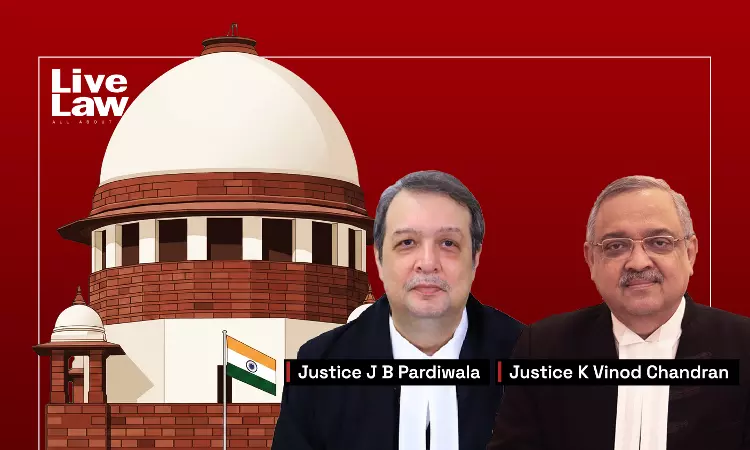
The Supreme Court on Friday (July 31) observed that evidence recorded in a trial against one accused cannot be used against an absconding accused in a subsequent trial unless an order under Section 299 Cr.P.C. / Section 335 BNSS was passed establishing the two jurisdictional facts, i.e., the accused was absconding and that there was no immediate prospect of arresting him. A bench...
This is a premium content
Available exclusively to
Our subscribers
Subscribe Premium 
INR 1099+GST
Your support helps us to bring you more content at
an affordable subscription scheme !!!
All payment options available
The Supreme Court on Friday (July 31) observed that evidence recorded in a trial against one accused cannot be used against an absconding accused in a subsequent trial unless an order under Section 299 Cr.P.C. / Section 335 BNSS was passed establishing the two jurisdictional facts, i.e., the accused was absconding and that there was no immediate prospect of arresting him.
A bench comprising Justice J.B. Pardiwala and Justice K. Vinod Chandran set aside the murder conviction of the appellant, who had absconded during the trial against his co-accused in 1999 and was later convicted in a separate trial. His conviction was based on the testimony of a deceased witness whch was recorded in the previous trial against the co-accused.
The Court held that since no formal order under Section 299 of the Cr.P.C. was passed to establish the jurisdictional facts, namely, that the accused was absconding and that there was no immediate prospect of his arrest, the testimony of the deceased witness recorded in the earlier trial could not be used in a trial against the appellant, following his arrest in 2017.
“…there was no order passed under Section 299 in the year 1999 when the matter was brought before Court, either at the time of committal or at the time of commencement of trial. The flight of the accused, the appellant herein, and the impossibility of apprehending him immediately had to be urged before that Court and it has to be proved to the satisfaction of that Court. Only an order passed, finding proof of both the jurisdictional facts would enable testimony of the witness recorded at that stage to be relied on at a later stage; when the presence of that witness cannot be procured.”, the Court observed.
As per the prosecution's case, two accused were charged with murder in 1999. The appellant allegedly sat on the victim's chest and strangulated him, while the other accused exhorted and threatened passersby. The appellant absconded, while the second accused was tried and acquitted.
The appellant was arrested in 2017, i.e., more than 18 years later. By the time the trial against the appellant commenced, the crucial eyewitness (PW1) had died. The Trial Court and the High Court relied on PW1's testimony recorded in the earlier trial against the second accused, which led to the Appellant's conviction.
Aggrieved by the impugned findings, the Appellant moved to the Supreme Court.
Setting aside the impugned ruling, the judgment authored by Justice Chandran held that the conviction was vitiated because no formal order under Section 299 of the Cr.P.C. was passed during the first trial establishing the jurisdictional facts necessary to use the testimony of PW-1, who died during the trial against the appellant, in the subsequent trial against him.
“…we do not find such an order having been passed in the earlier trail against the second accused. The prosecution, hence, as against the first accused, the appellant herein, fails. The appellant would stand acquitted of the charges framed against him.”, the Court observed.
Notably, a few days back, another co-ordinate bench led by Justice Sanjay Karol in the case of State of West Bengal v. Kader Khan, 2026 LiveLaw (SC) 692, had taken a contrary view on this issue. It was held in Kader Khan that the passing of a formal order under Section 299 Cr.P.C. is not mandatory to use the testimony of the deceased witness against the absconding accused in a trial against him. Therein, the Court observed that the purpose of Section 299 CrPC would be defeated if the testimony of a victim or witness who has since died is refused to be used against an absconding accused merely because the trial court did not pass a formal order when the testimony was recorded during the trial of the co-accused.
"There is no statutory requirement in the aforesaid Section, mandating the formal passing of an order by the Magistrate concerned, recording that the above two facts have been complied with, before the witness has deposed. What would be relevant is whether these two essentials stood established on the date of the deposition of the witness.", the Court observed in Kader Khan (supra). The judgment in Kader Khan explained that when a witness is alive and available, there is ordinarily no occasion to invoke Section 299 because the witness can be examined in the subsequent trial. It is only when the witness dies, becomes incapable of giving evidence, cannot be traced, or cannot be produced without unreasonable delay or expense that the prosecution may seek to rely on the earlier deposition, subject to the statutory requirements.
Cause Title: Mahendra Singh Versus The State of Chhattisgarh
Citation : 2026 LiveLaw (SC) 747
Click here to download judgment
Appearance:
For Petitioner(s) :Mr. Jayesh K. Unnikrishnan, AOR Mrs. Sasmita Tripathy, Adv. Ms. Smriti Parija, Adv. Mrs. Gitanjali Tripathy, Adv. Ms. Gautami Budhapriya, Adv. Mr. Niranjan Bishi, Adv. Mr. Abhilash Joseph, Adv. Mr. Ashish Kumar Rai, Adv. Mr. Ayush Baliarsingh, Adv. Mr. Somesh Sankhala, Adv.
For Respondent(s) :Mr. Siddhartha Sinha , AOR Mr. Praneet Pranav, D.A.G. Mr. Abhishek Pandey, Adv.
Tags

Yash Mittal
Yash Mittal is a Correspondent with LiveLaw, covering the Supreme Court of India

