



- Home
- /
- Supreme court
- /
- Workers Hired Through Contractors...
Workers Hired Through Contractors Can't Claim Equal Status As Regular Employees : Supreme Court
Yash Mittal
12 Jan 2026 1:28 PM IST
The Supreme Court held that contractual workers engaged through third-party service providers are not entitled to equivalent employment benefits as regular employees, observing that such parity would undermine the foundational principles of public recruitment and transparent hiring processes. “If the persons who are employed through a contractor, and have come to work, are given equal...
This is a premium content
Available exclusively to
Our subscribers
Subscribe Premium 
INR 1099+GST
Your support helps us to bring you more content at
an affordable subscription scheme !!!
All payment options available
The Supreme Court held that contractual workers engaged through third-party service providers are not entitled to equivalent employment benefits as regular employees, observing that such parity would undermine the foundational principles of public recruitment and transparent hiring processes.
“If the persons who are employed through a contractor, and have come to work, are given equal benefit and status as a regular employee, it would amount to giving premium and sanction to a process which is totally arbitrary as there is no mode prescribed in any contract as to how the contractor would employ or choose the persons who are to be sent, except for the basic qualification, i.e., knowledge in the field for which they are required.”, the Court observed.
The court observed that regular employment under a State entity is a public asset and cannot be equated with contractual engagement through contractors. It held that if distinctions between regular and contractual employees are blurred, the very purpose of different modes of hiring would be defeated. While regular appointments are governed by transparent procedures ensuring equal opportunity to all eligible candidates, engagement through contractors is left to the contractor's discretion, making the two categories fundamentally distinct in law.
"If all such distinctions between a regular employee and such contractual employees is not made, then the basic concept of hiring through various modes and in different capacity would lose its purpose and sanctity and ultimately everybody would be getting exactly the same benefit. This cannot be permitted in law for the reason that employment under a State entity is a public asset and every citizen of the country has a right to apply for it. In a regular employment, directly made by the said State entity, there are safeguards to ensure that the system of employment/engagement is transparent and fulfills a minimum criteria and is open to all eligible persons and a mode/procedure is adopted for ultimately choosing the right person.
When employees/workmen are taken through a contractor, it is the absolute discretion of the contractor as to whom and through which mode he would choose such persons to be sent to the principal. This is where the difference lies, which is a very valid distinction in law. The reason why there are safeguards in regular appointment is that there should not be any favoritism or other extraneous consideration where persons, only on merit, are recruited through a fully transparent procedure known in law."
The case involved dozens of workers, including sanitation staff, engaged by the Nandyal Municipal Council in Andhra Pradesh's Kurnool District through various manpower contractors since 1994. Despite contractors changing over the years, the same group of workers continued their duties for the municipality for nearly three decades.
Feeling aggrieved that they were performing identical work as regular municipal employees but receiving significantly lower wages, the workers approached the Andhra Pradesh Administrative Tribunal seeking regularization and pay parity. The Tribunal rejected their claim, but the Andhra Pradesh High Court in 2018 ruled in their favor, directing the municipality to grant them the minimum of the time-scale pay attached to regular posts, along with annual increments.
Citing CBSE vs Raj Kumar Mishra, 2025 LiveLaw (SC) 343, the municipality appealed to the Supreme Court, arguing that there was no direct employer-employee relationship with these workers, to make them liable to pay equal pay to the Respondents.
Opposing the appeal, the Respondents citing State of Punjab and Others vs. Jagjit Singh and others, (2017) 1 SCC 148, argued that even the contractual employee performing same duties to that of the regular employee, entitled to receive same benefits.
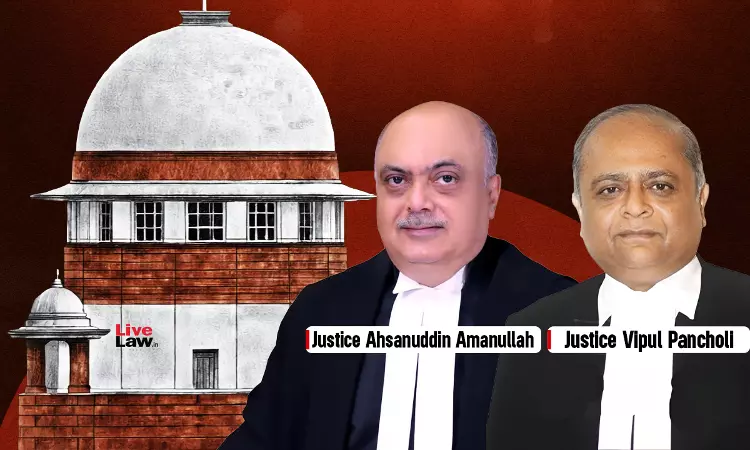
Setting aside the impugner order, a bench of Justices Ahsanuddin Amanullah and Vipul M. Pancholi accepted the Appellant's argument, holding that since no direct employment relationship existed between the Respondent workers and the Municipal Council, the Council was not liable to extend the same employment benefits to them. The Court emphasized that the workers were engaged through an intermediary contractor, which fundamentally altered the nature of their employment.
“If all such distinctions between a regular employee and such contractual employees is not made, then the basic concept of hiring through various modes and in different capacity would lose its purpose and sanctity and ultimately everybody would be getting exactly the same benefit.”, the court said.
“From the facts discussed above, it is clear that the appellant had no direct connection with the actual persons who were employed by the contractor, i.e., the respondents. The obligation and responsibility of the appellant was to pay to the contractor the amount which had been contracted and agreed to between the appellant and the contractor, and the responsibility then was that of the contractor to ensure payment of wages and other emoluments as per the terms of the contract to the persons who were actually sent by the contractor to the appellant for performing various types of job.”, the court added.
Rejecting the Respondent's reliance on Jagjit Singh's case, the Court distinguished this case from the present case, noting that in Jagjit Singh workers involved were directly employed on a contractual basis by the government. In this case, the Court noted, the employment was through an intermediary contractor, creating a fundamentally different legal relationship.
“The judgment/ order relied upon by learned counsel for the appellant aptly covers the field in the present case. The judgment cited by learned senior counsel for the respondents is basically different on facts for the reason that there the contractual employment was directly by the principal and in that background contractual workers have been regularized.”, the court said.
Court Grants limited Relief to Respondents-Contractual Employees
However, in an interesting turn of events, the Court, while allowing the appeal, directed the Appellants to consider exploring the possibility of their regularization, keeping in mind the humanitarian factor.
“we would require the appellant to look into whether the jobs which were being done by the respondents, in the background that they have not been disengaged or returned to the contractor on the ground of being unsatisfactory, having uninterrupted service under the appellant for decades can be regularized on posts, which prima facie appears to be perpetual in nature.”, the court said.
However, the court clarified that “this direction is limited for the purposes of the present case only as it has been passed in the special facts and circumstances of the present case and shall not be treated as a precedent in any other case.”
Headnote
Service Law – Contractual Employment through Third-Party Contractor vs. Direct Contractual Employment – Claim for Minimum Time Scale of Pay – Distinction in Law – The Supreme Court set aside a High Court order directing the Municipal Council to pay the minimum time scale of pay to workers engaged through third party contractors - held that a valid distinction exists between persons employed directly by a State entity and those engaged through an intermediary contractor - While regular employment involves transparent, merit-based procedures open to all citizens, contractors have absolute discretion in selecting personnel to be sent to the principal employer - Granting equal benefits and status to contractor engaged workers would sanction an arbitrary recruitment process and bypass constitutional safeguards for public employment. [Relied on Bharat Heavy Electricals Limited vs. Mahendra Prasad Jakhmola and others, (2019) 13 SCC 82; Joint Secretary, Central Board of Secondary Education and Another Vs. Raj Kumar Mishra and Another, Civil Appeal No. 4014 of 2025; Paras 8-11]
Employer-Employee Relationship – Sham or Camouflage – Held that mere fact that the same individuals continued to work for the principal employer despite periodic changes in contractors does not, by itself, establish a direct relationship or prove a "sham" arrangement - Contractors may retain existing personnel to ensure continuity and prevent complaints from the principal employer - Regularization – Despite allowing the appeals, the Supreme Court exercised its discretion to direct the appellant to consider the respondents' cases for regularization on a sympathetic basis, given their decades of uninterrupted service in jobs that appear perpetual in nature - This direction was issued under the "special facts and circumstances" of the case and is not to be treated as a precedent.
Cause Title: THE MUNICIPAL COUNCIL VERSUS K. JAYARAM AND OTHERS ETC.
Citation : 2026 LiveLaw (SC) 38

Yash Mittal
Yash Mittal is a Correspondent with LiveLaw, covering the Supreme Court of India

