



- Home
- /
- Top Stories
- /
- 2-Judge Bench Created Unnecessary...
2-Judge Bench Created Unnecessary Uncertainty : CJI Surya Kant On Judgment Against Post-Facto Environmental Clearances
LIVELAW NEWS NETWORK
16 Feb 2026 7:17 PM IST
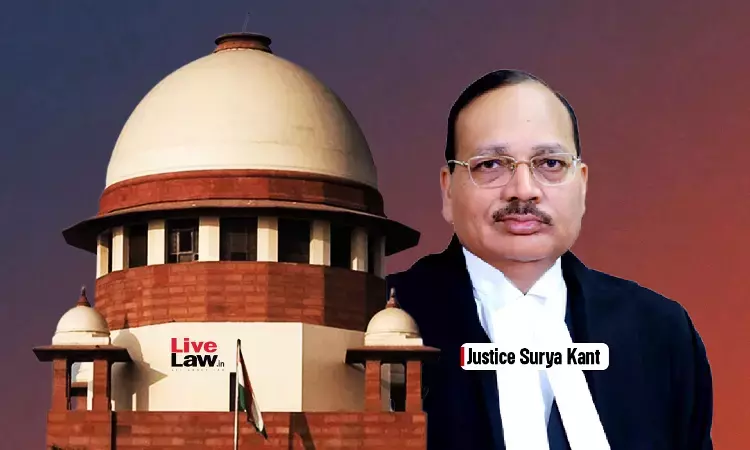
The Court will examine if the recall of the 'Vanashakti' judgment has the effect of upholding the Union OMs on post-facto ECs.
Chief Justice of India Surya Kant on Monday expressed displeasure with the May 2025 judgment of the Supreme Court in the 'Vanashakti' case which barred the grant of post-facto Environmental Clearances, saying that the verdict unnecessarily created uncertainty.Observing that the Supreme Court itself was leading to unpredictability, the CJI said that the 2-judge bench ought to have considered...
This is a premium content
Available exclusively to
Our subscribers
Subscribe Premium 
INR 1099+GST
Your support helps us to bring you more content at
an affordable subscription scheme !!!
All payment options available
Chief Justice of India Surya Kant on Monday expressed displeasure with the May 2025 judgment of the Supreme Court in the 'Vanashakti' case which barred the grant of post-facto Environmental Clearances, saying that the verdict unnecessarily created uncertainty.
Observing that the Supreme Court itself was leading to unpredictability, the CJI said that the 2-judge bench ought to have considered the entire case law before taking a view.
In November 2025, a 3-judge bench (by 2:1 majority), in review, had recalled the May 2025 judgment and restored the matters to the file. The matters were listed today before a bench comprising Chief Justice of India Surya Kant, Justice Joymalya Bagchi and Justice Vipul Pancholi.
The bench said that it will examine on February 25 if the November 2025 judgment in the 'Vanashakti' review has the effect of upholding the Office Memorandums (OMs) issued by the Union Government in 2017 and 2021 allowing the grant of ex-post facto Environmental Clearances.
The bench noted that the review judgment has certain observations which approve the 2017 and 2021 OMs.
Today, Solicitor General of India Tushar Mehta informed the bench that the May 2025 judgment had put various public projects under uncertainty. He cited a mining project of the SAIL and a fully constructed airport in Karnataka as some examples. Senior Advocate P Wilson for the State of Tamil Nadu submitted that a 218-crore cancer hospital project in the State and the construction of a District Collectorate office are now stalled.
Senior Advocate Gopal Sankaranarayanan for the petitioners, clarified that the review judgment does not expressly decide the validity of the OMs, and it only recalled the previous judgment, which invalidated the OMs. The main matter is consequently restored to files for fresh consideration. He cited paragraph 142 of the judgment.
Justice Bagchi, however referred to paragraph 96 of the judgment, where it is observed that the May 2025 judgment was rendered contrary to the previous precedents. Reference was also made to the observation in paragraph 140, which disapproved of the demolition of completed constructions.
CJI Kant also noted paragraph 90 of the judgment which observed that the Common Cause precedent of the Supreme Court did not bar the grant of post-facto ECs.
Solicitor General referred to paragraph 118 of the judgment which held that PSUs which acted as per the 2021 OM cannot be deprived of the benefits.
Justice Bagchi said that it has to be considered if these observations are in the form of "binding precedents" or merely tenative views which prompted the re-opening of the issue.
"Since the final decisions are one of recall, then all these observations might be in the nature of obiter. If these observations are binding observations, then there is nothing left to decide," Justice Bagchi said. He added that the fundamental principle of review is that it only sets aside the earlier judgment, and that it does not decide the lis. "The list comes alive after the review," Justice Bagchi said.
At the same time, Justice Bagchi noted that there are observations in the judgment that the 2021OM was upheld in D. Swamy v. Karnataka State Pollution Control Board(2021 and Pahwa Plastics Private Limited v. Dastak NGO (2023).
"The thing to be seen is if the finding binds us. It is by a coordinate bench," Justice Bagchi noted.
CJI Kant then expressed displeasure with the approach of the 2-judge bench.
"It was the duty of the 2-judge bench that they should have considered the entire case law at that time before taking a view instead of unnecessarily creating uncertainty. We ourselves are leading to unpredictability, and that is unfortunate. Somebody should have honestly assisted the bench pointing out all the judgments Therefore the review bench is absolutely correct that it was a per incurium view. But having said that, the matter is now before us and it is our duty to now decide."
"We have enough time to refer to various parts of the Constitution, but we don't have enough time to refer to our precedents!" CJI added. CJI however added that the bench will hear the matter "with an open mind."
One counsel then pointed out that there is a dissent in Vanashakti review. The dissenting judge, Justice Ujjal Bhuyan, had observed that the precedents in Common Cause (2018) and Alembic Pharmaceuticals (2020) had expressly ruled against ex-post facto ECs, and the judgments in D Swamy and Pahwa were per incurium for not following them.
The bench was also informed that a recent notification issued by the Ministry of Environment and Forests on January 20 said that the Centre as awaiting the Supreme Court's final decision.
Ultimately, the CJI said that the Court will examine the matter on Febraury 25.
Case : Vanashakti v Union of India W.P.(C) No. 1394/2023 and connected cases.


