Top Stories
Clause Saying Arbitration "May Be Sought" Doesn't Constitute A Binding Arbitration Agreement : Supreme Court
The Supreme Court recently held that a clause in an agreement that arbitration "may be sought" to resolve disputes between the parties will not constitute a binding arbitration agreement.Approving the refusal of the High Court to refer the parties to arbitartion, the Supreme Court observed that the phraseology of the clause did not indicate that the parties were bound to go...
SEBI Act | Interest On Unpaid Penalty Applicable Retrospectively, Liability Accrues From Adjudication Order : Supreme Court
In a case involving SEBI's imposition of interest on unpaid penalties, the Supreme Court recently held that interest on unpaid penalty amounts can be applied retrospectively and the defaulter's liability to pay interest shall accrue from the date of expiry of the period specified in the assessment order.No separate demand notice, after the liability is crystallized in the assessment order,...
Supreme Court To Hear President's Reference On Time Limit For Bills' Assent On July 22
The Supreme Court will hear the Reference made by the President under Article 143 of the Constitution on the questions relating to the grant of assent to Bills on July 22.A Constitution Bench comprising Chief Justice or India BR Gavai, Justices Surya Kant, Vikram Nath, PS Narasimha and AS Chandurkar will hear the matter.The President made the reference following the Supreme Court's judgment...
Order XLI Rule 4 CPC No Shield Against Abatement In Joint Appeals Without Substitution Of Deceased Party's LRs : Supreme Court
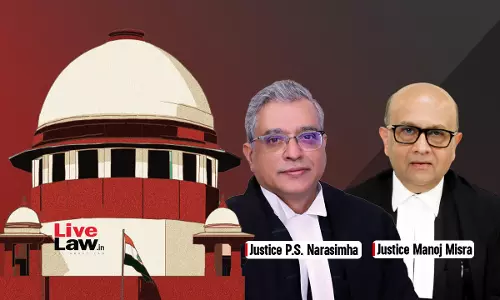
The Supreme Court on Friday (July 18) clarified that a remedy under Order XLI Rule 4 CPC (which allows one party to appeal on behalf of others if the decree is based on common grounds) does not apply when all defendants jointly appeal and one dies without substitution. The bench comprising Justices PS Narasimha and Manoj Misra heard the case where the Appellants/defendants challenged the MP...
NDPS Act | S.32B Doesn't Restrict Trial Court's Power To Impose Sentence Higher Than Statutory Minimum: Supreme Court
The Supreme Court, on 17 July, clarified that Section 32B(factors to be taken into account for imposing higher than the minimum punishment) of the Narcotic Drugs and Psychotropic Substances Act, 1985 ("NDPS Act") does not restrict the trial court's power in awarding a sentence higher than the minimum of ten years. To state briefly, the Appellant was convicted along with another accused by...
Supreme Court Half Yearly Digest 2025 -Code Of Civil Procedure, 1908
Code of Civil Procedure, 1908Order VII Rule 11 – Rejection of Plaint – Multiple Causes of Action – Whether a plaint can be rejected under Order VII Rule 11 CPC solely because one of the reliefs sought is legally untenable, when other reliefs are maintainable and arise from independent causes of action. Held, a plaint cannot be rejected in its entirety under Order VII Rule 11 CPC...
MP Entry Tax Act | Manufacturers Liable For Entry Tax As They “Cause Entry” Of Liquor Into Local Areas : Supreme Court
The Supreme Court upheld the MP High Court's decision to levy the 'entry tax' on the beer and Indian Made Foreign Liquor (“IMFL”) manufacturers for transporting goods into local areas for sale. The Court reasoned that the liquor manufacturers "cause entry" of goods into local areas, making them liable for tax under Section 2(3) of the Madhya Pradesh Sthaniya Kshetra Me Mal Ke Pravesh Par...
'Appeal Fully Abates If LRs Of Deceased Party In Joint Decree Not Substituted', Supreme Court Summarises Law On Suit Abatement
In a notable ruling delivered on Friday (July 18), the Supreme Court held that when a joint and indivisible 'decree' is passed involving multiple plaintiffs or defendants, the entire appeal will abate as per Order XII Rule 3 of Code of Civil Procedure (“CPC”) if the legal representatives of any deceased party are not substituted in time. The Court reasoned that failure to bring the...
Supreme Court Directs Personal Appearance Of Investigating Officer With CCTV Footage In Uttarakhand Murder Case
While considering a plea to cancel the bail granted to an accused in the case related to the murder of a young man in Uttarakhand last year, the Supreme Court directed the Investigating Officer to remain personally present on the next date of hearing, along with the case documents and the CCTV footage of the crime.The case relates to the murder of a youth in Raipur in Dehradun District...
Why Women Committing Crimes Due To Societal Constraints Need To Be Seen From A Reformative Approach: Supreme Court Explains
The Supreme Court, in a recent decision, observed that a reformative approach has to be adopted towards women who commit crimes under social circumstances, especially in cases of marriage against their will. The Court also emphasised how gendered inequalities and societal norms may alienate a woman and restrain her from pursuing her freedom, which in turn may lead her to commit defiant...