



- Home
- /
- Top Stories
- /
- 3 Year Practice Rule Won't Affect...
3 Year Practice Rule Won't Affect Women, Experience As Lawyer Necessary To Be Judge: Justice BV Nagarathna
Gursimran Kaur Bakshi
5 April 2026 10:05 AM IST
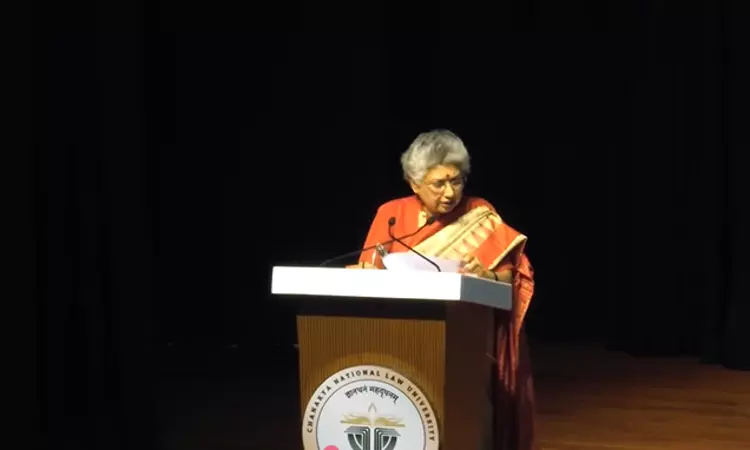
"Unless you know the tactics and strategy of a lawyer, you can't be a successful judge," Justice Nagarathna said.
Supreme Court Justice BV Nagarathna on Saturday disagreed with the view that the minimum three year practice requirement for entry into judicial service would discourage women aspirants, stressing that experience at the Bar is essential to becoming a competent judge. She emphasised that practical exposure to litigation equips future judges with the maturity and skills necessary to...
This is a premium content
Available exclusively to
Our subscribers
Subscribe Premium 
INR 1099+GST
Your support helps us to bring you more content at
an affordable subscription scheme !!!
All payment options available
Supreme Court Justice BV Nagarathna on Saturday disagreed with the view that the minimum three year practice requirement for entry into judicial service would discourage women aspirants, stressing that experience at the Bar is essential to becoming a competent judge. She emphasised that practical exposure to litigation equips future judges with the maturity and skills necessary to administer justice effectively.
She was responding to audience queries after delivering a lecture at the Chanakya National Law University, Patna. Vice Chancellor of CNLU, Professor Faizan Mustafa, opined that the Supreme Court's judgment mandating 3-year practice to enter judicial service will discourage women from joining the judicial service. Disagreeing, Justice Nagarathna said she did not share that apprehension. She stated:
"I disagree with you Sir. Next year, I will be completing 40 years in the Bar. I have so many things to learn. If students who come from the bench of the classroom to the bench of the Court hall, they are losing out on experience- please don't think losing three years is a loss of life. I am learning still at 40...If the student is not able to stand before a judge and make an argument, seeking a relief, how will you, as a judge, grant relief? Don't think the three year of life is lost. That is a very negative attitude you have."
She further observed that even three years of practice may not be sufficient, noting that the requirement is aimed at strengthening the justice delivery system through experienced adjudicators. She said:
"Three years is not sufficient, according to me. However, the Supreme Court has said three years. If a case is dismissed for default, what will you do? You will go and give your personal affidavit as a lawyer and seek restoration because a litigant has suffered because you have not appeared. If you have not done that as a lawyer, how will you grant relief as a judge?... If you have not been in the Bar, how will you face the advocates in the Court? You will not be successful. You will start crying on the bench, that will add a very negative aspect to your personality. Unless you get into the water, you can't swim."
She criticised the perception among law students that practising for three years amounts to a loss of time, stressing that the period is essential for acquiring practical skills that ultimately benefit them in their judicial careers.
"Unless you know the tactics and strategy of a lawyer, you can't be a successful judge. If you want to be a successful judge, practice for more than 3 years and then write the exam. This is my advice," she recommended. She added that writing examinations based merely on textbook knowledge would not be helpful in the long run."
She further stated that there is an unwritten expectation that a High Court judge should be at least 45 years old, underscoring that maturity is necessary to handle complex and sensitive matters.
"A District Judge can give a death penalty but imagine if we appoint somebody who is 30 years with lack of experience and he starts giving death penalty in all POCSO cases because there is a death penalty provided and so many references in the High Court, what happens to our judicial system? All this is in order to save our judicial system in the country, that we want maturity in our judges. Maturity comes with experience."
Master Of The Roster: Chief Justice Has No Role After Case Assignment
Addressing concerns regarding the "Master of the Roster" convention, Justice Nagarathna clarified that the role of the Chief Justice ends once a case is assigned to a bench. She emphasised that judicial independence ultimately depends on the individual judge.
She said: "Chief Justice, whether of the High Court or the Supreme Court is the Master of the Roster. Nothing more can be said about it. Once he assigns the case to a particular judge, so many cases go up in terms of subject roster. There are some cases where matters are assigned depending on the wisdom of the hon'ble CJ, whether of the High Court or the Supreme Court. Thereafter, he has no say in the matter. It is for that particular bench to decide."
She added: "Did anybody predict I would dissent in so many cases?"
Justice Nagarathna answered that ultimately it depends on the conviction, independence, and courage of the judge who has been assigned the matter.
"Dual Role" Of Women Affects Representation In Legal Profession
Justice Nagarathna observed that the relative absence of women judges and advocates is often linked to the multiple responsibilities women shoulder within families. She remarked: "The reason is, the dual role the woman has to play. If she takes up a career in law, she also has her household to look after."
Reflecting on her own journey, she highlighted the importance of family support in enabling women to sustain professional careers. She said: "When it comes to a successful man, there is always a woman. When it comes to a successful woman, there is a family behind a successful woman. Why do I say a successful family? Because her responsibility in the household is taken over by the members of her family and as a result she can devotee more time to her career and profession."
Call For Minimum 30% Women As Government Law Officers
Highlighting the need to improve women's visibility in the legal profession, Justice Nagarathna urged governments to ensure that at least 30 percent of government law officers at the Centre, States, and in public sector institutions are women. She reasoned that greater representation would create a stronger pipeline for judicial appointments.
She said: "If they are given an opportunity, they will continue to remain in the profession come what may. Their visibility in the profession would be greater, and then the Chief Justice will say, yes yes she has been appearing in my Court and she does well, why not consider her for the bench. It is because of this dual responsibility of a woman lawyer and many a times she has to drop out of the profession mid-way or after her pregnancy and having a child, she can't return to the profession because of insufficient number of cases to attend to and having this entire responsibility on her. There are many women who do not ultimately continue in the profession for long."
She expressed optimism about future representation, noting that women now constitute nearly half of recruits in judicial services. She added: "I am very optimistic and I have a very positive outlook about it."
Justice Nagarathna concluded by advising law students to focus on developing professional skills and exercise caution in relying excessively on artificial intelligence tools for drafting pleadings.
Also from the event - Centre Should Not View States As Subordinates; Citizens Of A State Cannot Be Discriminated Against: Justice BV Nagarathna
Gursimran Kaur Bakshi
Gursimran is the Principal Correspondent with LiveLaw for the Supreme Court. She can be reached out at: simrankaurbakshi@livelaw.in

