



- Home
- /
- Top Stories
- /
- Ad Hoc Employees Appointed Without...
Ad Hoc Employees Appointed Without Recruitment Advertisements Or Interviews Cannot Be Regularised: Supreme Court
Amisha Shrivastava
18 April 2026 9:18 PM IST
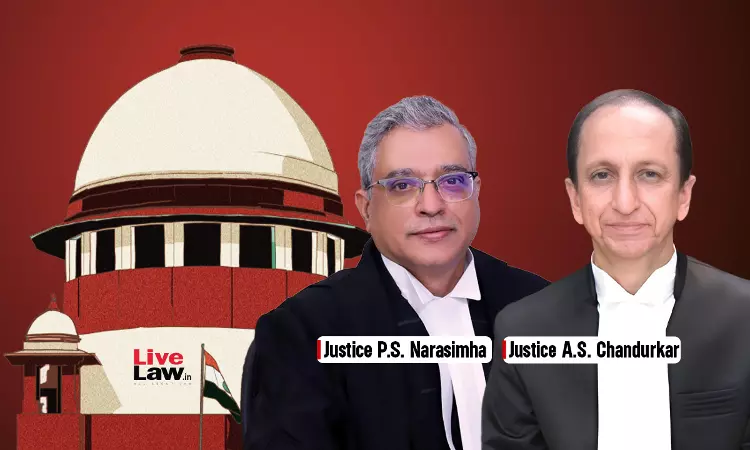
The Supreme Court recently partly set aside a Punjab and Haryana High Court judgment which had quashed a set of Haryana government policies aimed at regularising contractual, ad hoc and daily wage employees. The Court upheld the validity of two notifications issued on June 16, 2014 and June 18, 2014, but struck down two notifications issued on July 7, 2014.A bench of Justice PS Narasimha...
This is a premium content
Available exclusively to
Our subscribers
Subscribe Premium 
INR 1099+GST
Your support helps us to bring you more content at
an affordable subscription scheme !!!
All payment options available
The Supreme Court recently partly set aside a Punjab and Haryana High Court judgment which had quashed a set of Haryana government policies aimed at regularising contractual, ad hoc and daily wage employees. The Court upheld the validity of two notifications issued on June 16, 2014 and June 18, 2014, but struck down two notifications issued on July 7, 2014.
A bench of Justice PS Narasimha and Justice Atul Chandurkar noted that the July 2014 notifications sought to regularise those ad hoc employees who were not appointed following a proper recruitment process initiated via a public advertisement, thus violating the principles laid down by the Supreme Court in Secretary, State of Karnataka v. Umadevi (2006).
In the Umadevi judgment, the Supreme Court held that public employment must ordinarily be filled through a proper recruitment process and that contractual or ad hoc employees cannot be regularised as a matter of course. The Court had, however, permitted a limited “one-time measure” to regularise employees who had worked for over ten years as of April 10, 2006 without court protection.
“The intent was to accommodate such ad hoc employees, who came to be engaged, albeit temporarily, in the absence of any public advertisement or interview. We see no justifiable reason to uphold the validity of the two Notifications dated 07.07.2014 since they intend to regularise the services of such ad hoc employees, who were engaged without any advertisement and without being interviewed. To that extent, the impugned judgment of the High Court holding the Notifications dated 07.07.2014 to be arbitrary and illegal does not deserve to be interfered with”, the Court observed.
While quashing the said two policies, the Supreme Court directed that employees who had already continued in service under the July 7, 2014 policies would not be removed and would instead be placed on the lowest pay scale of the posts they hold.
The Court opined that the High Court erred in invalidating the June 2014 notifications, which were issued to extend the benefit of an earlier 1996 regularisation policy to similarly placed employees who had been left out.
These notifications required employees to have been appointed against sanctioned posts, possess prescribed qualifications, and satisfy reservation requirements. Therefore, the Court said, they did not dilute the standards applicable to regular recruitment.
A batch of writ petitions before the High Court challenged Haryana government notifications dated June 16, 2014, June 18, 2014, and July 7, 2014, which sought to regularise Group B, C and D employees working on contractual or ad hoc basis.
On May 31, 2018, the High Court quashed these policies, holding them contrary to the law laid down in Secretary, State of Karnataka v. Umadevi, and directed withdrawal of benefits granted under them while allowing employees to continue for six months to enable fresh recruitment.
Before the Supreme Court, the State of Haryana and affected employees argued that the policies were a valid exercise of executive power under Article 162 of the Constitution, adopted to address staff shortages. They also argued that the employees were qualified, had been appointed through public advertisements and selection committees, and were only irregular, not illegal, appointees.
The Court examined the June 2014 notifications and noted that they were intended to regularise employees who had been eligible under the earlier 1996 policy but were left out. It noted that the criteria for regularisation were consistent with recruitment norms, including the requirement of working against sanctioned posts and possessing necessary qualifications. The Court found no material to show that ineligible persons were being regularised or that the exercise was arbitrary or mala fide.
In contrast, the Court held that the July 7, 2014 notifications were arbitrary and illegal. It noted that these policies sought to regularise employees who had not been appointed through any advertisement or interview, and made those employees eligible who would complete ten years of service only by December 31, 2018. The Court said there was no justification for such a policy and that it would prevent regular recruitment by reserving posts for such employees.
“There is no justification placed on record by the State of Haryana as to why services of such ad hoc employees, who had not been engaged on the basis of any advertisement or interview were sought to be regularised, that too by taking into consideration a future cut-off date of 31.12.2018. The claim of being engaged sans an advertisement itself gives rise to doubts as regards the manner of engagement. Absence of any record whatsoever of the manner of engagement does not inspire any confidence in such process. That such ad hoc employee has not faced any interview is another relevant feature. Further, there does not appear to be any rational basis for fixing a future cut-off date, which is beyond four years from the date of the Notifications. This would indicate that even when it was possible to initiate a process of regular recruitment after issuance of the Notifications dated 07.07.2014, by virtue of the impugned Notifications, number of posts which could have been filled in through regular recruitment were not liable to be advertised”, the Court observed.
While striking down the July 7, 2014 notifications, the Court noted that many employees had continued in service for years under interim orders and that the State itself had stated that their continuation would not affect advertised posts. Invoking its powers under Article 142 of the Constitution, the Court directed that such employees should not be disturbed and should be placed at the lowest pay scale applicable to their posts, in line with the principle of equal pay for equal work.
The Court accordingly modified the High Court's judgment. It upheld the June 16 and June 18, 2014 notifications and restored benefits granted under them, subject to verification. It struck down the July 7, 2014 notifications but protected employees already continuing under them.
Headnote
Service Law — Regularisation — Validity of State Notifications — Group 'B', 'C', and 'D' employees — Distinction between "Irregular" and "Illegal" appointments — The Supreme Court examined the validity of Haryana Government Notifications dated 16.06.2014, 18.06.2014, and 07.07.2014, which sought to regularise contractual/ad hoc employees – i. Validity of Notifications dated 16.06.2014 and 18.06.2014: Supreme Court held these notifications valid as they were intended to grant benefits to employees who were eligible under the 1996 policy but were left out due to its administrative withdrawal - Since these employees occupied sanctioned posts and met prescribed qualifications at the time of initial engagement, their appointments were "irregular" but not "illegal"- The High Court's quashing of these two notifications was set aside; ii. Invalidity of Notifications dated 07.07.2014: Supreme Court upheld the High Court's decision to strike down the 07.07.2014 notifications - These policies were found arbitrary as they sought to regularise employees engaged without any public advertisement or interview, and utilized a future cut-off date (31.12.2018), which bypassed regular recruitment processes. (Paragraph 21); iii. Protection under Article 142: Despite striking down the 07.07.2014 notifications, the Court invoked its extraordinary jurisdiction under Article 142 of the Constitution of India to protect the services of those ad hoc employees who have already secured benefits and remain in service - to balance equity, such employees are to be placed at the lowest pay scale admissible to their posts. [Relied on State of Karnataka v. Umadevi (2006) INSC 216; State of Punjab v. Jagjit Singh (2016) INSC 993; State of Karnataka v. M.L. Kesari (2010) INSC 469; Paras 18 – 25]
Case no. – Civil Appeal No. 1996 of 2024
Case Title – Madan Singh and Ors. v. State of Haryana and Ors.
Citation : 2026 LiveLaw (SC) 390
Click Here To Read/Download Judgment
Appearances:
Amicus Curiae:
Mr. Nidhesh Gupta, Senior Advocate, assisted by Ms. Japneet Kaur, Mr. Bikram Dwivedi, Ms. Vriti Gujral, Mr. Gursimar Preet Singh and Ms. Sajal S., Advocates.
For the Appellant(s):
Mr. K. V. Jagdishvaran, Advocate; Ms. Malika Agarwal, Advocate; Ms. G. Indira, AOR; Mr. P. Gandepan, Advocate; Ms. Anjali Singh, Advocate; Ms. Yashi Jain, Advocate; Mr. Sachin, Advocate; Mr. Prince Kmumar Insa, Advocate; Mr. Rameshwar Prasad Goyal, AOR; Ms. Preeti Singh, AOR; Mr. Siddharth Mittal, AOR; Mr. Roopansh Purohit, AOR; Ms. Narayani Sepaha, Advocate; Mr. Satyendra Kumar, AOR; Dr. Sudhir Bisla and Mrs. Sumitra Bisla, Advocates; Mr. B. Adi Narayan Rao, Senior Advocate; Dr. Amardeep Gaur and Mr. Jitendra Kumar Deo, Advocates; Mr. Ravi Prakash Mehrotra and Mr. Lok Pal Singh, Senior Advocates; along with Mr. Divyanshu Sahay, Mr. Mukesh Kumar, Mr. Ashutosh Bhardwaj, Mr. Prateek Rai, Mr. Srikant Singh, Mr. Srajan S. Kulshreshtha, Mr. Anurag Pandey, Mr. Bharpur Singh, Mr. Akash and several other Advocates, with M/s V. Maheshwari & Co., Mr. Haresh Raichura, Mr. Dinesh Kumar Garg, Mr. Himanshu Sharma, Mr. Deepak Goel, Mr. Akshay Amritanshu, Mr. S. K. Verma, Mr. R. C. Kaushik, Mr. Varun Punia, Mr. Ram Naresh Yadav, Dr. Mrs. Vipin Gupta, Mr. Subhasish Bhowmick, Mr. Ravi Panwar, Mr. Robin Khokhar, Mr. Prem Malhotra, Mr. Abhimanyu Tewari, Mr. Shivam Jasra and Mr. Ranvir Singh, Advocates-on-Record.
For the Respondent(s):
Mr. Sarthak Ghonkrokta, AOR; Mr. Jasbir Singh Malik, Ms. Prachi Sohi and Ms. Nitika Dubey, Advocates; Mr. Varun Punia and Ms. Baani Khanna, AORs; Mr. Robin Singh and Mr. Kapil Balwani, Advocates; Ms. Komal Thakkar, Advocate; Mr. Arun Bhardwaj and Dr. Monika Gusain, Senior Advocates; Mr. Akshay Amritanshu, AOR; Mr. Hariom Yaduvanshi, Ms. S. Harini, Mr. Arjun Yaduvanshi and Ms. Neha Mishra, Advocates; Mr. Samar Vijay Singh, AOR; Mr. Amit Ojha, Ms. Sabarni Som, Mr. Aman Dev Sharma, Mr. Keshav Mittal and Mr. Gaj Singh, Advocates; Mr. Ashok Mathur, Mr. John Mathew, Dr. Nirmal Chopra, Ms. G. Indira and Mr. Dhananjay Garg, AORs; Mr. U. K. Uniyal and Mr. Narender Hooda, Senior Advocates; along with several other Advocates and AORs including Mr. Surender Singh Hooda, Mr. F. I. Choudhury, Mr. Ravi P. Wadhwani, Mr. B. K. Satija, Mr. Chritarth Palli, Mr. Rabin Majumder, Mr. Ashish Pandey, Ms. Madhu Moolchandani, Ms. Aakriti Jain, Mr. Narender Kumar Verma, Mr. Ansar Ahmad Chaudhary, Mr. Devashish Bharuka, Mr. Piyush Sharma, Mr. Kunal Verma, Mr. Deepak Goel, Mr. Siddharth Batra, Mr. Rao Ranjit and Mr. Sahil Tagotra, Advocates-on-Record.
Tags

Amisha Shrivastava
Amisha Shrivastava is a Senior Correspondent with LiveLaw, covering the Supreme Court of India. She can be reached at amisha@livelaw.in

