



- Home
- /
- Top Stories
- /
- After BCI Chairperson's Remarks On...
After BCI Chairperson's Remarks On Fake Advocates, Plea Filed In Supreme Court To Verify Law Degrees
Gursimran Kaur Bakshi
25 May 2026 9:29 PM IST
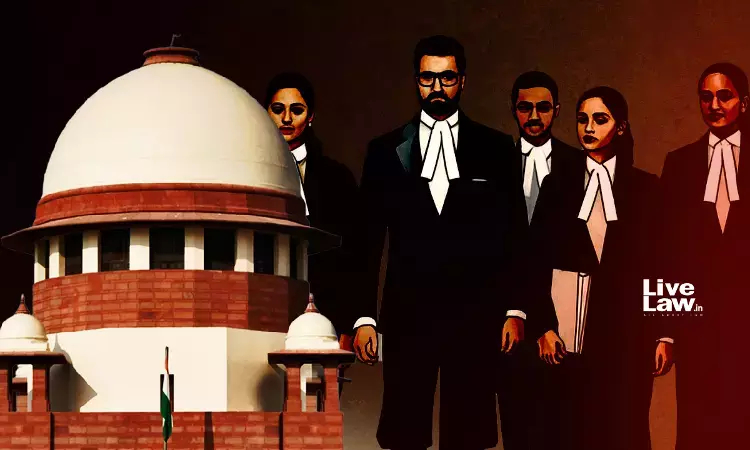
The plea seeks nationwide verification of educational qualifications, enrolment credentials and practice status of advocates across the country,
A writ petition has been filed over the recent remarks made by the Chairman of the Bar Council of India that 35-40 per cent of advocates have fake degrees, and are practising in the Courts based on fabricated degree certificates.The writ petition filed under Article 32 of the Constitution, seeks directions to the Union of India, Bar Council of India (BCI), all State Bar Councils, and...
This is a premium content
Available exclusively to
Our subscribers
Subscribe Premium 
INR 1099+GST
Your support helps us to bring you more content at
an affordable subscription scheme !!!
All payment options available
A writ petition has been filed over the recent remarks made by the Chairman of the Bar Council of India that 35-40 per cent of advocates have fake degrees, and are practising in the Courts based on fabricated degree certificates.
The writ petition filed under Article 32 of the Constitution, seeks directions to the Union of India, Bar Council of India (BCI), all State Bar Councils, and the University Grants Commission to establish a transparent and uniform verification mechanism for advocates' credentials.
The petition has been filed by Ms Yogamaya MG, who is a practising advocate. It says: "The issue assumes grave constitutional significance in light of public recent statements reportedly made by the leadership of the Bar Council of India, indicating that a considerable percentage of persons enrolled or practising as advocates may possess fake, forged, or unverifiable educational credentials, and that a substantial number have not completed the prescribed verification processes."
The petitioner has also referred to reports regarding the removal of fake advocates from enrolment rolls in various States, indicating that the issue is not an isolated one but has a systematic implication affecting the legal profession and the justice delivery system at large. This is because if a person with forged documents continues to remain enrolled, the consequences extend beyond professional misconduct as it directly affects litigants, judicial institutions and public confidence in the rule of law.
The petitioner has referred to the recent elections in the State Bar Councils and the Supreme Court's order monitoring them in M. Vardhan v UOI. In its November 11, 2025, order, the Supreme Court had said that upon verification of a law degree, those whose degrees are found to be fake/not genuine/unrecognised should not be allowed to participate in the election process.
But two women advocates, whose law degrees were pending verification by the Bar Council of Delhi, were permitted to contest elections, as stated in the petition.
"It is submitted till date, the information regarding verification status as available on the BCD, R-4 website discloses that the verification of the Law Degrees of 2 candidates viz Ballot No. 195 and Ballot No. 220, are still pending. These instances raise serious concerns regarding the scrutiny of the nomination forms that were to be done by the Respondent No. 4 BCD before finalising the list of candidates."
The petitioner has also raised concerns regarding recent Bar Council elections, particularly in Delhi, alleging that advocates whose degree verification remained pending were permitted to contest or vote. The plea contends that such issues raise broader concerns regarding transparency and scrutiny in electoral processes within Bar Councils.
The petitioner states that those advocates who were enrolled with the Bar Council of Delhi in the last two years, and even earlier, were included in the final voters' list, but their verification status remains pending.
"For e.g. status available on the Bar Council of Delhi website of Enrollment no. D/18453/2025, at serial No. 98300 of the BCD final voters list 2026, is showing a blank. In other words, there is no confirmation that she has been verified. Similar is the case of Enrollment No. D/11281/2024 whose name appears at serial no. 98293 of the BCD final voters list, 2026. It is submitted that a lot of these voters, whose verification is pending till date, if they are found to have invalid degrees or their verification is rejected for any reason, then the problem faced is as to how the votes given by them, which would be invalid, can be identified. Accordingly, there will be several candidates who will be beneficiaries of these invalid votes. This itself is a good ground for countermanding the entire election process."
Referring to the Supreme Court's earlier judgment in Ajay Shankar Srivastava v. Bar Council of India and directions issued in M. Vardhan v. Union of India, the petition argues that despite judicial intervention concerning verification processes, effective and transparent implementation remains lacking.
The petition states that the relief sought is not aimed at targeting individual advocates, but at ensuring privacy-compliant transparency, regulatory accountability, and strengthening confidence in the justice delivery system.
The petition has been filed by Deepak Prakash AoR.
Gursimran Kaur Bakshi
Gursimran is the Principal Correspondent with LiveLaw for the Supreme Court. She can be reached out at: simrankaurbakshi@livelaw.in

