



- Home
- /
- Top Stories
- /
- AI Cannot Replace Judge's Lived...
AI Cannot Replace Judge's Lived Human Experience; Judging Is Human Responsibility: Justice Vikram Nath
Anmol Kaur Bawa
20 April 2026 10:03 AM IST
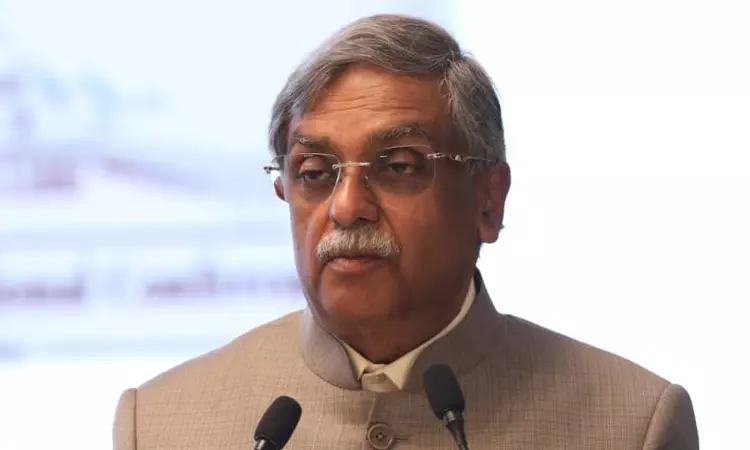
Supreme Court Judge, Justice Vikram Nath, yesterday expressed that while AI is here to stay, it cannot replace a judge's lived human experience, which is crucial in decision-making. Justice Nath was speaking at the Valedictory Function of the 22nd Biennial State Level Conference of Karnataka State Judicial Officers Associations Justice Nath expressed that one has to acknowledge with clarity...
This is a premium content
Available exclusively to
Our subscribers
Subscribe Premium 
INR 1099+GST
Your support helps us to bring you more content at
an affordable subscription scheme !!!
All payment options available
Supreme Court Judge, Justice Vikram Nath, yesterday expressed that while AI is here to stay, it cannot replace a judge's lived human experience, which is crucial in decision-making.
Justice Nath was speaking at the Valedictory Function of the 22nd Biennial State Level Conference of Karnataka State Judicial Officers Associations
Justice Nath expressed that one has to acknowledge with clarity that artificial intelligence is here to stay and the judiciary cannot remain untouched by the AI influence. He then highlighted :
" The question is not whether AI will exist, the question is whether we as judges, how shall we as judges, judicial officers, respond to it?"
Justice Nath answered, affirming a principle he stands by - " AI is a tool to assist the judicial process, it is not, and can never become a substitute for the judicial mind. A machine may help collect material, it may help classify data, it may help identify patterns, it may even help place information before us in a convenient form, but adjudication is not the mechanical arrangement of inputs"
He emphasised that judicial decision-making is a process largely involving human experiences which the AI cannot replace.
"Judging is a human responsibility. It calls for discernment, it calls for balance, it calls for conscience. It calls for an ability to appreciate not merely what is written on paper, but what lies beneath it in human experience."
Justice Nath stressed that a judge not only decides between competing claims but also has to read between the " competing hardships" of the parties, which the AI cannot decide.
" Algorithm can replace moral judgment, no automated process can replace the discipline of reason, adjudication. That is why even in an age of rapid technological change, the central figure in the justice system remains the judge."
Cautioning judicial officers on the need to draw a careful balance between the use and misuse of AI, Justice Nath said they must learn to use AI tools while remaining alert to situations where such tools may be unsafe. He added that although the legal system should welcome technological innovation, it must never do so uncritically.
Justice Nath also highlighted that while young judicial officers are in a position of power, this power cannot be misunderstood as a 'position of pride'.
"What each one of you holds, is an office of responsibility and trust, it is in one sense an office of power, you speak through orders that affect rights, liberty, property, family, reputation and sometimes the futue course of a person's life...but judicial power is unlike other forms of power, it can never be exercised with pride, with distance from people"
Justice Nath concluded the address by citing Rudyard Kipling's poem 'If' :
" If you can keep your head when all about you, If you can trust yourself when all men doubt you, But make allowance for their doubting too; Are losing theirs and blaming it on you..."
He added how the above lines apply to those leading a judicial life:
"In these lines, there is an enduring message for the judicial life- remain calm amidst pressure, remain firm without being rigid and to carry a quality of humility. These are the qualities no machine can replicate and no age of innovation can make irrelevant."
Justice Aravind Kumar was also present at the event.
The event can be viewed here.

Anmol Kaur Bawa
Reporter

