



- Home
- /
- Top Stories
- /
- AI May Assist, But Only More Judges...
AI May Assist, But Only More Judges Can Match Exploding Supreme Court Filings : Justice Dipankar Datta
Yash Mittal
27 Jan 2026 1:33 PM IST
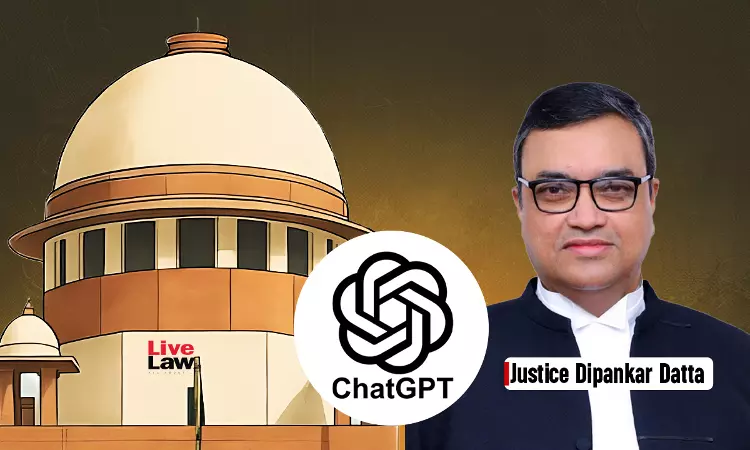
AI must be kept at our feet and should not be allowed to sit on our head, the judge commented.
While expressing concerns about the “explosion of litigation” before the Supreme Court, Justice Dipankar Datta stressed that no amount of Artificial Intelligence (AI) or technological intervention can compensate for the acute shortage of judges in the face of rapidly rising caseloads. Speaking at the panel discussion “Law, Lawyers, and AI: The Next Frontier”, organized by Supreme...
This is a premium content
Available exclusively to
Our subscribers
Subscribe Premium 
INR 1099+GST
Your support helps us to bring you more content at
an affordable subscription scheme !!!
All payment options available
While expressing concerns about the “explosion of litigation” before the Supreme Court, Justice Dipankar Datta stressed that no amount of Artificial Intelligence (AI) or technological intervention can compensate for the acute shortage of judges in the face of rapidly rising caseloads.
Speaking at the panel discussion “Law, Lawyers, and AI: The Next Frontier”, organized by Supreme Court Advocates On Record Association, Justice Datta observed that the Supreme Court is witnessing an unprecedented surge in filings, which has placed enormous pressure on the institution and Judges. He emphasized that the problem is not about the people approaching the Court, but the system's limitation failing to meet the demand.
“In 2018, Supreme Court filing was 40,000. The sanction strength was 31… The strength increased from 31 to 34 in mid-2019… We are still at 34. Seven years down the line, 43,000 [filings] has become 75,000.” Justice Datta said, emphasizing that AI might play a role in assisting in research, preparing for case, and for other ancillary work, however the constitutional duty of adjudication, especially in assessing human elements and intentions behind litigation, currently rests firmly with the human judiciary, and cannot be replaced by AI.
Justice Datta highlighted the irreplaceability of the human element in judging, stating that judges are tasked with assessing the "human elements that go into the litigation" i.e., the motives of hinsa (violence), lobh (greed), kaam (lust), and krodh (anger). He said AI cannot replace the human interaction of the Court with the litigants.
He spoke about his personal use of AI in his judicial work, stating that the use of AI can be limited to legal research or refining the judicial language, but shouldn't overpower the Judges while doing the core analytical part of the judgment, which he said he performs himself. “What you write by your hand is the best product.”, he said.
To illustrate the limitations of predictive technology, Justice Datta shared a personal secret: he has twice dictated an order in open court but refused to sign it after re-examining the file and realizing that the order needed correction. He noted that under Supreme Court precedents, a judge can change their decision as long as the order remains unsigned - a level of intuitive self-correction he suggested AI may struggle to emulat
Furthermore, issuing a stern ethical warning to the legal profession, Judge underscored the "fragile" trust between the bar and the bench, stating that misuse of AI to generate submissions or mislead the court would irrevocably damage this foundational relationship. He placed the "onerous duty" on lawyers to verify all AI-generated content, affirming that the human lawyer's responsibility is non-negotiable in the legal profession.
Justice Datta called for the development of more sophisticated administrative AI tools within the Supreme Court registry. He specifically noted that the registry currently fails to properly segregate different types of bail applications, such as regular bail versus those filed in 389 appeals, which requires different judicial mindsets regarding the presumption of innocence.
Regarding the ethics of AI, Justice Datta used a metaphor involving a king and a monkey to warn that AI should be kept "at our feet" as a servant, rather than being allowed to "sit on the head" of the practitioner. He further cautioned against the "irresponsible usage" of public AI platforms like ChatGPT, warning that uploading draft judgments to such tools exposes confidential data to the world, as the machine learns from every input.
Justice Datta concluded by acknowledging that while he will likely "endure" the evolution of AI for the remainder of his tenure, the core of advocacy remains the "moral courage" to argue unpopular cases, a trait no machine can possess.

Yash Mittal
Yash Mittal is a Correspondent with LiveLaw, covering the Supreme Court of India

