



- Home
- /
- Top Stories
- /
- 'All NLUs Suffering' : Supreme...
'All NLUs Suffering' : Supreme Court Stays Delhi HC Judgment Against Debarring Law Students For Low Attendance
Gursimran Kaur Bakshi
26 May 2026 2:42 PM IST
'Why take admisison if you don't have to attend classes?' the Court asked.
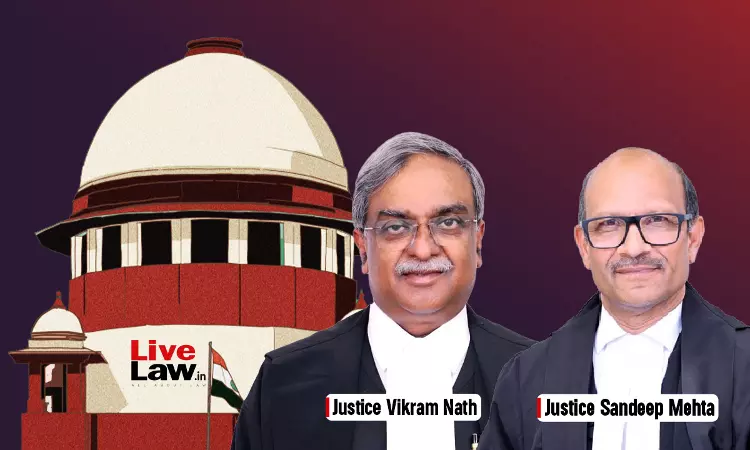
The Supreme Court on Tuesday (May 26) stayed the Delhi High Court's order, which said that no student can be prevented from taking exams on the grounds of lack of minimum attendance. The Court stayed paragraph 249 of the High Court' order order where directions were passed in this regard. A bench comprising Justice Vikram Nath and Justice Sandeep Mehta issued notice in a petition filed by the...
This is a premium content
Available exclusively to
Our subscribers
Subscribe Premium 
INR 1099+GST
Your support helps us to bring you more content at
an affordable subscription scheme !!!
All payment options available
The Supreme Court on Tuesday (May 26) stayed the Delhi High Court's order, which said that no student can be prevented from taking exams on the grounds of lack of minimum attendance. The Court stayed paragraph 249 of the High Court' order order where directions were passed in this regard.
A bench comprising Justice Vikram Nath and Justice Sandeep Mehta issued notice in a petition filed by the Bar Council of India against the Delhi High Court's order. It has now tagged the petition along with two pending writ petitions by students challenging the two circulars by the BCI requiring universities to implement a criminal background check system, installation of a biometric attendance system and CCTVs in all classrooms.
At the outset, many counsels, including Senior Advocate Mukul Rohatgi, submitted that the Delhi High Court's order should be stayed. Rohatgi stated that the judgment has given a premium to bypass disclipine to attend classes.
The bench was also told that different High Courts have taken a different stand on the issue of the minimum attendance requirement. For instance, the Uttarakhand High Court recently observed that permitting a law student to take exams despite the failure to meet the minimum attendance requirement could be "counterproductive".
Seemingly agreeing to this, Justice Mehta stated that the Delhi High Court's judgment will be considered as a free pass by the students to not attend classes at all. He said: "The judgment doesn't preclude students from going to the classes, why have they taken admission?"
Justice Nath also asked what the teachers are supposed to do in these universities if students are not willing to attend classes.
Justice Mehta also asked the BCI's chairperson Manan Kumar Mishra as to what took them so long to challenge the judgment. "All the National Law Universities are suffering [because of the judgment]," he told Mishra.
Earlier, the present bench, while hearing another matter, had expressed reservations about the High Court's view, and had asked the BCI to challenge it.
The High Court passed the directions while considering a suo motu case taken over the suicide of a student.
In the paragraph 249 which has been stayed, the Delhi High Court has said:
"...2. In order to safeguard the life and mental health of students, keeping in mind the debilitating impact on students that detention or nonappearance in examinations, due to mandatory attendance requirements can have, while the consultations by the BCI are underway, it is directed in the interregnum, as under:
a. No student enrolled in any recognized law college, University or institution in India shall be detained from taking examination or be prevented from further academic pursuits or career progression on the ground of lack of minimum attendance;
b. No law college, University or institution shall be permitted to mandate attendance norms over and above the minimum percentage prescribed by the BCI under the Legal Education Rules;
c. Insofar as the mandatory attendance norms fixed by the BCI are concerned, all law colleges, Universities and institutions recognized which impart 3 years and 5 years LLB degree courses shall with immediate effect, implement ameliorative measures including:
i. Weekly notification of attendance of students through an online portal/ a mobile app including on the notice board; ii. Monthly notice to parents/legal guardian/family members regarding any shortage in attendance; iii. Conducting extra physical or online classes for such students, who do not fulfil the minimum attendance norms; iv. Home assignments to be completed in lieu of shortage of attendance; v. Stringent practical work in legal aid clinics or similar such bodies, duly certified, which can cover up the shortage of attendance during the semester itself. Such steps shall thus be taken during the semester itself. vi. In terms of Rule 12 of Legal Education Rules, 2008, the attendance percentage shall be calculated on the basis of ACTUAL CLASSES HELD by the teachers.vii. If at the end of a semester, a student still does no the prescribed attendance norms, the college/University cannot bar the student from taking the examination. The student shall be permitted to take the semester examination, however, in the final result for the semester, the grade of the student would be permitted to be reduced by a maximum of 5%, in case of marks being awarded and by 0.33% in case of the CGPA system being followed. Merely on shortage of attendance, promotion to the next Semester shall not be withheld."
Case Details: Bar Council of India v. Union of India Diary No. 29604-2026
PRAKRUTHI JAIN Vs BAR COUNCIL OF INDIA W.P.(C) No. 31/2025
Gursimran Kaur Bakshi
Gursimran is the Principal Correspondent with LiveLaw for the Supreme Court. She can be reached out at: simrankaurbakshi@livelaw.in

