



Where Did It Come From? Allahabad High Court Questions Use Of 'Andolanjeevi' Term In Journalist Satyam Verma's NSA Detention Grounds
LIVELAW NEWS NETWORK
8 Oct 2026 7:25 PM IST
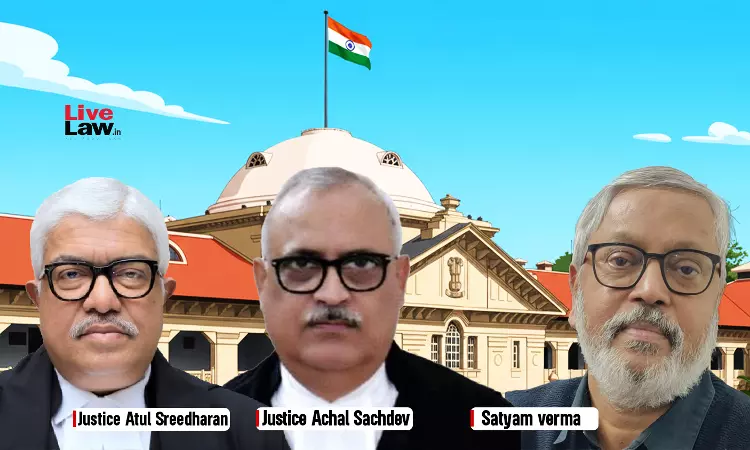
"Where did this term come from? How did it find its way into an official document?" Justice Atul Sreedharan questions use of the term 'Andolanjeevi' in grounds of detention issued by Noida DM Medha Roopam.
The Allahabad High Court on Thursday orally questioned the use of the term 'आंदोलनजीवी' (Aandolanjeevi) in the grounds of detention forming the basis of the preventive detention order passed against journalist Satyam Verma under the National Security Act, 1980 (NSA).
The Bench of Justice Atul Sreedharan and Justice Achal Sachdev questioned Additional Advocate General Manish Goyal as to how such terminology had found its way into an official government detention document.
"Where did this term 'Aandolanjeevi (आंदोलनजीवी)' come from? How did it find its way into an official document?" Justice Sreedharan asked.
The Bench raised the issue while reserving judgment in Verma's habeas corpus petition challenging his preventive detention in connection with the April 2026 workers' protest and violence in Noida.
The Bench heard the matter over two days, on October 7 and 8.


During the hearing, the Bench perused the detention order and the grounds of detention supplied to Verma. The detention order dated May 12, 2026 was passed by Gautam Buddh Nagar/Noida District Magistrate Medha Roopam under Sections 3(2) and 3(3) of the NSA. The petition itself separately refers to the grounds of detention supplied to the detenue.
Justice Sreedharan also questioned why the Detaining Authority (the DM) relied on Verma's ideology, literature, and association with an organization as material forming the basis for his preventive detention.
In substance, the Bench questioned as to how merely holding a particular ideology or possessing literature could, by itself, constitute a basis for preventive detention.
What do the detention grounds say?
The detention grounds (dated May 12) describe the violence during the April 2026 labor unrest as potentially harming industrial investment, employment and industrial development in Gautam Buddh Nagar.
They refer to the district's concentration of industrial units and state that recurring violence could create fear among investors and adversely affect the industrial environment.
The grounds further state that continued violent activity could create conditions detrimental to industrial development and disrupt the normal flow of public life.
The document also contains references to Verma's alleged ideological activities and describes him as an 'आंदोलनजीवी'.
The relevant portion of the grounds reads:
"औद्योगिक अशांति एवं हिंसात्मक वातावरण उत्पन्न होने से इस औद्योगिक प्रगति के वातावरण पर अत्यंत विपरीत प्रभाव पड़ा है, जो उद्योग नियोजकों एवं निवेशकों के लिए भय, दहशत और संत्रास उत्पन्न करने वाला कारक है, जो आप जैसे अतार्किक व हठी हिंसक 'आंदोलनजीवी' व्यक्तियों की कुत्सित विचारधारा के चलते, जो अति सक्रियता के साथ ऐसी लोक-विक्षोभ उत्पन्न करने वाली परिस्थितियों के निर्णायक योजनाकार होते हैं और राष्ट्रीय राजधानी क्षेत्र के मानेसर औद्योगिक क्षेत्र, हरियाणा और नोएडा में सक्रिय रूप से औद्योगिक अशांति उत्पन्न करते हैं।" [Due to the emergence of industrial unrest and a violent environment, an extremely adverse impact has been caused on the environment of industrial progress, which is a factor creating fear, panic and distress among industrial employers and investors, owing to the vicious ideology of violent 'aandolanjeevi' persons like you, who are irrational and obstinate, who, with excessive activism, are the principal planners of such circumstances causing public disturbance and actively create industrial unrest in the Manesar industrial area of the National Capital Region, Haryana, and Noida]
The document further alleges that Verma was associated with the Revolutionary Workers Party of India (RWPI) and that the organization's activities and literature were used to influence younger people and encourage them toward violent activities.
It also refers to what it describes as "narrative making through mass communication", allegedly aimed at provoking workers and the general public by creating "anti-state, anti-administration thinking" with an intention to disturb public tranquillity.
The detention grounds further state that Verma's continuous and repeated violent activities were once again creating circumstances in the district which constituted a serious impediment to development generated by industry.
"This forms the basis for the strong presumption that, unless the potential consequences resulting from your activities and the favourable conditions that encourage workers are prevented, you will continue to persist in such activities, which would prove disastrous in the future for public peace, the industrial sector, as well as the industrial development of the State."
The State relied on these circumstances to justify invoking the NSA against Verma.
Verma alleges detention grounds were copied from social media thread
Challenging the detention, Senior Advocate Colin Gonsalves, appearing for Verma, argued that the detention material sought to criminalize Verma's political ideology, association with the RWPI, and his work involving literature and translation.
Verma's case is that such material cannot substitute for concrete material establishing the statutory basis for preventive detention.
A significant allegation in the petition is that the grounds of detention dated May 12 were a "direct, unverified, and verbatim reproduction" of a social media thread published by a Twitter/X handle named "The Chronology" on April 14, 2026.
The petition further alleges that a report submitted by the Inspector of Police Station Phase-II on May 9, 2026, which subsequently formed part of the material relied upon for the detention, was itself "cut copy paste" from the said social media thread.
According to Verma's petition, the thread presented what he describes as a politically motivated conspiracy theory titled: "Revolutionary Workers' Party of India (RWPI): A Multi-Front Agitation Syndicate (Thread) - Inside Story of Noida Violence".
The petition alleges that the thread attempted to connect the Noida minimum-wage labour dispute with unrelated national and international developments, including Gaza solidarity protests in Mumbai, the anti-CAA-NRC agitations, Delhi pollution protests and the Bhagat Singh Jan Adhikar Yatra.
Verma disputes alleged role in April 13 violence
During the hearing, Gonsalves also submitted that the detention order proceeded on the premise that Verma was involved in the April 13 Noida violence, whereas, according to the petition, CCTV footage places him in Lucknow at the relevant time.
The petition states that CCTV footage allegedly shows Verma in Lucknow around 2:13 PM on April 13, and that police took him into custody shortly thereafter. It also relies upon his mobile Call Detail Records to support the alleged alibi.
Verma's plea further alleges that the Detaining Authority suppressed these materials while placing the CDR of another accused before it.
The petition also contends that Verma was not named in any of the 11 FIRs relied upon in connection with the detention.
Verma further disputed the authorities' characterization of his professional income as funding for the alleged unrest, maintaining that he earned the money through his profession and received it through formal banking channels.
Gonsalves argued that academic reading, journalistic writing and ideological belief are constitutionally protected, and that speech can attract penal consequences only where the requisite nexus with incitement to violence is established.
The petition also relies on Supreme Court judgments on the limited use of preventive detention and contends that the extraordinary power cannot substitute for the ordinary criminal justice system or merely defeat the regular bail process.
Accordingly, the plea challenges the subjective satisfaction recorded by the Detaining Authority and alleges that the material relied upon did not establish the requisite nexus between Verma and the alleged violence.
The petition also raises separate procedural challenges concerning the handling of Verma's representation before the Advisory Board and the subsequent additional grounds of detention dated May 26, 2026.
Senior Advocate Colin Gonsalves appeared for Verma, assisted by Advocates Abhishek Dwivedi, Deeksha Dwivedi and Manik Gupta.


