



- Home
- /
- Top Stories
- /
- Allowing ED To File Writ Petition...
Allowing ED To File Writ Petition Against State Govt Dangerous To Federalism : West Bengal Govt To Supreme Court
Amisha Shrivastava
18 March 2026 4:08 PM IST
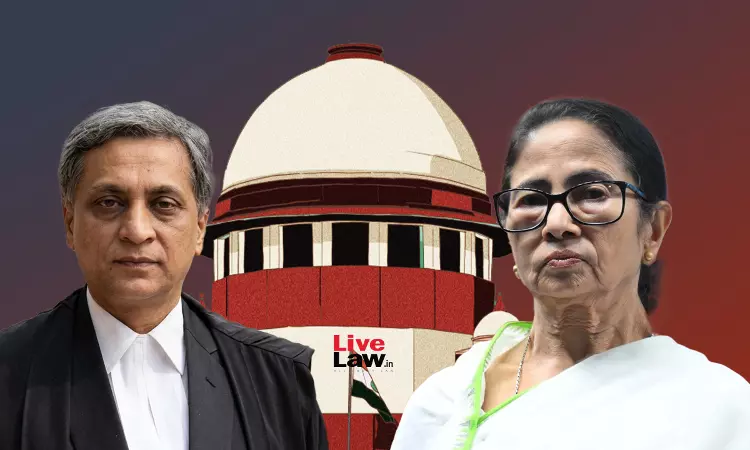
ED has no juristic personality, and cannot file a writ petition under Article 32, argued the State Government.
The State of West Bengal, on Wednesday, opposed the maintainability of the writ petition filed in the Supreme Court by the Enforcement Directorate (ED) under Article 32 of the Constitution, contending that the agency lacks the legal personality required to invoke fundamental rights jurisdiction against a State.Senior Advocate Shyam Divan, for the State, contended that ED lacked a...
This is a premium content
Available exclusively to
Our subscribers
Subscribe Premium 
INR 1099+GST
Your support helps us to bring you more content at
an affordable subscription scheme !!!
All payment options available
The State of West Bengal, on Wednesday, opposed the maintainability of the writ petition filed in the Supreme Court by the Enforcement Directorate (ED) under Article 32 of the Constitution, contending that the agency lacks the legal personality required to invoke fundamental rights jurisdiction against a State.
Senior Advocate Shyam Divan, for the State, contended that ED lacked a juristic personality, as it was only a government department, and allowing a Central Government Department to file a writ petition against a State Government would be "dangerous to the federal structure."
A bench comprising Justice Prashant Kumar Mishra and Justice NV Anjaria was hearing the Enforcement Directorate's writ petition alleging obstruction by West Bengal authorities during its January 8 search of the office of political consultancy firm I-PAC in Kolkata in connection with a money laundering probe linked to the coal scam. The ED sought registration of CBI FIR against Chief Minister Mamata Banerjee and the State Police Officials who allegedly obstructed the ED raid. There was a connected writ petition filed by ED officers challenging the FIR registered by the West Bengal Police against them.
ED Not A Juristic Entity, Cannot Invoke Article 32 Against State: Shyam Divan
Opening his submissions, Divan argued that the ED is merely a department of the Central Government and not a juristic or natural person capable of maintaining a writ petition under Article 32. He submitted that the very foundation of Article 32 rests on the enforcement of fundamental rights, which can be claimed only by persons, whether natural or juristic. Since the ED has neither status, it cannot allege violation of fundamental rights.
“ED is not a juristic entity… it is nothing beyond just a department of the Government. It does not have by itself any personality,” Divan told the Bench, adding that if there is no enforceable fundamental right, “the Article 32 petition is not maintainable.”
He further contended that the petition raises a significant constitutional issue concerning the federal structure, which forms part of the basic structure of the Constitution. According to him, disputes between the Union and States are governed by a distinct constitutional mechanism, particularly under Article 131, read with Article 300, and cannot be bypassed through Article 32 proceedings initiated by a government department.
Divan cautioned that permitting such petitions would undermine the constitutional scheme. “If we allow this, a situation can arise where Article 32 is being used by one department against another department, or between the Centre and States. This would completely bypass the checks and balances embedded in the constitutional framework,” he submitted.
Tracing the statutory framework, Divan argued that neither the Prevention of Money Laundering Act (PMLA) nor other governing statutes confer any “right to sue” upon the ED. He contrasted this with statutory bodies such as SEBI, which has been conferred with the right to sue.
Justice Mishra then pointed out that SEBI is a regulatory body and not an investigating body. Divan said that other bodies like NHAI, UIDAI, TRAI, and IRDAI, are expressly created as body corporate with the power to sue and be sued. “The right to sue has to be specifically conferred by Parliament. That is absent in the case of the ED,” he said.
Referring to the history of the ED, Divan pointed out that it originated as an enforcement unit within the Department of Economic Affairs and continues to function as an organisational limb of the Central Government. “It was a department within a department, and it remains so,” he submitted.
He also emphasised that investigative agencies such as the CBI, Narcotics Control Bureau, Directorate of Revenue Intelligence, and Serious Fraud Investigation Office similarly lack statutory recognition as bodies corporate with an independent right to sue. Extending the argument, he noted that even State-level agencies like CID, Vigilance Commissions, and Anti-Corruption Bureaus do not possess such rights.
Justice Mishra then said that there might arise "unusual" situations such as a Chief Minister obstructing a Central Agency.
"Because in this case, according to them, the Chief Minister barged into some government office controlled by the Central Government.. if 226 is also not maintainable 32 is also not maintainable, then who will decide? Someday some other Chief Minister may enter into some other office..." Justice Mishra said.
Addressing concerns raised by the Bench about the absence of a remedy in situations where a State allegedly obstructs a central agency, Divan maintained that the Constitution does provide a remedy, but it must be invoked in the proper manner. He suggested that the Union Government itself could initiate appropriate proceedings in accordance with the constitutional scheme, rather than a department acting independently.
“The Central Government may certainly come forward. But that must be examined within the framework prescribed by the Constitution,” he said, adding that the issue warrants consideration by a Constitution Bench under Article 145 due to its implications for federal balance.
The Bench, however, repeatedly questioned what remedy would be available in extraordinary situations, such as the alleged interference by a Chief Minister with central agency operations, if neither Article 32 nor Article 226 were available. Justice Mishra observed that “there should not be a vacuum.”
Divan responded that the perceived vacuum is precisely why the issue requires authoritative determination by a larger Bench, reiterating that permitting individual departments to invoke writ jurisdiction could pose “a danger to the federal structure” and lead to unchecked inter-governmental litigation.
"ED cannot maintain Article 32, cannot maintain Article 226, cannot maintain Article 227, cannot file a suit. it's not as if there is no remedy in this situation. The Union of India can sue. That comes from Article 300," Divan said.
He argued that ED cannot claim any violation of fundamental rights under Articles 14 and 21, as these are rights conferred on "persons". He also questioned the basis of the ED claiming that it has the "parens patriae" power to file the petition on behalf of citizens whose rights have been allegedly infringed due to the alleged obstruction by the State.
ED cannot file a writ petition seeking CBI FIR : Sibal
After Divan, Senior Advocate Kapil Sibal made brief submissions on behalf of Mamata Banerjee. He argued that ED cannot file a writ petition seeking to direct the CBI to register an FIR with respect to the alleged obstruction.
Justice Mishra then pointed out that as per the petition, the safety of ED officers was threatened.
"Assuming they have been threatened, what is the fundamental right here? Let's see section 221 of the BNS - obstructing a public servant who is discharging public duties. That is the answer," Sibal said.
"ED cannot ask the CBI to investigate. Unless there is a predicate offence ED cannot come into the picture, cannot file a writ petition for the fundamental right to have the CBI lodge an FIR," Sibal added.
Sibal also backed Divan's argument for a larger bench reference, pointing out that another bench is also considering the same issue in petitions filed by the States of Kerala and Tamil Nadu.
The court will continue to hear arguments next week on March 24, 2026
Background
According to the ED, Chief Minister Mamata Banerjee reached the search premises along with senior party leaders and state police officers, confronted officials and allegedly took away certain files and digital devices, which impeded its investigation. Following the incident, the West Bengal police registered three FIRs against ED officials.
The ED has sought directions for registration of an FIR and an independent probe by the Central Bureau of Investigation, contending that interference by the state executive compromised its ability to discharge statutory functions.
The state government has opposed the maintainability of the writ petition, citing the pendency of similar proceedings before the Calcutta High Court. Further, the has maintained that the Chief Minister took material from the premises without objection from ED officials. It has claimed that police intervention was triggered by information that armed persons had entered the office impersonating central agency officers.
In its rejoinder affidavit, the ED disputed the state's version of events and maintained that material was removed from the premises during the search without its consent.
In January, the Court issued notice on ED's plea and stayed further proceedings in the FIRs lodged against its officials, observing that the matter raised a serious issue which required examination to avoid a possible “situation of lawlessness” in the state. The Court also directed the state to preserve CCTV footage and other electronic material relating to the January 8 search.
Case no. – W.P.(Crl.) No. 16/2026
Case Title – Directorate of Enforcement and Anr. v. State of West Bengal and Ors.
Tags

Amisha Shrivastava
Amisha Shrivastava is a Senior Correspondent with LiveLaw, covering the Supreme Court of India. She can be reached at amisha@livelaw.in

