



- Home
- /
- Top Stories
- /
- Allowing Famous Person Like Elvish...
Allowing Famous Person Like Elvish Yadav To Use A Voiceless Victim Gives Bad Message : Supreme Court In Snake Venom Case
Amisha Shrivastava
18 Feb 2026 7:51 PM IST
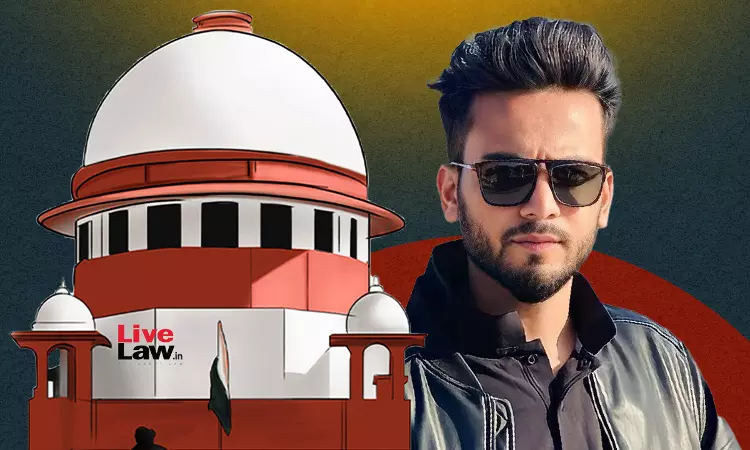
The Supreme Court today said it will examine whether there is adequate material to implicate YouTuber Elvish Yadav in the snake venom case under the Wildlife Protection Act, observing that it gives a very bad message that a popular person used a voiceless snake for publicity.“There are 2 things we will consider. What is your role and is there anything to implicate you on the alleged offence....
This is a premium content
Available exclusively to
Our subscribers
Subscribe Premium 
INR 1099+GST
Your support helps us to bring you more content at
an affordable subscription scheme !!!
All payment options available
The Supreme Court today said it will examine whether there is adequate material to implicate YouTuber Elvish Yadav in the snake venom case under the Wildlife Protection Act, observing that it gives a very bad message that a popular person used a voiceless snake for publicity.
“There are 2 things we will consider. What is your role and is there anything to implicate you on the alleged offence. At the same time, we have to see what is the action that is required to be taken under the Wildlife Protection Act. We could have disposed even today itself. It will send a very bad message outside if a person like you know who is otherwise a person who is popular is allowed to use a hapless victim which is voiceless. It gives a very, very bad message”
A bench of Justice MM Sundresh and Justice N Kotiswar Singh was hearing Yadav's plea challenging the Allahabad High Court's order dated May 12, 2025, which had dismissed his petition against the chargesheet and summoning order issued in a case under various provisions of the Wildlife Protection Act, IPC, and NDPS Act.
Last year, on August 6, the Court had granted stay on trial court proceedings against Yadav in a case alleging that he misused snakes and snake venom for a YouTube video and was involved in organising rave parties where foreigners allegedly supplied snake venom and other intoxicating drugs.
During the hearing today, Senior Advocate Mukta Gupta for Yadav submitted that what was recovered in the case was not snake venom but antibodies. Referring to the Forensic Science Laboratory report, she said it showed “positive result for antibodies of snake venom for four common snakes, namely cobra, krait, russells and saw scaled viper” and not snake venom itself. She further said that the snakes involved in the video had no teeth and no venom glands. She argued that the entire chargesheet proceeds on the basis that snake venom was recovered, which is contrary to the record.
She also relied to a report of a six-member medical committee which stated that snake venom may have neurotoxic effects and may act as a substitute for opioids, but anti-snake venom is used to neutralise snake envenomation and is administered intravenously. She submitted that anti-venom is not reported to be used for recreational purposes and what was allegedly recovered would neutralise venom rather than act as an intoxicant.
On the applicability of the NDPS Act, she argued that snake venom antibodies are not included in the Schedule to the Act. She added, “Police cannot create an offense which is not there on the statute book.”
The State opposed this contention and argued that new substances are continuously added to the Schedule. “This is an evolving thing, which continuously upgrades. Certain new substances are always added to the Schedule. It can't be said that if it is not in Schedule, it cannot be used as a substance which is of danger or any harm to the society”, the state counsel contended.
The Court asked the State to clarify whether venom could be extracted if the snakes did not have fangs and whether there was material to show use at rave parties.
The State counsel submitted that location records showed Yadav and other accused at the same banquet hall and restaurant on multiple occasions. He relied on surveillance inputs alleging that Yadav used virtual numbers to remain in contact with co-accused Vinay Yadav, Ishwar Yadav and Rahul Sapera, and that snakes were supplied for rave parties where venom was extracted and used as intoxicants.
Counsel for Yadav denied any role in organising rave parties and said there is no evidence of any such party. She submitted that no snakes, venom or narcotic substances were recovered from Yadav and he was not present at the alleged spot of recovery.
With respect to alleged offences under Sections 284 and 289 IPC, she pointed out that these provisions have been invoked on the basis of a YouTube video in which Yadav made a guest appearance for a song. She submitted that a separate FIR in Gurgaon concerning the same video has already concluded in a closure report after finding that no cruelty was caused to the snakes and required permissions had been obtained. She argued that the same material cannot be used to implicate Yadav again.
The Court said that it will examine the effect of the closure effect. Justice Sundresh questioned whether a person can handle snakes for publicity.
“If you could take this snake and play around and show it around, see now these are all Scheduled animals. Even if a snake comes here, we are not supposed to kill it. Now, if that is the situation, if you take it out when you know it under the protection of the Wildlife Act, we are not supposed to touch it. Now, whatever the closure report, we have to think beyond it. If you take it and then play it around....”, he observed.
Yadav's counsel highlighted that under Section 55 of the Wildlife Protection Act, no court can take cognisance of offences under the Act except on a complaint by specified authorities or a person who has given the requisite notice. She argued that in the present case, cognisance has been taken on a police chargesheet and not on a complaint as required.
The State contended that the Uttar Pradesh government has authorised police officers in this regard and sought time to place the relevant notification on record.
The Court asked the State to clarify whether the producer of the video actually had all the requisite permissions. The Court kept the matter on March 19, 2026 to enable the State to place additional material on record.
Case no. – SLP(Crl) No. 11480/2025
Case Title – Elvish Yadav @ Siddharth v. State of UP and Anr.
Tags

Amisha Shrivastava
Amisha Shrivastava is a Senior Correspondent with LiveLaw, covering the Supreme Court of India. She can be reached at amisha@livelaw.in

