



- Home
- /
- Top Stories
- /
- Arbitration Now Acquiring Failings...
Arbitration Now Acquiring Failings Of Formal Litigation : CJI Surya Kant
LIVELAW NEWS NETWORK
5 Jun 2026 6:11 PM IST
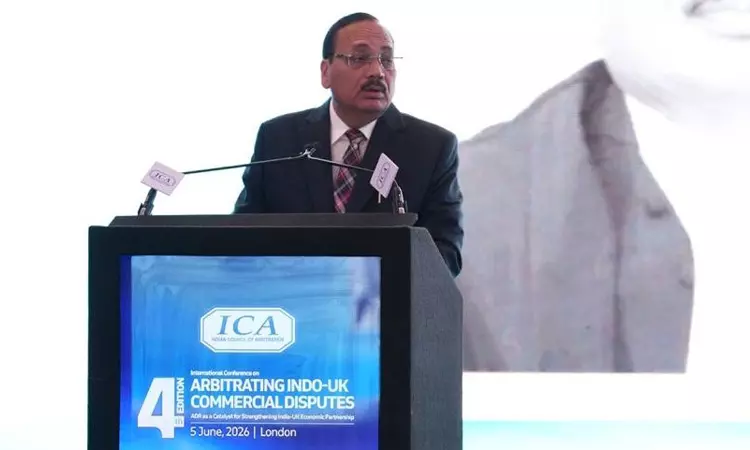
CJI said that the success of the India-UK Free Trade Agreement (FTA) would depend also on the creation of an effective alternative dispute resolution (ADR) framework.
Chief Justice of India Surya Kant on Friday cautioned that arbitration is increasingly mirroring the defects of conventional court litigation, observing that the dispute resolution mechanism has begun acquiring many of the very failings it was originally designed to overcome."Arbitration was built to be the answer to the pathologies of formal litigation, and it is now seemingly acquiring each...
This is a premium content
Available exclusively to
Our subscribers
Subscribe Premium 
INR 1099+GST
Your support helps us to bring you more content at
an affordable subscription scheme !!!
All payment options available
Chief Justice of India Surya Kant on Friday cautioned that arbitration is increasingly mirroring the defects of conventional court litigation, observing that the dispute resolution mechanism has begun acquiring many of the very failings it was originally designed to overcome.
"Arbitration was built to be the answer to the pathologies of formal litigation, and it is now seemingly acquiring each of those very failings. In other words, the remedy has come to resemble the disease it was designed to cure," the Chief Justice said while inaugurating the 4th International Conference on Arbitrating Indo-UK Commercial Disputes organised by the Indian Council of Arbitration in London.
In a candid assessment of the state of international arbitration, CJI Surya Kant said the system faces several structural challenges, including rising costs, delays, concentration of appointments among a small group of practitioners and increasing procedural complexity.
According to him, arbitration has increasingly come to be treated as "a product to be promoted rather than a mechanism to be refined", causing the focus to shift away from parties and businesses and towards the industry that has developed around arbitration.
The Chief Justice observed that appointment patterns in high-value international arbitrations often remain concentrated among a relatively small pool of repeat arbitrators, counsel and experts, creating a perception that the arbitral system is difficult for new entrants to access.
He further noted that international arbitration has, in some cases, absorbed the very habits of litigation it was intended to avoid, including extensive pleadings, multiple procedural rounds, prolonged hearings and costly fee structures.
The CJI also expressed concern over increasingly complex arbitration clauses, which often trigger litigation over threshold questions such as the validity of arbitration agreements, the governing law, the arbitral seat and jurisdiction, before parties can even address the merits of their disputes.
Questioning an expansive interpretation of party autonomy, Justice Kant said the principle should not be understood as an unrestricted right to choose adjudicators likely to favour a party's position. Rather, he said, party autonomy guarantees a process that is independent, impartial and fair.
The remarks came in the context of the recently concluded India-UK Free Trade Agreement, which the Chief Justice described as a historic opportunity requiring a robust dispute-resolution architecture to support growing commercial ties between the two countries.
Warning that arbitration mechanisms cannot be designed only for large corporations, he stressed the need for affordable and accessible dispute resolution for MSMEs, start-ups, fintech firms and other businesses expected to drive the next phase of Indo-UK trade.
"If our ADR mechanisms work only for disputes large enough to justify high fees and large legal teams, they will fail the very commercial partnership they are meant to support," he said.
To strengthen the India-UK ADR framework, the Chief Justice proposed a joint Indo-UK arbitrator accreditation programme, a swift-track protocol for mid-value commercial disputes and stronger integration of arbitration and mediation through hybrid dispute-resolution mechanisms.
"The India-UK economic partnership cannot be strengthened by trade agreements, tariff schedules and investment announcements alone. It also needs an ADR architecture that converts commercial confidence into day-to-day practice. And it is that apprehension of the structural failures I have just described that stand most directly between the aspiration of the FTA and the commercial reality it is meant to enable," he said.
Concluding his address, Justice Kant said arbitration must return to its founding purpose and remain "not a privilege of scale, but an instrument of justice."


