



- Home
- /
- Top Stories
- /
- Avoid Interpretation Silencing...
Avoid Interpretation Silencing Reformist Voices Within Religion : Mohan Gopal In Sabarimala Reference
Gursimran Kaur Bakshi
13 May 2026 2:02 PM IST
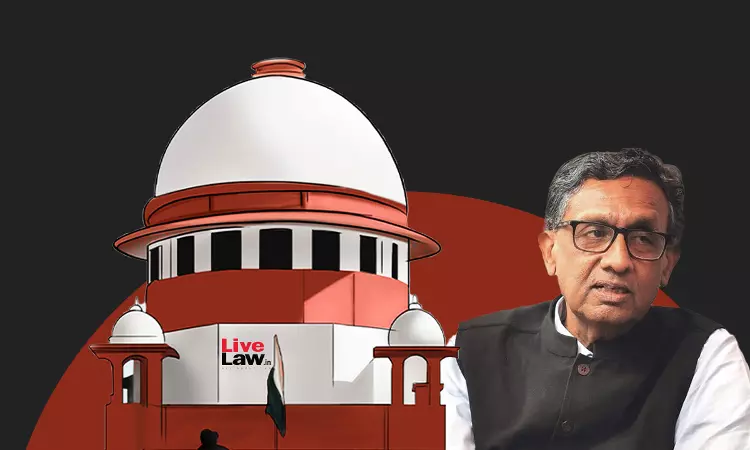
He argued that an interpretation allowing the clergy to overpower individual conscience must be shunned.
Dr G Mohan Gopal on Wednesday urged the Supreme Court's nine-judge Bench hearing the Sabarimala reference to ensure that the constitutional interpretation of religious freedom does not suppress reformist voices emerging from within religious communities.Appearing for an intervenor, Sree Narayana Manava Dharmam Trust, Dr. Gopal argued that the constitutional debate should not be viewed merely...
This is a premium content
Available exclusively to
Our subscribers
Subscribe Premium 
INR 1099+GST
Your support helps us to bring you more content at
an affordable subscription scheme !!!
All payment options available
Dr G Mohan Gopal on Wednesday urged the Supreme Court's nine-judge Bench hearing the Sabarimala reference to ensure that the constitutional interpretation of religious freedom does not suppress reformist voices emerging from within religious communities.
Appearing for an intervenor, Sree Narayana Manava Dharmam Trust, Dr. Gopal argued that the constitutional debate should not be viewed merely as a clash between fundamental rights under Part III and the rights of religious denominations under Article 26, but must also account for demands for social justice arising from within religions themselves.
“The point I seek to address is one issue which, in my respectful submission, has not received adequate attention so far. That is the demand for social justice emerging from within religious communities themselves,” he submitted.
Referring to nineteenth-century social reform movements, Dr. Gopal said many transformative movements had emerged from within religions, led by reformers such as Sri Narayana Guru. He said the constitutional framework should create space for such internal reformist traditions to remain active and complement the transformative values of Part III.
“What I seek to submit is this: can space be found within the architecture of the constitutional right to religion itself for these reformist forces within religions to remain active?” he argued.
Chief Justice of India Justice Surya Kant observed that reform initiated from within a religion would also, in his view, be protected under Article 25.
Dr. Gopal responded that while such voluntary reform may be possible in principle, judicial interpretation of religious freedom over the last seventy-five years had effectively “silenced” such internal reformist voices. He described the present reference as a rare constitutional opportunity for the Court to conceptually re-examine religion itself and recalibrate the interpretive framework without altering the Constitution.
"Therefore, this becomes an extraordinary opportunity for a course correction. Not by changing the Constitution, but by recalibrating the interpretive structure in a manner that creates constitutional space for such internal reformist traditions."
In support of his submissions, Dr. Gopal relied on a 1947 document submitted by Dr. B.R. Ambedkar to the Constituent Assembly's Sub-Committee on Fundamental Rights, containing Ambedkar's proposed framework on religious freedom.
Reading from the document, he pointed out that Ambedkar's formulation guaranteed liberty of conscience and the free exercise of religion, including the right to “profess, preach and convert,” but did not include the word “practice.”
Dr. Gopal argued that this omission was significant and reflected an understanding shaped by the oppression experienced by many within religious structures.
Questioning broad judicial definitions of Hinduism, Dr. Gopal referred to the 1966 judgment in Swami Yagnapurushdasji, where Chief Justice Gajendragadkar defined a Hindu as one who accepted the Vedas as the highest authority. Gopal argued that such a monolithic definition of Hinduism is unwarranted, as many within the religion do not accept the final authority of the Vedas.
“None of us ever said that. Now, I have the highest respect for the Vedas and great admiration for them. But is it a fact that every person today classified as Hindu accepts the Vedas as the highest authority in all spiritual and philosophical matters?
So in this manner, we were not merely subsumed into religion, we were consumed by religion. Therefore, from a constitutional point of view, we also have to ask. Where is individual choice? Where is the agency?"
Justice BV Nagarathna responded that Hinduism has often been understood as a “way of life,” noting that a person need not necessarily visit temples or perform rituals to remain Hindu.
“If that understanding comes through in the reference judgment, it would provide enormous constitutional relief,” Dr. Gopal replied.
Justice Nagarathna further observed that religiosity can exist independent of formal ritual practice, saying many people may not even have a prayer room or sacred space in their homes but remain deeply religious in their psyche.
In his concluding remarks, Dr. Gopal cautioned against an interpretation that would allow any group to declare itself a religious denomination and thereby claim immunity from constitutional guarantees under Part III.
“If the argument of the opposite side is accepted, then any group in this country can simply declare itself to be a religious denomination and thereby acquire the power to supersede Article 25 and the guarantees contained in Part III,” he submitted.
"Put most strongly, they would effectively acquire a right to secede from Part III of the Constitution with respect to anything they choose to characterise as a matter of religion, without any constitutional guardrails such as essentiality. In effect, that would amount to a gross misinterpretation of the constitutional right to freedom of religion. The real issue before this Court in these hearings is this - faith in God versus faith in clergy. Please do not allow faith in clergy to defeat faith in God originating in the conscience of the individual."
Justice Nagarathna, responding, underscored that Article 25(1), which guarantees freedom of conscience and free profession, practice and propagation of religion, is itself part of Part III of the Constitution.
Written submissions
In the detailed written submissions, the Trust has urged the Court to fundamentally recast its religion jurisprudence, arguing that constitutional interpretation must not silence reformist voices from within religious communities or allow clerical authority to prevail over individual conscience.
At the heart of the submission is the contention that the Court's interpretation of religious freedom has historically treated religion as a constitutional silo, detached from the broader framework of fundamental rights. Drawing from the Supreme Court's shift from A.K. Gopalan to Maneka Gandhi, the Trust argued that the same integrated constitutional approach that now governs liberty jurisprudence must be extended to religious freedom as well.
“For seventy-six years,” the Trust argued, the Court has erroneously treated the right to freedom of religion as insulated from the rights to equality and freedom, thereby permitting exclusionary structures within religion to evade constitutional scrutiny.
“The Constitution of India does NOT establish a dyarchy which leaves religion as a self-governing sovereign, autocratic and theocratic republic ruled by an oligarchic clergy as an extra-Constitutional zone within the larger sovereign democratic Republic,” the plea said.
The intervention argues that Article 25 protects the individual's freedom of conscience and the right to profess, practice and propagate religion, whereas Article 26 merely confers managerial rights on religious denominations. According to the Trust, courts have incorrectly elevated denominational rights into substantive religious authority, enabling clergy to define religious orthodoxy in a manner that suppresses dissenting believers.
The submission said the real constitutional relationship is not between clergy and institutions, but between the devotee and God.
It specifically argued that priests cannot impose disabilities on worshippers in the name of religious custom. If restrictions are to be imposed, the plea contended, they must be legislatively enacted and constitutionally justified.
Referring to the Sabarimala issue, the Trust submitted that if exclusion of women between 10 and 50 years is to be defended, proponents must persuade Parliament or the legislature to enact such a restriction rather than seek judicial validation for priestly authority.
Who speaks for Hinduism?
Does constitutional recognition go only to organized priestly structures, it asks, while excluding Dalits, backward communities, women, and others whose religious experiences may diverge from orthodox formulations?
The plea argues that Hinduism cannot be reduced to priestly interpretations rooted in orthodoxy, particularly in a society marked by diverse and deeply individualized spiritual traditions.
"The question also needs to be asked: who speaks for Hindus? Is it the Dalit Paraiah, the Pulaya, the Valmiki who speaks for the Hindus? Or, can only the Brahmin and other members of powerful Varnas and high priests speak for the community? Whose tenets, beliefs, practices and rituals will be recognised and enforced? who will be recognised as a religious denomination and have their essential religious practices protected? Will “auto-theistic” people (those who construct their own spirituality and religion) who constitute the vast majority of Hindus have a voice? Or will it only be the monotheists and the polytheists who are in organized Hindu religion (who follow prescribed tenets and rituals) enjoy the right to religion in India?"
Constitutional Morality Must Govern Religion
On the question whether “morality” in Articles 25 and 26 includes constitutional morality, the Trust argued that in the Indian constitutional framework, morality cannot mean religious orthodoxy or prevailing social prejudice. Instead, morality must necessarily mean constitutional values.
The plea warns that any ambiguity on this point would permit exclusionary practices to claim constitutional legitimacy.
Even if the Court chooses a different phrase such as constitutional ethos or constitutional values, the substantive principle must remain unchanged, the submission says.
Article 25(2)(b) A Social Reform Mandate
The Trust describes this provision as a revolutionary constitutional mandate for democratizing religion.
It argues that the phrase “sections of Hindus” must be interpreted broadly to include any excluded group, including caste-oppressed communities and women.
The submission contends that Article 25(2)(b) reveals the framers' explicit recognition that religious practices in India may perpetuate structural inequality requiring state intervention.
The Trust says the true purpose of the provision is to ensure that the promise in Article 25(1), equal and free exercise of religion, becomes a lived reality.
On judicial review, the Trust argues that courts must not retreat from examining religious practices where constitutional rights are implicated.
If religion is being used to perpetuate hierarchy or exclusion, judicial intervention is not an intrusion but a constitutional necessity, the plea contends. Public interest litigation challenging discriminatory religious practices should remain maintainable, especially where marginalized communities lack institutional power.
The arguments are progressing before the 9-judge bench. Live updates can be followed here.
Gursimran Kaur Bakshi
Gursimran is the Principal Correspondent with LiveLaw for the Supreme Court. She can be reached out at: simrankaurbakshi@livelaw.in

